

Key Takeaways
Your life drifts toward whatever thoughts you feed the most
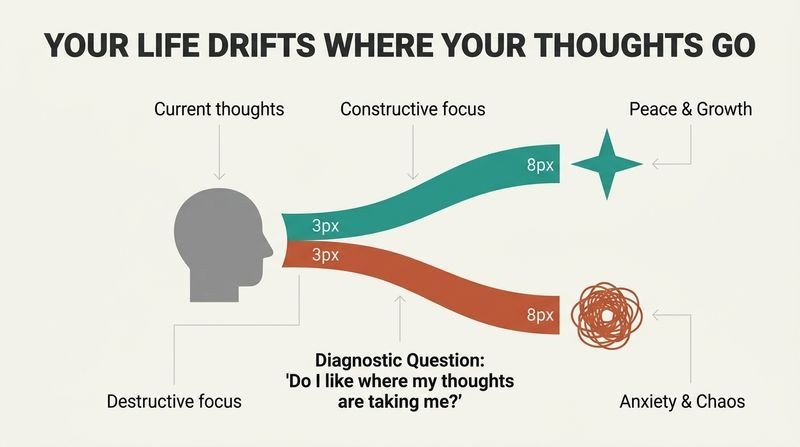
The central thesis of the book. Groeschel argues that we become the direction of our strongest, most repeated thoughts, often without noticing. He anchors this in both Scripture (Proverbs 23:7, "as he thinks in his heart, so is he") and modern psychology, specifically cognitive behavioral therapy, which treats disorders from anxiety to addiction by first changing distorted thinking patterns.
His convergence claim is the hook: when a 3,000-year-old proverb and clinical psychology agree, pay attention. He offers a diagnostic question rather than motivation: "Do I like where my thoughts are taking me?" If the honest answer is no, the fix is not trying harder at behavior but auditing what runs through your head all day and deciding to change your mind so your life can follow.
What's striking is how this reframes personal change as upstream work. Most self-help targets behavior; Groeschel targets the cognition that produces behavior, aligning with Aaron Beck's founding insight in CBT that thoughts, not events, drive emotion. The claim has real empirical backing, though it can slide into overstatement. Not every hardship yields to reframing, and clinical depression often needs more than thought discipline. The strongest version of his argument is directional, not absolute: thoughts bias trajectory over time, the way small daily habits compound. Readers get the most value treating this as a probabilistic steering wheel, not a guarantee.
A lie you believe rules you as if it were literally true
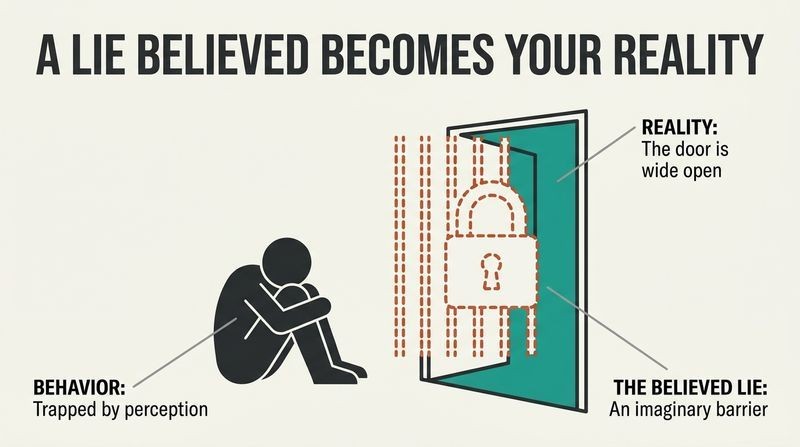
Belief, not reality, drives behavior. Groeschel opens with his colleague Kevin, whom he pranked by claiming a closet door was locked when it never was. Kevin panicked, climbed into the ceiling tiles, and stayed trapped for twenty minutes because he believed the lie. The escape artist Harry Houdini reportedly failed to break out of a cell once because the jailer never actually locked it, so Houdini kept relocking an open door.
The principle: a falsehood accepted as truth shapes your life as though it were true. People once avoided sailing far out for fear of falling off a flat earth. Groeschel's own lifelong lie, that he would never measure up, was reinforced by childhood rejections and even a denomination refusing to ordain him, until he decided he was who God said he was, not who others declared.
This maps neatly onto the Thomas theorem in sociology: situations defined as real become real in their consequences. It also echoes the placebo and nocebo effects, where belief alone produces measurable physiological change. The framing is powerful because it locates freedom in an accessible place: you cannot always change circumstances, but you can interrogate the premise you are living from. A useful caution is that not all limiting beliefs are false. Sometimes the closet really is locked. Wisdom lies in distinguishing a genuine constraint from an inherited assumption, which is precisely the diagnostic work the next principle demands.
Trace your problem backward with questions to expose the hidden lie
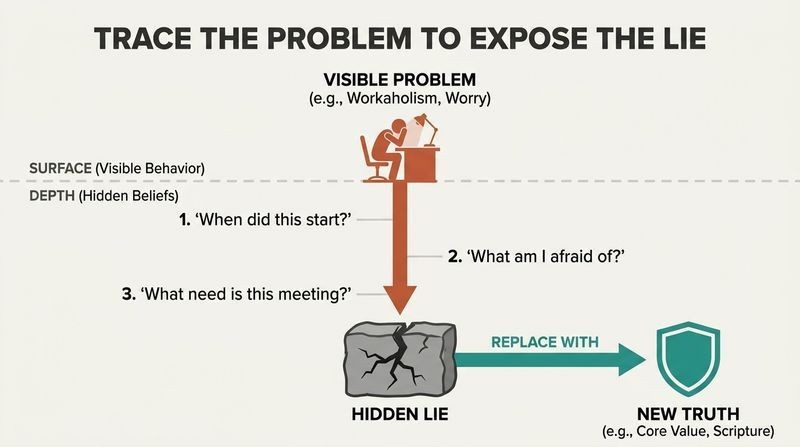
The Replacement Principle in action. Because we rarely recognize our lies as lies, Groeschel offers a three-step reverse-engineering process:
1. Identify the problem you can actually see (overspending, a compulsive habit, chronic worry).
2. Ask probing questions: When did this start? What am I afraid of? What need is this meeting?
3. Pinpoint the lie beneath it.
His own example: workaholism traced back to the belief that his worth depended on others' approval, revealed when his young daughter told him he lived at the office, not home. Once the lie is named, you replace it with a specific Scripture and write a personal "declaration" of the new truth. The model is Jesus in the wilderness, answering each temptation with a memorized verse rather than willpower.
The method resembles the "downward arrow" technique in cognitive therapy, where clinicians repeatedly ask "and what would that mean?" to surface a core belief driving surface symptoms. Groeschel's insistence on starting with the visible problem is psychologically shrewd: symptoms are observable, root beliefs are not. The addition of a written declaration parallels evidence that self-affirmation and implementation intentions strengthen behavior change. One honest tension: he frames the enemy as a literal deceiving Satan, while the mechanism he describes (self-reinforcing negative schemas) works identically in secular therapy. Readers of any background can apply the diagnostic; the attribution of source is a matter of worldview.
Repeated thoughts carve brain ruts you fall into on autopilot
Neural pathways are grooves worn by repetition. Groeschel explains that every thought produces a neurochemical change, and thinking the same thing repeatedly builds a neural pathway that makes that thought progressively easier and more automatic. He compares it to his dog wearing a circular dirt track in the yard, and to an Alaskan road sign warning drivers to choose their rut carefully because they will be in it for sixty miles.
Two brain systems deepen the grooves. The reticular activating system filters incoming data to match what you already believe, so a person convinced they are a victim collects victim evidence and ignores the rest. Meanwhile dopamine rewards a behavior with a pleasurable hit that whispers "do that again," turning an awkward first choice into an entrenched habit. Behavior modification fails because it saws off a branch while the root neural pathway regrows it.
The neuroscience is broadly sound, if simplified. Hebb's principle (neurons that fire together wire together) and the documented reality of neuroplasticity support the rut metaphor. The RAS point overlaps with confirmation bias and predictive processing theories, where the brain acts as a prediction machine confirming its priors. Groeschel is refreshingly honest that willpower alone fails, which matches research showing habits are cue-driven and largely automatic. A worthwhile nuance: he sometimes implies ruts form quickly, but durable habit formation research (such as Lally's work) suggests it can take months, meaning both the digging of bad ruts and new ones require sustained repetition.
Overwrite bad ruts by writing, thinking, and confessing new declarations
The Rewire Principle: build a trench of truth. A rut forms accidentally and traps you; a trench is dug on purpose to redirect flow. Groeschel's antidote to a destructive neural pathway is a competing one, built from Scripture-based statements he calls declarations. For his lifelong money fear, he wrote and repeated lines affirming that God is an abundant provider and that he will lead with generosity, until the words moved from paper into belief.
The method is deliberate repetition: write it, think it, confess it until you believe it, ideally first thing each morning since early thoughts set the day's trajectory. He grounds this in the "law of exposure" (the mind reflects what it is most exposed to) and the finding that people endure roughly 500 unwanted intrusive thoughts daily, about two hours' worth. Write declarations as already true, even before they feel true.
This is essentially self-directed neuroplasticity through spaced repetition, and it rhymes with cognitive restructuring in CBT, where clients rehearse balanced alternative thoughts. The instruction to write in the present tense, before belief catches up, is controversial but defensible: it resembles the "act as if" tradition in behavioral activation and the research on self-fulfilling expectancy. A skeptic would note that empty affirmations can backfire; a 2009 study by Wood found positive self-statements worsened mood in people with low self-esteem. Groeschel's version may sidestep this because declarations are tethered to an external truth claim rather than hollow self-praise, giving the repetition a stable anchor.
The enemy wins by repetition, so out-repeat him with truth
Meditation means rumination, chewing the same truth repeatedly. Groeschel notes the biblical word for meditate parallels what a cow does with its cud: swallow, bring it back up, chew again, extract maximum nutrition. Christian meditation is not emptying the mind (as in some Eastern practice) but filling it deliberately with a specific verse examined word by word.
His sharpest observation concerns why lies stick: the illusory truth effect, a documented glitch where simply hearing a claim repeatedly makes it feel true. He illustrates with widely believed falsehoods, that we use only 10% of our brains or that vitamin C cures colds, which persist purely through repetition. Satan, he says, is not creative but relentlessly repetitive, whispering the same handful of lies for years. The counterstrategy is to repeat truth until it reaches automaticity, the point where the right response requires no conscious effort, like fluency in a language.
The illusory truth effect is well established in cognitive psychology (Hasher's original 1977 work, replicated many times), and it is genuinely unsettling that repetition increases believability even when the claim contradicts known facts. Groeschel weaponizes this insight brilliantly: if repetition installs lies, disciplined repetition can install truth. This connects to processing fluency research, where familiar, easily processed statements feel more credible. His self-aware detail that the 10% brain myth is itself a repeated lie is a clever demonstration. The concept of automaticity is legitimate motor and cognitive learning science, though reaching it for emotional beliefs is harder and slower than for tennis strokes or showering.
You cannot control what happens, only the frame you view it through
The Reframe Principle and cognitive bias. Groeschel borrows the psychological term cognitive bias, a consistent pattern of deviating from reality that constructs a subjective world dictating our responses. His example: a boss gives identical feedback to two employees; one hears helpful coaching, the other hears an insult, because each looks through a different lens shaped by history. Notably, research he cites suggests our relationship with our earthly father colors how we perceive God.
The corrective is cognitive reframing: identifying and correcting irrational interpretation. The steps are to stay calm, name the situation, catch your automatic thought, and find objective evidence. His model is the apostle Paul, who wanted to preach in Rome but arrived as a chained prisoner, then reframed his guards as a captive audience for the gospel rotating every eight hours. Same facts, transformed meaning.
Cognitive reframing is a core, evidence-backed CBT technique, and Groeschel represents it accurately. The father-image-of-God connection reflects a genuine research literature (attachment theory applied to religion, notably Kirkpatrick's work), where secure early attachment predicts a more benevolent God concept. What elevates this section is the Stoic parallel: Epictetus taught that we are disturbed not by events but by our judgments about them, virtually identical to Groeschel's thesis. The reframe on Paul is compelling but worth balancing; reframing can shade into toxic positivity if it denies real loss. Healthy reframing acknowledges the pain while widening the interpretive frame, not papering over it.
Thank God for the prayers he refused, not just the ones he answered
Reframing the past through unanswered prayer. Groeschel introduces "collateral goodness," the flipside of collateral damage: the unnoticed good that flows from God's activity, especially from what he declined to do. His signature story: a shattered pitching hand in eighth grade ended his baseball dreams, his family moved to a town he disliked, and he took up tennis only to chase a girl. That tennis scholarship sent him to a college he would never have attended, where he met Jesus and his wife Amy.
A second thread: he begged God for a different circumstance repeatedly, and the refusals produced his marriage, six children, and a multi-campus church born accidentally when a video sermon (shown because his son was being born) worked better than expected. The practice: deliberately look for God's goodness, because a vulture finds carrion and a hummingbird finds nectar, each finding what it seeks.
The insight taps a robust finding in positive psychology: gratitude interventions, particularly counting blessings, reliably raise wellbeing (Emmons and McCullough's research). Groeschel's twist, gratitude for non-events and averted outcomes, is less studied but psychologically astute, resembling counterfactual thinking used constructively. There is an inherent survivorship-bias risk: it is easy to thank God for refusals that led somewhere good, harder when refusals lead to lasting grief. The vulture-versus-hummingbird framing is a memorable statement of selective attention, though the honest version admits that reframing the past is easiest in hindsight and offers cold comfort while a prayer still hangs unanswered.
Choose your interpretation of an event before it even happens
Preframing is reframing's proactive cousin. Rather than waiting to interpret an experience after it occurs (and defaulting to your old bias), Groeschel advocates deciding in advance the lens you will use. His origin story is tennis: after blowing seven match points against a ranked senior, opponents nicknamed him a choker who folds under pressure. His coach refused to let the label stick and reframed the loss as unmatched experience in tight spots, insisting he play to win rather than not to lose.
From then, Groeschel walked into pressure telling himself he performs best when stakes are highest because God is with him. He applies preframing to ordinary dread: a packed day becomes a chance to experience strength in weakness, a hard conversation is entrusted to God ahead of time, a scary doctor's appointment is met with expectation of good news or, failing that, God's presence.
Preframing closely mirrors implementation intentions (Gollwitzer's "if-then" planning), which research shows dramatically improve follow-through by pre-deciding responses. It also overlaps with sports psychology's mental rehearsal and pre-performance routines, widely validated for reducing choke under pressure. The choking anecdote is textbook: Beilock's work shows anxiety-induced choking often stems from playing not to lose, exactly the trap the coach named. A caveat worth flagging is that preframing outcomes as guaranteed good can set up disappointment; the more resilient formulation Groeschel offers is conditional, framing God's presence as the constant regardless of result, which protects the practice from becoming naive optimism.
When you have had enough, God is enough
The Rejoice Principle and the panicking brain. Groeschel explains panic physiologically: the almond-shaped amygdala triggers fight-or-flight, flooding the body with adrenaline. The problem is it cannot tell a charging threat from a hostile text; it reacts identically to a real danger and an overdrawn account. The logical prefrontal cortex is meant to check it, a levelheaded referee against a hysterical alarm.
The biblical anchor is Elijah, who after a spectacular victory collapsed into suicidal despair when threatened, fixating on his problem and forgetting the God whose name literally meant "the Lord is my God." God appeared not in wind, earthquake, or fire but in a gentle whisper, because he whispers to draw us close. Groeschel's own 2019 breakdown (a mold-infested house, a health scare with his granddaughter, crushing workload) taught him the declaration: his experience plus God's presence is enough.
The amygdala-versus-prefrontal-cortex framing simplifies but captures real dual-process neuroscience; the fight-or-flight response genuinely misfires on modern non-lethal stressors, a mismatch evolutionary psychologists call an evolutionary lag. Elijah's crash after triumph is a keen observation resonant with the psychological phenomenon of post-achievement depression, where the adrenaline of a peak gives way to a vulnerable trough. Groeschel's willingness to disclose therapy and a performance psychologist is notable in a pastoral context that has sometimes stigmatized mental health care. The "whisper" theology reframes divine silence as intimacy rather than absence, a pastorally generous interpretation, though it will land differently for those whose crises met only silence.
Praise God for who he is before he fixes what is wrong
Prayer and praise as the mind's two raised guards. Groeschel offers the practical "God box": physically write each worry on paper and drop it in a box, praying to hand it over; to reclaim the worry, you must literally take the slip back out, a jarring picture of distrust. He cites neuroscientist Andrew Newberg, whose imaging work suggests prayer changes brain chemistry and can dampen the amygdala's fight-or-flight response, and Caroline Leaf's claim that twelve minutes of daily focused prayer over eight weeks produces measurable brain change.
The capstone is Paul and Silas, beaten and jailed in Philippi, who sang praise at midnight before any rescue, after which an earthquake broke their chains. Groeschel draws three lessons: praise for the who (God's character) not the what (circumstances), praise before the provision, and expect God to show up in the praising. The Magic Eye metaphor seals it: look through your problems, not at them.
The neuroscience claims deserve a careful footnote. Newberg's neuroimaging of contemplatives is real and intriguing, but the specific "twelve minutes changes your brain" figure is thinly sourced and should be treated as suggestive, not settled. That said, the broader finding that meditative and prayerful practices reduce amygdala reactivity and stress markers is well supported across mindfulness research (Davidson, Kabat-Zinn). The genuinely counterintuitive move here is gratitude before resolution, which contradicts our transactional instinct to withhold thanks until we get what we want. Behaviorally, the God box externalizes rumination, and writing worries down has documented benefits (Pennebaker's expressive writing research) for reducing their intrusive grip.
Analysis
Winning the War in Your Mind is a fusion project: Craig Groeschel, a megachurch pastor, welds cognitive behavioral science onto Protestant spiritual formation and packages the result in four alliterative principles (Replacement, Rewire, Reframe, Rejoice). Its rhetorical engine is convergence, the repeated claim that Scripture and neuroscience independently arrive at the same conclusion, which lends the advice a credibility neither source alone would carry for his audience. Structurally it is a self-help hybrid, each chapter pairing a self-deprecating personal story (a headlight-wired car stereo, a shattered baseball hand, a public breakdown) with a biblical exemplar (Paul, Elijah, Silas) and a workbook exercise.
The book's intellectual backbone is essentially cognitive behavioral therapy repackaged for believers. Groeschel's "lies to strongholds to demolition" pipeline is cognitive restructuring; his "ruts to trenches" is neuroplasticity and habit formation; his reframing and preframing are textbook CBT and implementation-intention research. This is both its strength and its ceiling. The strength: the underlying techniques are among the most empirically validated in psychology, so readers who apply them will likely benefit regardless of theology. The ceiling: the neuroscience is popularized and occasionally overstated (the twelve-minute brain-change figure, the tidy amygdala-versus-cortex morality play), and the spiritual-warfare frame, attributing negative cognition to a personal Satan, is a worldview commitment, not a finding.
What distinguishes the book from secular equivalents is not method but motivation and anchoring. Groeschel tethers each new thought to an external, unchanging truth claim rather than self-generated affirmation, which may inoculate his declarations against the documented backfire of hollow positive self-talk in low-self-esteem individuals. His candor about therapy, medication-adjacent counseling, and his own chronic insecurity is pastorally significant in a subculture that has historically spiritualized mental illness. The honest limitation, which he only lightly touches, is that thought discipline has boundaries: severe depression, trauma, and clinical anxiety often require more than reframing. Read as a compounding steering practice rather than a cure, the book delivers durable value.
Review Summary
Winning the War in Your Mind received mostly positive reviews, with readers praising its practical advice on changing thought patterns and integrating faith with cognitive science. Many found it helpful for addressing negative thinking and anxiety. Critics felt it relied too heavily on religious concepts or lacked depth. Some appreciated the author's personal anecdotes and exercises, while others found the content repetitive or overly simplistic. Overall, the book was well-received by its target Christian audience seeking mental and spiritual growth.
People Also Read








Glossary
The Replacement Principle
Remove lies, replace with truthThe first of four principles. Since believing a lie shapes life as if it were true, the fix is a two-step move: identify and remove the specific false belief, then replace it with a Scripture-based truth. Lies are located by identifying a visible problem, asking probing questions about its origin, and pinpointing the underlying deception, then countering it with a written declaration.
The Rewire Principle
Rewire brain, renew mindThe second principle, grounded in neuroplasticity. Repeated thoughts form neural pathways (ruts) that become automatic. To change, you deliberately build a competing pathway (a trench of truth) using Scripture-based declarations repeated until believed, replacing the groove that triggers destructive behavior rather than just fighting the behavior itself.
The Reframe Principle
Reframe mind, restore perspectiveThe third principle, drawn from cognitive reframing. You cannot control what happens, only how you interpret it. By recognizing your cognitive biases and choosing a more God-centered frame, you reinterpret past events (through gratitude and collateral goodness) and pre-select the frame for future events (preframing).
The Rejoice Principle
Revive soul, reclaim lifeThe fourth principle. When problems trigger panic (an amygdala response), staying mindful of God's presence leads to prayer and praise. These practices, Groeschel argues citing brain research, calm the fight-or-flight response and shift perspective. Praise is offered for who God is and before circumstances improve, not after.
Stronghold
A deeply fortified false beliefBorrowed from the Greek ochuroma (a fortress). Groeschel uses it for a lie so reinforced by repetition that it becomes a fortified mental structure keeping truth out. Because a stronghold rebuilds itself if only the surface behavior is attacked, it must be demolished at the root, which he says requires divine rather than self-generated power.
Trench of Truth
Intentional new neural pathwayA purposely dug mental pathway that redirects thought, contrasted with a rut that forms accidentally and traps you. Built from Scripture-based declarations repeated daily (write it, think it, confess it until you believe it), a trench diverts the flow of thinking away from destructive automatic patterns toward life and peace.
Collateral Goodness
Unnoticed good from God's activityGroeschel's inversion of collateral damage: the often-hidden good that results from God's involvement in life, especially from prayers he declined to answer. Practicing it means deliberately scanning past and present for God's goodness, on the premise that people find what they look for, as a vulture finds carrion and a hummingbird finds nectar.
Preframing
Choosing interpretation before an eventThe proactive form of reframing: deciding in advance the lens through which you will interpret an upcoming experience, rather than defaulting to an old bias. Example: entering a high-pressure situation having pre-decided you perform best under pressure because God is with you, so you play to win instead of playing not to lose.
Illusory Truth Effect
Repetition makes lies feel trueA documented cognitive glitch in which simply repeating a statement makes people more likely to believe it, even when it contradicts known facts. Groeschel uses it to explain why the enemy's repeated lies take hold, and why the counterstrategy is disciplined repetition of truth. He cites persistent myths like the 10%-brain claim as examples.
Amygdala Hijack
Emotion overrides rational brainA term coined by Daniel Goleman for when the amygdala, the brain's emotion and survival center, produces an immediate, disproportionate fight-or-flight reaction that overwhelms the logical prefrontal cortex. Groeschel argues the amygdala cannot distinguish a real threat from a mere stressor, so it triggers panic over texts, bills, or fears as if they were physical danger.
The God Box
Physical box for surrendered worriesA practical exercise: write each worry, temptation, or intrusive thought on a slip of paper and place it in a box labeled God, praying to entrust it to him. To reclaim a worry you must physically remove the slip, a deliberately uncomfortable picture of taking back what you claimed to surrender, designed to build persistent trust and prayer.
FAQ
What's "Winning the War in Your Mind" about?
- Focus on Thought Patterns: The book explores how our thought patterns can determine the course of our lives, emphasizing the importance of identifying and changing unhealthy thinking.
- Integration of Faith and Science: Craig Groeschel combines biblical teachings with modern psychology, particularly cognitive behavioral therapy, to provide a comprehensive approach to mental transformation.
- Practical Strategies: It offers practical strategies to help readers replace lies with truth, rewire their brains, and renew their minds for a more fulfilling life.
- Personal and Relatable: The author shares personal anecdotes and struggles, making the content relatable and applicable to everyday life.
Why should I read "Winning the War in Your Mind"?
- Transformative Approach: The book provides a transformative approach to changing your life by changing your thinking, which can lead to improved mental health and well-being.
- Biblical and Scientific Insights: It offers a unique blend of biblical wisdom and scientific research, making it appealing to both faith-based and secular audiences.
- Practical Exercises: Readers are given practical exercises to apply the concepts in their own lives, making the book not just theoretical but actionable.
- Personal Growth: It encourages personal growth and self-awareness, helping readers to overcome negative thought patterns and live a more purpose-driven life.
What are the key takeaways of "Winning the War in Your Mind"?
- Thoughts Shape Reality: Our lives move in the direction of our strongest thoughts, so changing our thinking can change our lives.
- Four Principles: The book introduces four principles: Replacement, Rewire, Reframe, and Rejoice, each offering a strategy to combat negative thinking.
- Power of Truth: Replacing lies with truth is essential for mental and spiritual freedom, as lies believed as truth will affect your life as if they were true.
- God's Presence: Recognizing and focusing on God's presence can provide peace and strength in overcoming mental battles.
How does Craig Groeschel suggest we change our thinking?
- Replacement Principle: Remove lies and replace them with truth, using biblical scripture as a foundation for truth.
- Rewire Principle: Rewire your brain by creating new neural pathways through repeated positive affirmations and declarations.
- Reframe Principle: Change your perspective by reframing your thoughts and focusing on God's goodness and presence.
- Rejoice Principle: Use prayer and praise to shift your mindset from panic to peace, acknowledging God's control and care.
What is the Replacement Principle in "Winning the War in Your Mind"?
- Identify Lies: The first step is to identify the lies you believe that are holding you back from living a fulfilled life.
- Replace with Truth: Once identified, replace these lies with truths found in scripture, which can set you free.
- Continuous Process: This is not a one-time action but a continuous process of capturing negative thoughts and making them obedient to Christ.
- Practical Application: The book provides exercises to help readers practice this principle in their daily lives.
What is the Rewire Principle in "Winning the War in Your Mind"?
- Neural Pathways: Understand that repeated thoughts create neural pathways, which can be changed by forming new, positive thought patterns.
- Trenches of Truth: Create "trenches of truth" by repeatedly affirming positive, biblical truths to replace negative ruts in your thinking.
- Meditation and Repetition: Use meditation on scripture and repetition of declarations to solidify these new pathways.
- Scientific Basis: The principle is supported by cognitive science, which shows that our brains can be rewired through intentional thought patterns.
What is the Reframe Principle in "Winning the War in Your Mind"?
- Cognitive Reframing: Learn to identify and correct irrational thinking by changing the frame through which you view your circumstances.
- Control Perception: While you can't control what happens to you, you can control how you perceive it, which can change your response and behavior.
- Thank God for What Didn't Happen: Reframe your past by thanking God for what didn't happen and looking for His goodness in every situation.
- Preframe Your Future: Choose in advance how you will view future situations, setting a positive and faith-filled frame.
What is the Rejoice Principle in "Winning the War in Your Mind"?
- Presence of God: Focus on the presence of God rather than the presence of problems, which can lead to peace instead of panic.
- Prayer and Praise: Use prayer and praise as tools to shift your mindset and invite God's peace into your life.
- Mindful of God's Nearness: Being mindful of God's nearness encourages persistent prayer and a perspective of gratitude.
- Transformative Power: This principle emphasizes the transformative power of worship and gratitude in changing your mental state.
What are the best quotes from "Winning the War in Your Mind" and what do they mean?
- "Our lives are always moving in the direction of our strongest thoughts." This quote emphasizes the power of thoughts in shaping our reality and the importance of aligning them with truth.
- "You cannot defeat what you cannot define." It highlights the necessity of identifying the lies and strongholds in our minds before we can overcome them.
- "When you've had enough, God is enough." This quote reassures readers of God's sufficiency and presence, even in overwhelming circumstances.
- "If it's big enough to worry about, it's big enough to pray about." It encourages turning worries into prayers, trusting God with every concern.
How does "Winning the War in Your Mind" integrate biblical teachings with modern psychology?
- Cognitive Behavioral Therapy: The book draws parallels between biblical teachings and cognitive behavioral therapy, showing how both address faulty thinking patterns.
- Scripture as a Tool: Biblical scripture is used as a tool to replace lies with truth, similar to how CBT uses positive affirmations to change thought patterns.
- Scientific Support: The book references scientific studies on neuroplasticity and the impact of prayer on the brain, supporting the idea that thoughts can be transformed.
- Holistic Approach: By integrating faith and science, the book offers a holistic approach to mental health and spiritual growth.
What exercises does "Winning the War in Your Mind" provide to help change thinking?
- Thought Audit: Conduct a thought audit to identify negative thought patterns and their impact on your life.
- Lie Detection: Identify specific lies you believe and replace them with biblical truths through written declarations.
- Trench Digging: Create trenches of truth by repeatedly affirming positive declarations based on scripture.
- God Box Exercise: Use a "God Box" to physically place your worries and concerns, symbolizing giving them to God in prayer.
How can "Winning the War in Your Mind" help with anxiety and negative thought patterns?
- Identify and Replace Lies: The book helps readers identify the lies that fuel anxiety and replace them with calming truths from scripture.
- Rewire Thought Patterns: By creating new neural pathways, readers can change their automatic responses to stress and anxiety.
- Focus on God's Presence: Emphasizing God's presence and control can provide peace and reduce anxiety.
- Practical Tools: The book offers practical tools and exercises to actively combat anxiety and negative thinking in daily life.
About the Author
Other books by Craig Groeschel








Download PDF
Download EPUB
.epub digital book format is ideal for reading ebooks on phones, tablets, and e-readers.








































