
Résumé de l'intrigue
La Poursuite dans le Désert
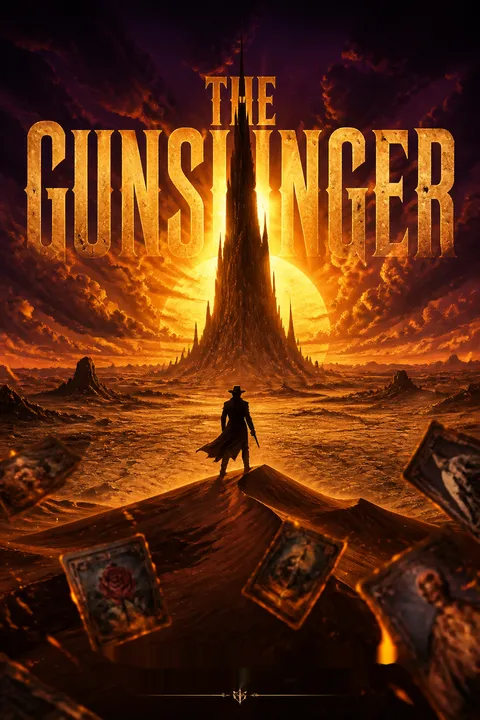
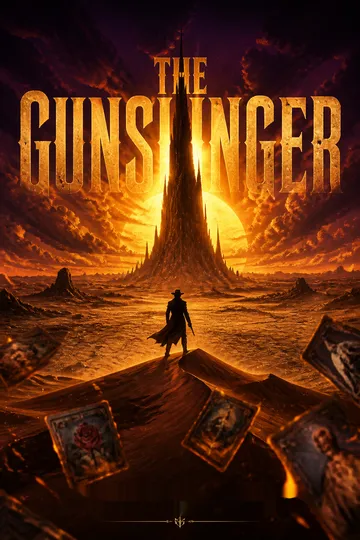
Dans un désert vaste et désolé, le Pistolero suit sans relâche l’Homme en Noir, une figure mystérieuse détenant la clé de sa quête. Le désert, rude et impitoyable, symbolise la déchéance du monde. Le Pistolero est un être solitaire, mû par une détermination inflexible à capturer sa proie insaisissable. Son voyage est jalonné des vestiges d’un monde révolu, ne laissant derrière lui que des traces de sa gloire passée.
Les Feux de Camp Mystérieux
Au fil de sa poursuite, le Pistolero découvre une série de feux de camp laissés par l’Homme en Noir. Ces feux, énigmatiques, ne laissent derrière eux que des idéogrammes que le Pistolero ne parvient pas à déchiffrer. Malgré l’absence d’indices tangibles, il ressent une proximité inexplicable avec sa cible. Ces feux de camp rappellent l’humanité de l’Homme en Noir, tout en soulignant l’isolement du Pistolero et la futilité apparente de sa quête.
La Sagesse de l’Habitant
Le Pistolero fait la connaissance de Brown, un habitant du désert, et de son corbeau parlant, Zoltan. Brown lui offre nourriture et refuge, et ils échangent sur l’Homme en Noir. La sagesse simple de Brown et son acceptation de la déchéance du monde offrent un moment de répit au Pistolero. Cette rencontre met en lumière la solitude du Pistolero et le poids de sa quête, alors qu’il médite sur les choix qui l’ont conduit jusqu’ici.
La Ville de Tull
Le Pistolero arrive à Tull, où il apprend que l’Homme en Noir est passé, semant le chaos derrière lui. Les habitants, sous l’influence de la magie noire de l’Homme en Noir, se retournent contre le Pistolero. Dans une confrontation brutale, il est contraint d’éliminer tous les habitants, y compris une femme à laquelle il s’était attaché. Ce massacre pèse lourdement sur lui, révélant l’ambiguïté morale de sa quête et les sacrifices qu’elle exige.
La Prophétie de l’Oracle
Le Pistolero rencontre un oracle dans les montagnes, un être surnaturel qui lui offre un aperçu de son avenir. L’oracle lui révèle qu’il doit rassembler trois personnes venues de mondes différents pour l’aider dans sa quête de la Tour Sombre. Cette prophétie prépare le terrain pour la prochaine étape de son voyage, alors que le Pistolero mesure les implications de son destin et les sacrifices qu’il doit encore consentir.
L’Ascension de la Montagne
Le Pistolero et un garçon nommé Jake, qu’il a pris sous son aile, entament l’ascension des montagnes. Le périple est périlleux, semé d’épreuves physiques et émotionnelles. En gravissant ces sommets, le Pistolero repense à son passé et aux choix qui l’ont mené là. Les montagnes symbolisent les obstacles à surmonter pour atteindre la Tour Sombre, et le lien qui unit le Pistolero à Jake est mis à rude épreuve face aux dures réalités de leur voyage.
L’Affrontement Final
Le Pistolero affronte enfin l’Homme en Noir dans un col montagneux désolé. Ce dernier révèle la véritable nature de la quête du Pistolero et les forces cosmiques en jeu. Dans une rencontre surréaliste et onirique, le Pistolero est témoin de visions de l’univers et de la Tour Sombre. Les révélations de l’Homme en Noir remettent en question la compréhension que le Pistolero a de sa mission, le laissant avec plus de questions que de réponses alors qu’il poursuit sa route vers la Tour.
Personnages
Le Pistolero
Roland Deschain, le Pistolero, est une figure solitaire animée par une quête inébranlable pour trouver la Tour Sombre. Homme de peu de mots, il est hanté par son passé et les sacrifices qu’il a consentis. Son parcours est marqué par une ambiguïté morale, alors qu’il lutte avec les conséquences de ses actes et les vies qu’il a prises. Sa détermination est à la fois sa plus grande force et sa plus grande faiblesse, l’isolant des autres et le confrontant à l’obscurité qui sommeille en lui.
L’Homme en Noir
L’Homme en Noir, aussi appelé Walter, est une figure mystérieuse détenant la clé de la quête du Pistolero. Maître de la manipulation et de la magie noire, il sème le chaos sur son passage. Ses véritables motivations restent obscures, et sa relation avec Roland est complexe, marquée par une histoire commune et une profonde compréhension mutuelle. Il agit à la fois comme guide et obstacle, remettant en question la compréhension que le Pistolero a de sa destinée.
Jake Chambers
Jake est un jeune garçon venu d’un autre monde, devenu le compagnon du Pistolero. Intelligent et perspicace, il est aussi vulnérable et hanté par son propre passé. Sa présence force Roland à affronter les implications morales de sa quête, le destin du garçon s’entremêlant à la poursuite de la Tour Sombre. L’innocence et la fin tragique de Jake rappellent douloureusement les sacrifices que Roland doit consentir dans sa quête implacable.
Brown
Brown est un simple habitant du désert qui offre nourriture et abri au Pistolero. Homme de peu de mots, sa sagesse et son acceptation de la déchéance du monde offrent un moment de répit à Roland. Sa présence souligne la solitude du Pistolero et le poids de sa quête, tandis qu’il réfléchit aux choix qui l’ont conduit jusqu’ici. Le corbeau parlant de Brown, Zoltan, ajoute une touche de surréalisme à leur rencontre.
Sylvia Pittston
Sylvia Pittston est une prédicatrice à Tull, sous l’influence de la magie noire de l’Homme en Noir. Elle use de sa position pour manipuler les habitants et les retourner contre le Pistolero. Le fanatisme de Sylvia et sa propension à sacrifier autrui pour ses propres intérêts illustrent l’ambiguïté morale de la quête du Pistolero, qui doit faire face aux conséquences de ses actes et aux vies qu’il a brisées.
Dispositifs Narratifs
Le Désert
Le désert incarne puissamment la déchéance du monde et l’isolement du Pistolero. Paysage rude et impitoyable, il reflète l’ambiguïté morale de la quête de Roland et les sacrifices qu’elle exige. L’immensité et le vide du désert font écho à la solitude du Pistolero et à l’obscurité qui l’habite, alors qu’il poursuit sans relâche l’Homme en Noir.
L’Oracle
L’oracle est un être surnaturel offrant au Pistolero un aperçu de son avenir. Il révèle les forces cosmiques à l’œuvre et les sacrifices nécessaires pour atteindre la Tour Sombre. La prophétie de l’oracle prépare la prochaine étape du voyage du Pistolero, remettant en question sa compréhension de sa mission et les implications morales de sa quête.
Les Cartes de Tarot
Les cartes de tarot sont utilisées par l’Homme en Noir pour dévoiler l’avenir du Pistolero et les forces cosmiques en jeu. Chaque carte représente un aspect différent du voyage de Roland, offrant un éclairage symbolique sur sa quête de la Tour Sombre. Ces cartes constituent un puissant dispositif de préfiguration, soulignant l’ambiguïté morale des actions du Pistolero et les sacrifices qu’il doit consentir.
Analyse
"Le Pistolero" est un récit complexe et riche en symboles, explorant les thèmes de l’ambiguïté morale, du sacrifice et de la poursuite implacable d’un but apparemment inaccessible. Roland Deschain, le Pistolero, est une figure solitaire animée par une quête inébranlable pour trouver la Tour Sombre, symbole mystérieux et puissant de la connaissance et du pouvoir absolus. Son parcours est marqué par une ambiguïté morale, alors qu’il lutte avec les conséquences de ses actes et les vies qu’il a prises. Le désert, l’oracle et les cartes de tarot sont autant de symboles puissants de la déchéance du monde et des forces cosmiques en jeu, remettant en question la compréhension que Roland a de sa mission et les sacrifices qu’il doit consentir. En définitive, "Le Pistolero" est une méditation sur la nature du destin, l’obscurité intérieure et le prix de la poursuite obstinée.
Les lecteurs ont aussi lu

FAQ
Synopsis & Basic Details
What is The Gunslinger about?
- Relentless pursuit across wasteland: The Gunslinger follows Roland Deschain's unwavering chase of the man in black across a desolate desert landscape, a journey driven by a mysterious and all-consuming quest.
- Quest for the Dark Tower: The story hints at a larger purpose, the search for the Dark Tower, a nexus point of reality, suggesting a battle against cosmic forces threatening existence itself.
- Moral compromises and sacrifices: Roland's journey forces him to make difficult choices, often sacrificing others and his own humanity in his relentless pursuit, raising questions about the cost of his obsession.
Why should I read The Gunslinger?
- Unique blend of genres: The Gunslinger masterfully combines elements of Western, fantasy, horror, and science fiction, creating a distinctive and captivating reading experience.
- Intriguing and complex characters: Roland Deschain is a compelling anti-hero, driven by a mysterious quest and haunted by his past, while the man in black is an enigmatic and powerful antagonist.
- Exploration of profound themes: The novel delves into themes of destiny, morality, sacrifice, and the nature of good and evil, prompting readers to contemplate the deeper meaning of existence.
What is the background of The Gunslinger?
- Post-apocalyptic setting: The story takes place in a world that has "moved on," a term implying a cataclysmic event or gradual decay that has left behind remnants of a once-advanced civilization.
- Mythological and literary influences: The Gunslinger draws inspiration from Arthurian legends, Western folklore, and various literary works, creating a rich tapestry of intertextual references.
- Decline of civilization and technology: The presence of abandoned coach roads, decayed towns, and remnants of advanced technology suggests a world where civilization and technological progress have regressed.
What are the most memorable quotes in The Gunslinger?
- "The man in black fled across the desert, and the gunslinger followed.": This iconic opening line immediately establishes the central conflict and sets the tone for the entire series, highlighting the relentless pursuit at the heart of the story.
- "The world has moved on.": This recurring phrase encapsulates the sense of loss, decay, and the passage of time that permeates the novel, emphasizing the gunslinger's connection to a bygone era.
- "There are other worlds than these.": This cryptic statement, uttered by Jake before his death, hints at the multiverse and the interconnectedness of all things, foreshadowing the larger scope of the Dark Tower series.
What writing style, narrative choices, and literary techniques does Stephen King use?
- Sparse and evocative prose: King employs a minimalist writing style, using concise language and vivid imagery to create a sense of desolation and mystery.
- Nonlinear storytelling and flashbacks: The narrative jumps between the present and the past, gradually revealing Roland's backstory and motivations through flashbacks and fragmented memories.
- Symbolism and allegory: The Gunslinger is rich in symbolism, with the desert, the Dark Tower, and various characters representing deeper themes and concepts.
Hidden Details & Subtle Connections
What are some minor details that add significant meaning?
- The High Speech: The use of the High Speech, an ancient and formal language, by Nort in Tull and later by Roland, connects them to a bygone era of civilization and emphasizes Roland's role as a relic of the past.
- The number 19: While not explicitly stated in The Gunslinger, the seeds are planted for the significance of the number 19, a recurring motif throughout the Dark Tower series, hinting at deeper connections and patterns within the narrative.
- The recurring nursery rhyme: The "rain in Spain" rhyme, seemingly nonsensical, represents Roland's fragmented memories and the loss of his past, highlighting the psychological toll of his quest.
What are some subtle foreshadowing and callbacks?
- The Speaking Demon: The encounter with the Speaking Demon in the cellar foreshadows the challenges Roland will face in confronting his own inner demons and the deceptive nature of the forces he opposes.
- Allie's scar: Allie's scar, described as a "hellish purple," foreshadows the corruption and darkness that pervades the world and the sacrifices Roland will be forced to make.
- The description of Cort: Cort's description as a man with a "face hem-stitched with the scars of bricks and bullets and blunt instruments" foreshadows the violence and brutality that Roland will encounter on his journey.
What are some unexpected character connections?
- Marten and the man in black: The revelation that the man in black is actually Walter, a former associate of Marten, Roland's nemesis, reveals a deeper conspiracy and highlights the interconnectedness of Roland's past and present.
- Sylvia Pittston and the desert dwellers: Sylvia Pittston's origins among the desert dwellers connect her to the wild, untamed forces of the landscape and suggest a deeper understanding of the world's decay.
- Brown and the man in black: Brown's knowledge of the man in black and his cryptic comments about time suggest a possible connection or shared understanding between them, hinting at a larger network of individuals involved in the events surrounding the Dark Tower.
Who are the most significant supporting characters?
- Cort: Cort's brutal training methods and unwavering dedication to the gunslinger code shape Roland's character and prepare him for the challenges ahead, even if his advice proves flawed.
- Allie: Allie's tragic fate and her connection to the man in black highlight the moral compromises Roland is forced to make and the collateral damage of his quest.
- Jake Chambers: Jake's innocence and vulnerability force Roland to confront the ethical implications of his actions and the sacrifices he is willing to make, ultimately leading to a pivotal decision.
Psychological, Emotional, & Relational Analysis
What are some unspoken motivations of the characters?
- Roland's guilt and redemption: Roland's relentless pursuit of the Dark Tower may be driven by a desire to atone for past failures and redeem himself in the face of a decaying world.
- The man in black's desire for chaos: The man in black's actions suggest a desire to disrupt order and sow chaos, possibly driven by a nihilistic worldview or a desire to test the limits of reality.
- Jake's search for belonging: Jake's willingness to follow Roland, despite the dangers, may stem from a deep-seated need for belonging and a desire to find purpose in a world where he feels lost and disconnected.
What psychological complexities do the characters exhibit?
- Roland's obsession and detachment: Roland's unwavering focus on his quest borders on obsession, leading him to prioritize his goal above all else and detach himself from human connection.
- The man in black's duality and manipulation: The man in black exhibits a complex duality, alternating between charm and cruelty, and using his manipulative abilities to control and influence others.
- Jake's trauma and resilience: Jake's experiences in his previous life and his subsequent journey with Roland leave him traumatized, yet he demonstrates remarkable resilience and a capacity for empathy.
What are the major emotional turning points?
- Roland's massacre in Tull: The massacre in Tull marks a significant emotional turning point for Roland, forcing him to confront the consequences of his actions and the moral ambiguity of his quest.
- Jake's death on the trestle: Jake's death represents a profound loss for Roland, highlighting the sacrifices he is willing to make and the emotional toll of his relentless pursuit.
- Roland's confrontation with the oracle: Roland's encounter with the oracle challenges his understanding of his purpose and forces him to grapple with the cosmic forces at play, leading to a period of intense self-reflection.
How do relationship dynamics evolve?
- Roland and Jake's father-son dynamic: The relationship between Roland and Jake evolves from a reluctant partnership to a deep bond of affection and trust, mirroring a father-son dynamic.
- Roland and the man in black's adversarial relationship: The relationship between Roland and the man in black is characterized by a complex mix of animosity, respect, and shared history, with each character challenging the other's beliefs and motivations.
- Roland's isolation and detachment: Roland's solitary nature and his tendency to prioritize his quest above all else often lead to isolation and detachment from others, hindering his ability to form meaningful relationships.
Interpretation & Debate
Which parts of the story remain ambiguous or open-ended?
- The nature of the Dark Tower: The true nature and purpose of the Dark Tower remain ambiguous, leaving readers to speculate about its significance and the ultimate goal of Roland's quest.
- The man in black's motives: The man in black's true motives and his relationship with the Dark Tower are never fully explained, leaving room for interpretation and debate.
- The fate of Roland's world: The fate of Roland's world and the reasons for its decay are only hinted at, leaving readers to imagine the events that led to its decline.
What are some debatable, controversial scenes or moments in The Gunslinger?
- The massacre in Tull: The massacre in Tull is a highly controversial scene, raising questions about Roland's morality and the justification for his actions.
- Roland's decision to let Jake fall: Roland's decision to let Jake fall from the trestle is a deeply disturbing moment, prompting debate about the limits of his dedication to his quest and the value he places on human life.
- The nature of the oracle encounter: The encounter with the oracle is open to interpretation, with some readers viewing it as a genuine glimpse into the future and others as a manipulative illusion.
The Gunslinger Ending Explained: How It Ends & What It Means
- Roland's regression and cyclical journey: The ending, where Roland awakens to find himself ten years older and back at the beginning of his quest, suggests a cyclical nature to his journey and the possibility of endless repetition.
- The loss of humanity and moral compromise: The loss of Jake and the acceptance of his death as a necessary sacrifice highlight the erosion of Roland's humanity and the moral compromises he has made in his pursuit of the Tower.
- The nature of destiny and free will: The ending raises questions about the nature of destiny and free will, suggesting that Roland may be trapped in a predetermined path, unable to escape his fate.
La Tour sombre Série
Télécharger le PDF
Télécharger l'EPUB
.epub digital book format is ideal for reading ebooks on phones, tablets, and e-readers.








































