


Key Takeaways
That chronic dread that everyone's secretly angry is a survival response
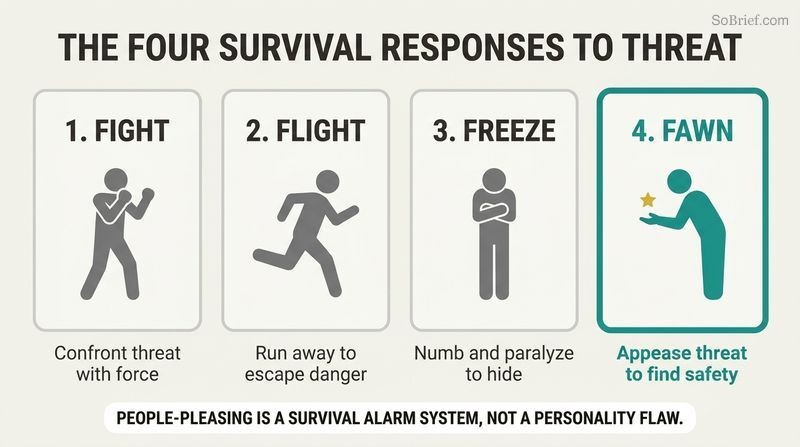
Fawning is the fourth trauma response. Most people know fight, flight, and freeze. Therapist Meg Josephson spotlights a fourth, named by psychotherapist Pete Walker in 2013: the fawn response. While fight attacks a threat and flight flees it, fawning moves toward the threat by appeasing, pleasing, and becoming useful to it. A child in a volatile home learns that being agreeable is safer than resisting.
It hides in plain sight because society rewards it. People pleasers get promotions and get called selfless. The endless question "Are you mad at me?" is not a personality flaw or excessive sensitivity but an alarm system built for survival. Josephson's own childhood, spent tracking her father's rage and her mother's silences, taught her to read rooms before she could read herself.
What's striking is how Josephson reframes a behavior usually pathologized as weakness into an intelligent adaptation. This aligns with polyvagal theory and Porges's work on the nervous system detecting safety versus danger below conscious awareness. The concept fills a real gap: codependency literature describes the behavior but rarely names the survival logic beneath it. One nuance worth flagging: because fawning overlaps heavily with ordinary agreeableness and socialization, especially for women, distinguishing trauma response from healthy prosociality requires care. Josephson handles this by pointing to resentment and self-abandonment as diagnostic markers, which keeps the framework from becoming a catch-all label for any kindness.
Trauma is what happened inside you, not the size of the event
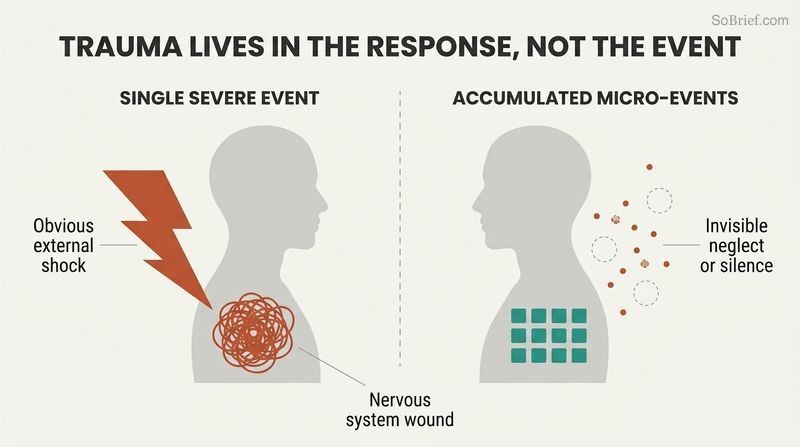
Small wounds accumulate into complex trauma. Many people disqualify their own pain because nothing "big" happened. Josephson's client Isabelle grew up with married parents and a family dog, yet spent childhood hiding in books while her parents' tension filled the air. Trauma, Josephson argues, is defined by how the nervous system processes an experience, not by the event's severity. This is why two siblings can emerge from the same house with completely different wounds.
Complex trauma includes what didn't happen. When caregivers who should provide safety instead deliver chaos, neglect, or silence, the repeated micro-injuries can wound as deeply as one catastrophic event. It also encompasses absent nurturing: the comfort never offered, the emotions never acknowledged. Because trauma lives in the wound rather than the event, healing is always possible even without changing the past.
This democratizes trauma in a clinically defensible way. The ACEs (Adverse Childhood Experiences) research and van der Kolk's work both support the idea that chronic relational stress reshapes physiology as powerfully as acute events. Josephson's sibling example neatly illustrates differential susceptibility, why the same environment produces divergent outcomes based on temperament and meaning-making. A constructive caution: expanding trauma's definition risks concept creep, where the word loses precision. Josephson mitigates this by anchoring trauma in nervous-system processing rather than declaring all discomfort traumatic, and by insisting the goal is understanding rather than blame, which keeps the framing therapeutic rather than victim-oriented.
You are not the anxious voice in your head; you're its witness
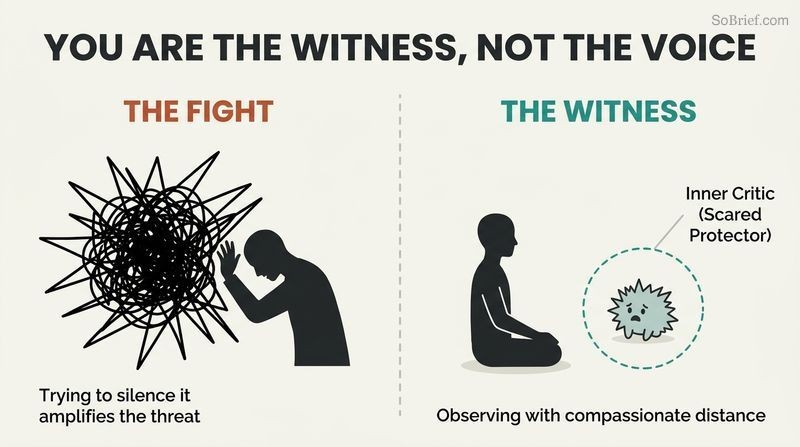
Awareness beats silencing. Clients arrive wanting to kill the anxious inner voice, but trying to silence it only amplifies it. The goal is noticing it, attaching to it less, and soothing it. Josephson borrows Paul Gilbert's zebra image: a zebra escapes a lion and instantly returns to grazing, while a human replays the threat for days, asking whether the lion has a master plan. The "new brain" that lets us plan and imagine also lets us ruminate ourselves into staying in survival mode when no danger exists.
The inner critic is a scared protector. Drawing on Internal Family Systems, Josephson describes the harsh inner voice as a young, frightened "part" recycling the words of dysregulated caregivers. It criticizes preemptively so no one else can. Treat it like a scared pet, not an enemy.
The distinction between having thoughts and being thoughts is the cognitive backbone of both mindfulness-based cognitive therapy and Acceptance and Commitment Therapy, where it is called defusion. Josephson's contribution is pairing that with IFS's compassionate reframe of the critic as protector rather than saboteur. The zebra metaphor echoes Sapolsky's Why Zebras Don't Get Ulcers, which made the same point about chronic human stress physiology. One tension: the claim that suppression backfires is well supported (Wegner's ironic process theory), yet some clinicians note that for acute crises, brief distraction can be adaptive. The nuance is dosage and context, not a blanket rule.
Rescue your emotions from the extra layer of shame you pile on top
Separate primary from secondary emotion. The raw feeling (anger, fear, sadness) is the primary emotion and is always allowed. The self-criticism heaped on top ("What's wrong with me for feeling this?") is the secondary emotion, and it's the unnecessary layer that prolongs suffering. Josephson's client Brianna wasn't just angry at her friend; she was angry at herself for being angry, leaving her "double-angry."
Emotions are messengers, not enemies. Anger signals a violated value or unmet need. Fear flags a perceived threat. Envy reveals a buried desire. Resentment, Josephson's favorite, is anger swallowed so many times it festers, and it's the clearest sign you're fawning rather than genuinely giving. Physiologically, an emotion's chemical wave lasts about ninety seconds; what extends it is the story we keep telling. Insert a pause between trigger and reaction, and you reclaim the power to respond.
The primary versus secondary emotion distinction comes from emotion-focused therapy (Greenberg) and is one of the most practically useful ideas here. The ninety-second figure, popularized by neuroanatomist Jill Bolte Taylor, should be treated as an evocative heuristic rather than hard science; emotion durations vary widely, and sustained moods differ from acute surges. Still, the underlying insight holds: rumination, not the feeling itself, is what traps people. Naming resentment as the diagnostic signal for fawning is genuinely original and actionable. It gives readers a somatic tripwire, a felt cue, rather than an abstract instruction to "know yourself," which is far easier to actually use.
Your body screams the words you never let yourself say
Suppressed emotion becomes physical symptom. For four years Josephson's throat burned with acid reflux despite clean eating, sobriety, and exercise. She came to see it as the swallowed words and unfelt anger of a lifetime of overapologizing. In her teens, within two months of her father's worst relapse and a betrayal, she lost nearly a third of her hair, yet told her doctor nothing stressful had happened. The body kept a record her conscious mind refused to.
Chronic survival mode exhausts the system. Fawning floods the body with cortisol and adrenaline. Josephson cites that 60 to 80 percent of primary care visits are stress-related and that nearly 80 percent of autoimmune diagnoses occur in women. The fix is embodiment practiced in small doses: elongated exhales, humming to stimulate the vagus nerve, shaking, or simply softening the stomach.
This chapter channels van der Kolk and Gabor Mate, both of whom argue that emotional suppression carries physiological cost. The autoimmune and stress statistics are directionally supported but correlational; causation between suppressed anger and specific diseases remains contested, and Josephson responsibly notes genetic and hormonal contributors. The strongest, most evidence-backed claim is about diaphragmatic breathing and vagal tone, where the physiology is solid. What elevates the section is the emphasis on titration, dipping a toe into discomfort rather than plunging, which mirrors the trauma-therapy principle of staying inside the window of tolerance so the nervous system learns safety instead of re-traumatizing itself.
People aren't thinking about you nearly as much as you fear
The spotlight effect shrinks your audience. Cornell researchers had participants wear embarrassing shirts, then estimate how many observers noticed. Participants wildly overestimated. The lesson: others aren't cataloging your cringey moments the way you are. A related bias, the illusion of transparency, means we overestimate how visible our inner states are to others.
Nothing is personal, permanent, or perfect. Josephson borrows Buddhist teacher Ruth King's translation of the three marks of existence. Personalization, blaming yourself for events that have little to do with you, is a survival-brain distortion. When someone seems distant, ask "Do I like how this person makes me feel?" instead of "What's wrong with me?" You cannot control others' perceptions no matter how perfectly you perform, so redirect that energy toward soothing yourself through the discomfort of not being universally liked.
Grounding self-help in the spotlight effect (Gilovich) and the three marks of existence gives this a rare East-meets-West rigor. The move from "how do I make them like me" to "do I even like them" is a subtle but powerful locus-of-control shift, echoing the Stoic dichotomy of control that Epictetus articulated two millennia ago. A worthwhile nuance: "nothing is personal" can be misread as emotional bypassing or as excusing others' genuinely harmful behavior. Josephson guards against this by insisting that not personalizing is different from not holding boundaries, and that accountability still matters, which prevents the teaching from sliding into detached indifference.
Take people at their word instead of decoding hidden anger
Conflict avoidance masquerades as peacekeeping. Because fawners learned that conflict meant danger or withdrawn love, they suppress needs and swallow resentment, which paradoxically creates more internal tension and kills real intimacy. Josephson's client Maddy never told her messy roommate anything, then ended the friendship with a vague text, losing the relationship precisely by avoiding the conversation.
Assume others communicate directly, because you now will too. Fawners project their own indirectness onto everyone, assuming people are secretly furious and just not saying so. When Ilana kept asking her calm sister if she was mad, the sister replied that she was only getting annoyed by the repeated asking. The practice: take what people say at face value. If someone is being passive-aggressive and won't name it directly, there is nothing for you to fix. Offer space and support, not mind-reading.
"Take their word for it" is deceptively radical for chronic over-analyzers, and it targets what cognitive therapists call mind-reading, a core distortion. The insight that we project our own conflict style onto others connects to the false-consensus effect from social psychology. Josephson's reassurance-versus-validation distinction (surfaced through the anxious-avoidant couple Sam and Alicia) adds real depth: reassurance temporarily extinguishes anxiety but breeds dependency, while validation acknowledges the underlying emotion and builds security. This maps onto attachment research showing that co-regulation, not endless reassurance, is what actually calms an activated attachment system. The framework turns a vague plea to "communicate better" into distinct, teachable moves.
A boundary states what you'll do, not what others must do
Boundaries are bridges, not walls. Josephson rebrands the stiff corporate version. A boundary isn't an attempt to control someone else's behavior; it's a declaration of your own. Instead of "Stop yelling at me," it's "I'll continue this conversation when you're not raising your voice." It requires nothing from the other person and everything from you. The three components: identify what you feel and need, express it clearly without fawny hedging, and maintain it consistently.
Nice is not compassionate. Niceness is about being perceived as good; compassion, defined in Compassion-Focused Therapy as sensitivity to suffering with commitment to relieve it, sometimes requires a firm no. Guilt after a new boundary isn't proof you did wrong; it's proof you did something new. Josephson stopped forcing her body into "eternal summer," realizing she'd used winter as external permission to rest she couldn't grant herself.
The reframe of boundaries as self-directed rather than other-directed is the single most clinically sound correction to popular boundary discourse, which often collapses into controlling or punishing others. This aligns with how family-systems and DBT practitioners actually teach limit-setting. The nice-versus-compassionate distinction has philosophical teeth: it echoes the difference between people-pleasing and genuine benevolence that thinkers from Aristotle to contemporary self-compassion researcher Kristin Neff have drawn. Neff's finding that self-compassion correlates with greater, not lesser, care for others directly supports Josephson's claim that abandoning yourself in service of others is unsustainable. The "guilt signals newness, not wrongness" reframe is a small gem for anyone paralyzed by boundary guilt.
Grieve the parent you needed, even while they're still alive
Healing requires mourning what you never got. Josephson watched her mother vanish into early-onset Alzheimer's starting at fifty-nine, grieving both the woman dying and the closeness they never had in healthy years. Grief for fawners includes the childhood, the nurturing, and the relationship that never existed. It means letting go of the fantasy that a parent will finally change.
Stop waiting for an apology that may never come. Her client Alex wanted her father to acknowledge his neglect before she could move on, outsourcing her healing to someone incapable of it. Josephson's reframe: people can meet us only as far as they've met themselves. You begin healing when you stop seeking validation from those who caused the harm and instead give your younger self the words you craved: I believe you, it wasn't your fault. Multiple truths coexist: gratitude and grief, empathy and anger.
This names ambiguous loss, a concept coined by therapist Pauline Boss for grief without closure or death, and disenfranchised grief, mourning that society doesn't validate. Both are underrecognized and precisely what estranged or emotionally neglected adult children experience. The insistence on holding contradictory truths simultaneously reflects the dialectical stance at the heart of DBT, where acceptance and change, love and hurt, are not mutually exclusive. The line about people meeting us only as far as they've met themselves is both compassionate and quietly liberating, because it removes the other person's growth as a precondition for one's own. It relocates agency without demanding forgiveness or reconciliation.
Run NICER instead of asking "Are you mad at me?"
A five-step pocket tool for spirals. NICER is Josephson's acronym for interrupting anxious rumination and processing emotion in real time:
1. Notice that the mind has started spiraling, without adding self-judgment
2. Invite the experience to stay, like an old friend, rather than shoving it away
3. Curiosity: gather field notes. What am I feeling? Where is it in my body? Is this thought even true?
4. Embrace the scared, protective part with warmth: thank you for trying to help me
5. Return to what's real right now: the breath, sounds in the room, feet on the ground
It builds awareness stronger than the thoughts. When a friend invited Josephson to a last-minute concert, she declined honestly, then spiraled into guilt and nearly reversed herself. Instead she ran NICER, and within three minutes felt different, not because the anxiety vanished, but because it no longer ran the show.
NICER is essentially a trauma-informed repackaging of mindfulness-based emotion regulation, with strong overlap to RAIN (Recognize, Allow, Investigate, Nurture), the technique taught by meditation teacher Tara Brach. The added value is the explicit IFS-flavored step of thanking the protective part, which shifts the stance from managing symptoms to befriending them. Acronyms like this succeed or fail on retrievability under stress; NICER's virtue is that it's short and its steps flow logically from awareness to grounding. The honest concert anecdote models something rarely shown in self-help: the author demonstrating the tool on a mundane, relatable trigger rather than a dramatic one, which makes it feel usable rather than aspirational.
Familiar feels safe, so healthy love can feel dangerously boring
The brain equates familiar with safe. Josephson's central mechanism for why we stay stuck: the primitive survival brain reads whatever is familiar as safe and whatever is unfamiliar as dangerous, even when reality is reversed. If hypervigilance and people-pleasing kept you safe as a child, they feel like home. This drives trauma reenactment: unconsciously gravitating toward toxic bosses, emotionally unavailable partners, and chaotic dynamics that mirror childhood, hoping to finally "win" and be enough.
Ask: unsafe or just unfamiliar? Clear, direct communication feels like aggression when your baseline is appeasement. A stable, safe partner can feel boring to a nervous system raised on chaos. Josephson met her steady husband at nineteen and had to distinguish her calm intuition (this person is safe) from her anxious voice (run, trust no one). Healing means deliberately building a new sense of familiar through repeated small experiences of safety.
This is the book's most explanatory idea, drawing on the well-documented mere-exposure effect and on attachment theory's insight that early relational templates become the unconscious blueprint for adult intimacy. The reframe question, "Is this uncomfortable because it's unsafe or because it's unfamiliar?" is a superb decision heuristic that externalizes what therapists call corrective emotional experiences. Neuroscientist Michael Merzenich's neuroplasticity research, which Josephson cites, provides the hopeful counterweight: familiarity is learned and therefore re-learnable. The one caution is that not everything unfamiliar is safe, and trauma survivors' instincts are sometimes accurate alarms. Josephson's pairing of this with intuition (calm and clear) versus anxiety (jittery and urgent) offers a workable, if imperfect, way to tell them apart.
Analysis
Are You Mad at Me? is a therapist's hybrid of memoir and clinical guide, structured as a progressive healing arc rather than a list of tactics. Its central intellectual move is to relocate people-pleasing from the realm of personality or moral virtue into the realm of trauma physiology. By elevating the fawn response, the least-discussed of the four threat responses, Josephson gives a name and a mechanism to an experience that codependency literature described but never fully explained. This is the book's genuine contribution: not the techniques, most of which are borrowed and synthesized, but the diagnostic reframe.
Methodologically, Josephson blends four traditions: attachment theory, Internal Family Systems, Compassion-Focused Therapy, and Buddhist mindfulness. This integration is the book's strength and its risk. The strength is coherence; concepts like the protective inner critic (IFS), the compassionate other (CFT), impermanence (Buddhism), and the familiar-equals-safe mechanism (attachment) reinforce one another. The risk is that empirical claims of varying strength sit side by side. The vagal-tone breathing research and the spotlight effect are robust; the ninety-second emotion figure and the suppressed-anger-to-autoimmune pathway are evocative but softer. Josephson generally flags this responsibly, noting genetic and hormonal contributors and framing trauma around nervous-system processing rather than event severity.
The sociopolitical framing, situating fawning within patriarchy, racism, and the model-minority narrative, broadens the book beyond individual pathology, though it occasionally gestures at systems it cannot fully address within a self-help format. The prose earns trust through vulnerability: the father's rage, the mother's Alzheimer's, the author's reflux and hair loss.
The deepest insight is quietly radical: that the pursuit of others' approval is self-abandonment in disguise, and that reconnecting to one's own needs, resentment, and intuition is not selfishness but the precondition for genuine compassion. Where the book is weakest, it risks concept creep and reassurance that all discomfort is trauma. Where it is strongest, it hands chronic worriers a precise, physiologically grounded explanation for why they cannot stop scanning faces, and a gentle, repeatable path out.
Review Summary
Are You Mad at Me? explores people-pleasing as a trauma response called "fawning." Readers consistently report feeling deeply seen, with many describing revelatory moments recognizing their own patterns of conflict avoidance, boundary struggles, and approval-seeking. Josephson presents six fawning archetypes and offers practical tools like the NICER technique for emotional regulation. Reviewers praise the book's accessible writing, compassionate tone, and integration of mindfulness with trauma therapy. Some note early chapters focus heavily on parental relationships, though most find transformative value. The book resonates particularly with those who constantly worry about others' perceptions.
People Also Read







Glossary
Fawn response
Appeasing threats to stay safeThe fourth trauma response, named by psychotherapist Pete Walker in 2013, alongside fight, flight, and freeze. Rather than confronting, fleeing, or dissociating from a threat, fawning means unconsciously moving toward it by pleasing, appeasing, agreeing, and becoming helpful. It typically develops in chaotic childhood homes where being agreeable was the safest strategy, and it is heavily reinforced by society, especially for women.
NICER
Five-step anxiety-processing toolJosephson's acronym for interrupting rumination and processing emotion: Notice the spiral without judgment, Invite the experience to stay, bring Curiosity to what you feel and where it lives in the body, Embrace the scared protective part with warmth, and Return to something real in the present such as the breath or ambient sounds. Used to respond rather than react.
Complex trauma
Repeated relational wounds over timeTrauma arising from prolonged exposure to feeling unsafe, unheard, unloved, or unseen, usually within the home or caregiving system that should have provided safety. Unlike a single catastrophic event, it accumulates through many small moments and also includes what did not happen: the nurturing, comfort, and acknowledgment never received.
Secondhand fawning
Appeasing others through someone elseJosephson's term for fawning on another person's behalf, trying to make someone associated with you (a partner, child, or family member) behave more agreeably because their perceived imperfection feels threatening to your own sense of safety. Example: nudging a soft-spoken partner to speak louder to preempt a critical parent's disapproval.
Primary vs. secondary emotion
Raw feeling versus added judgmentThe primary emotion is the raw, immediate feeling (anger, fear, sadness) and is always legitimate. The secondary emotion is the layer of self-criticism or shame piled on top ("What's wrong with me for feeling this?"), which is unnecessary and prolongs suffering. Healing means allowing the primary emotion while dropping the secondary layer.
Compassionate Other
Imagined wise, calm figureA framework from Compassion-Focused Therapy in which you picture a being who is compassionate, wise, calm, and grounded, and who can address the scared parts of you on your behalf. It can be your most evolved self, a trusted safe person, or a fictional character, and it never criticizes or blames.
The Three P's
Nothing personal, permanent, perfectBuddhist teacher Ruth King's translation of the three marks of existence, adapted by Josephson: nothing is personal (personalization is a survival-brain distortion), nothing is permanent (everything changes, so pain and pleasure both pass), and nothing is perfect (difficulty is inherent to being alive). Together they loosen the grip of self-blame and control.
Leaning back
Reducing unnecessary over-effort in relationshipsA subtle internal practice of not exerting energy where you habitually overextend, volunteer, or try to prove yourself unnecessarily. It is not neglecting responsibilities or leaving the room, but pausing to ask why you are about to do something and declining to fawn when it is not required.
FAQ
What is "Are You Mad at Me?" by Meg Josephson about?
- Explores the fawn response: The book delves into the often-overlooked trauma response known as "fawning," where people-pleasing and self-abandonment are used as survival mechanisms.
- Focuses on healing from people-pleasing: It provides a compassionate, trauma-informed approach to understanding and healing chronic people-pleasing, anxiety, and the fear of others being upset.
- Blends personal and clinical insight: Meg Josephson, a therapist, shares her own story alongside composite client vignettes to illustrate how these patterns develop and persist.
- Integrates mindfulness and self-compassion: The book combines Western psychology, Internal Family Systems, attachment theory, and Buddhist mindfulness practices to guide readers toward self-acceptance and internal safety.
Why should I read "Are You Mad at Me?" by Meg Josephson?
- If you struggle with people-pleasing: The book is especially relevant for those who constantly worry about others' perceptions, fear conflict, or feel responsible for others' emotions.
- For trauma-informed self-understanding: It offers a nuanced look at how childhood experiences and societal conditioning shape adult behaviors, especially in women and marginalized groups.
- Practical tools for healing: Josephson provides actionable exercises, reflection questions, and the NICER method to help readers break free from self-abandonment.
- Compassionate, relatable voice: The author’s blend of vulnerability, clinical expertise, and spiritual wisdom makes the book accessible and validating for anyone seeking deeper self-connection.
What are the key takeaways from "Are You Mad at Me?" by Meg Josephson?
- Fawning is a survival response: People-pleasing is not a personality flaw but an adaptive response to unsafe or unpredictable environments.
- Healing requires self-compassion: True change comes from understanding and soothing the scared, protective parts of ourselves, not from self-criticism.
- Boundaries are essential: Setting and maintaining boundaries is an act of self-care and necessary for authentic relationships.
- Awareness precedes change: Mindfulness, curiosity, and self-inquiry are foundational for noticing and shifting ingrained patterns.
- Healing is ongoing and imperfect: Progress is measured by increased awareness and self-kindness, not by never slipping into old habits.
What is the "fawn response" as defined in "Are You Mad at Me?" by Meg Josephson?
- Fourth trauma response: Alongside fight, flight, and freeze, "fawn" is the response where a person seeks safety by appeasing, pleasing, or accommodating others.
- Rooted in early environments: It often develops in childhoods marked by conflict, unpredictability, or emotional neglect, where being "good" or "helpful" was necessary for safety.
- Not a conscious choice: Fawning is an unconscious, adaptive mechanism, not a deliberate behavior or personality trait.
- Reinforced by society: Especially for women and marginalized groups, fawning is socially rewarded and thus becomes chronic and normalized.
How does "Are You Mad at Me?" by Meg Josephson explain the origins of people-pleasing and self-abandonment?
- Childhood dynamics: The book details how roles like Peacekeeper, Performer, Caretaker, Lone Wolf, Perfectionist, and Chameleon are formed in response to family conflict, neglect, or abuse.
- Complex trauma: Repeated small traumas or unmet needs, not just major events, can lead to chronic fawning and self-abandonment.
- Societal and cultural factors: Patriarchal, white-dominant, and ableist systems reinforce the need to fawn for survival and acceptance.
- Attachment styles: Fawning is linked to anxious and avoidant attachment, with the underlying goal of preventing abandonment and maximizing safety.
What is the NICER method introduced in "Are You Mad at Me?" by Meg Josephson?
- A mindfulness-based tool: NICER stands for Notice, Invite, Curiosity, Embrace, and Return, and is used to process anxious thoughts and emotions.
- Step-by-step process: Notice what’s happening internally, Invite the experience to stay, approach it with Curiosity, Embrace it with compassion, and Return to the present moment.
- Breaks automatic patterns: NICER helps interrupt spirals of overthinking, self-criticism, and reactive behaviors by creating space for conscious response.
- Applicable in daily life: The method can be used in moments of anxiety, guilt, or conflict, both in private reflection and in real-time situations.
How does "Are You Mad at Me?" by Meg Josephson address the relationship between thoughts, emotions, and healing?
- You are not your thoughts: The book emphasizes that thoughts are not ultimate truths; they are often protective stories rooted in past experiences.
- Emotions as messengers: Emotions like anger, fear, guilt, and resentment are seen as temporary signals, not problems to be fixed or suppressed.
- Self-criticism prolongs suffering: Judging oneself for having certain thoughts or feelings adds unnecessary layers of pain and keeps old patterns alive.
- Mindfulness and labeling: Practices like labeling thoughts and emotions help create distance and allow for more compassionate self-inquiry.
What role do boundaries play in healing, according to "Are You Mad at Me?" by Meg Josephson?
- Boundaries as self-care: Setting boundaries is reframed as an act of compassion for oneself and others, not as selfishness or meanness.
- Bridges, not walls: Healthy boundaries foster sustainable, authentic connections rather than isolation or rigidity.
- Resentment as a signal: The presence of resentment often indicates a need for a boundary or unmet need.
- Consistency and self-trust: Maintaining boundaries, even when uncomfortable, builds self-trust and clarifies relationships.
How does "Are You Mad at Me?" by Meg Josephson suggest readers process grief, anger, and other challenging emotions?
- Grief for what was missing: The book validates grieving not just losses, but also the nurturing, safety, or relationships one never had.
- Anger is allowed: Anger is reframed as a healthy, necessary emotion that signals violated needs or boundaries, not as something to be ashamed of.
- Remove secondary criticism: The author encourages readers to drop self-judgment about their emotions and simply allow them to be present.
- Emotions are temporary: By sitting with emotions using mindfulness and NICER, readers can let them move through rather than become stuck.
What are the main healing practices and tools recommended in "Are You Mad at Me?" by Meg Josephson?
- Mindfulness and meditation: Regular practices to increase awareness of thoughts, emotions, and bodily sensations.
- Grounding techniques: Exercises like deep breathing, sensory awareness (5-4-3-2-1), movement, and nature connection to regulate the nervous system.
- Self-compassion exercises: Talking to oneself as a loving parent or compassionate other, especially when the inner critic is loud.
- Reflection questions: Each chapter ends with prompts to help readers explore their patterns, needs, and progress.
- Gradual exposure to discomfort: Encourages "dipping toes" into new behaviors (like setting boundaries) in safe, manageable steps.
How does "Are You Mad at Me?" by Meg Josephson address the impact of trauma on the body and intergenerational patterns?
- Trauma is stored in the body: Chronic fawning and stress manifest as physical symptoms, exhaustion, and health issues.
- Mind-body connection: Healing requires reconnecting with the body, not just intellectual understanding.
- Intergenerational trauma: The book explains how trauma and coping patterns are passed down biologically and behaviorally across generations.
- Healing as breaking cycles: By becoming aware and making new choices, readers can stop passing on patterns of self-abandonment and pain.
What are the best quotes from "Are You Mad at Me?" by Meg Josephson and what do they mean?
- "What feels familiar to the body is going to feel safe." – Highlights why we unconsciously repeat old patterns, even when they no longer serve us.
- "Fawning, at its core, is what we learn to do to avoid being abandoned or rejected and to maximize feelings of love and safety. The irony is that, in an unconscious attempt to avoid abandonment, we end up abandoning ourselves." – Captures the central paradox of people-pleasing.
- "Healing is an imperfect, lifelong practice of realizing that we were never 'broken' to begin with." – Emphasizes self-acceptance and the ongoing nature of healing.
- "Boundaries are bridges, not walls." – Reframes boundaries as tools for connection, not separation.
- "You are not responsible for the version of you that exists in other people’s minds." – Encourages letting go of the need to control others’ perceptions and reclaiming self-trust.
Download PDF
Download EPUB
.epub digital book format is ideal for reading ebooks on phones, tablets, and e-readers.








































