

Key Takeaways
Every human carries a predator; only a few ever unleash it
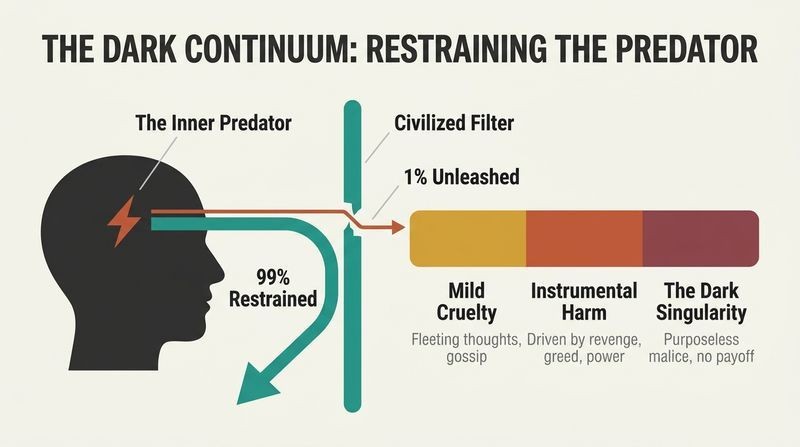
Dark Psychology is the study of the human capacity to prey on others. Hollins argues that beneath our civilized surface, all of us harbor fleeting impulses to hurt, dominate, or destroy. Most people restrain these urges through guilt and social conditioning. A small minority act on them. He places all harmful behavior on a Dark Continuum, a spectrum running from mildly cruel thoughts to purposeless psychopathic violence.
The rare 1% act without any goal. He calls the theoretical extreme the Dark Singularity: violence with no rational payoff, no money, sex, or revenge. Comparing Jeffrey Dahmer (who killed from a delusional craving for companionship) with Ted Bundy (who inflicted pain for its own sake), he shows that motive, not body count, determines where someone lands on the continuum.
The claim that cruelty is latent in everyone echoes Jung's concept of the shadow and Zimbardo's Lucifer Effect, which showed ordinary students turning brutal in the Stanford prison simulation. What's provocative is Hollins framing morality itself as a fragile veneer over a survivalist animal, closer to Hobbes than to modern positive psychology. Critics would note that most violence researchers find purposeless killing vanishingly rare, and that attributing a mystical Dark Singularity risks romanticizing pathology. Still, the core diagnostic value holds: recognizing your own dark potential, the book argues, is precisely what keeps it dormant.
Judge any influence tactic by one test: would you accept it done to you?
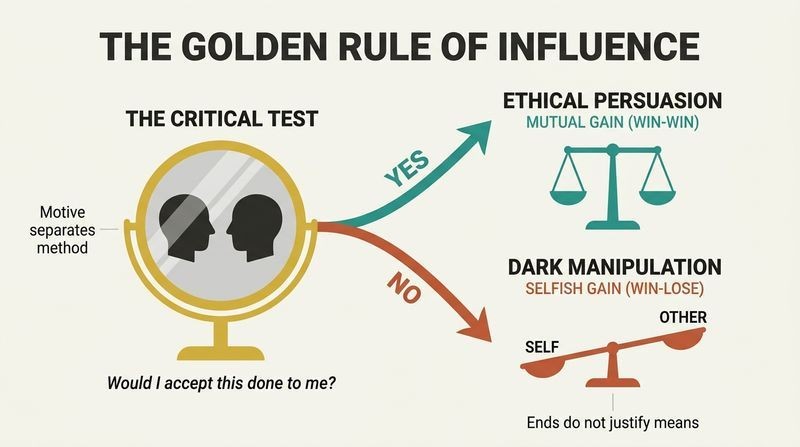
Intent separates ethical persuasion from dark manipulation. Hollins insists the line is not the technique itself but the motive behind it. Before deploying any influence tool, ask three questions: Is it right? Would I like this done to me? Can I use this without abusing it? If a tactic serves only your gain at another's expense, it has crossed into dark territory.
Aim for genuine win-win, and be honest about it. He warns that the trap is self-deception. A salesperson who convinces himself the customer truly benefits can rationalize any coercive trick under an ends-justify-the-means logic. He names the frequent offenders: narcissists, sociopaths, some attorneys, politicians, salespeople, and self-serving people who are comfortable with win-lose outcomes.
This is the ethical spine of the book, and it is essentially Kant's categorical imperative applied to persuasion: act only as you would want universalized. It also mirrors the Golden Rule across faith traditions. The sharpest insight is psychological: manipulators rarely see themselves as villains because motivated reasoning lets them relabel exploitation as helpfulness. Behavioral economists call this ethical fading, the gradual blurring of moral stakes inside a transaction. The weakness is enforceability. Intent is invisible and self-reported, so the test works best as private conscience-check rather than external standard, which is likely why Hollins frames it as a question you must ask yourself.
Manipulators disarm you by switching off your critical mind first
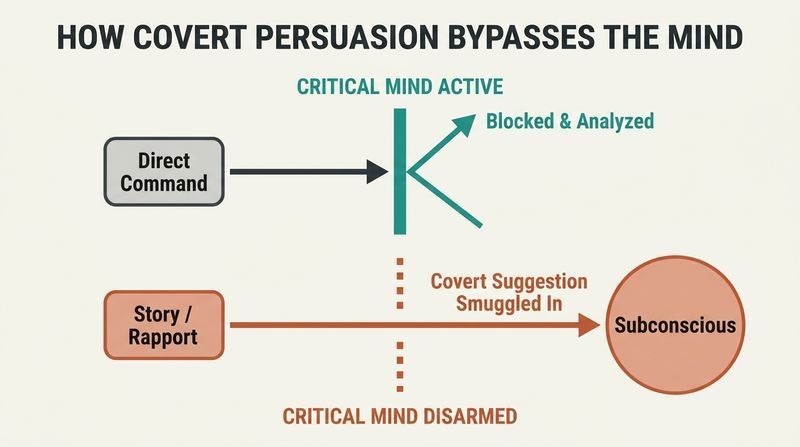
Covert emotional manipulation controls people below conscious awareness. Hollins describes a repeatable sequence. First, the manipulator builds rapport through compliments, shared laughter, or mirroring your body language. Second, they suspend your analytical thinking by inviting imagination with phrases like "What if..." or "Imagine this..." which shift you from scrutiny into fantasy. Third, once your critical filter is offline, they slip in suggestions and requests.
Stories are the smuggler's vehicle. Because the mind lowers its guard for narrative, commands are wrapped in metaphor and delivered indirectly. The defense is equally structured: recognize these tactics exist and are widespread, study them in detail so you spot them in real time, and respond with assertive communication. When someone interrupts, redirects, or invades your space, name it out loud. Calling out the maneuver strips away its power.
The mechanism aligns with dual-process theory from Kahneman: System 2 (slow, analytical) is effortful and easily bypassed, leaving fast, emotional System 1 exposed. Advertisers, cult recruiters, and confidence tricksters all exploit the same rapport-then-fantasy pipeline. The practical genius here is that naming a tactic breaks its spell, a finding echoed in negotiation research where labeling an opponent's move ("it sounds like you're anchoring high") neutralizes it. One caution: hyper-vigilance can curdle into paranoia, seeing manipulation in every warm gesture. Rapport-building is also how genuine friendship forms, so the tell is hidden agenda, not friendliness itself.
Mass media pacifies you with distraction and manufactured crises
Populations are steered through predictable strategies. Drawing on a list often misattributed to Chomsky (traced to Sylvain Timsit), Hollins catalogs how elites manage public opinion. Attention is a scarce resource, so the first move is distraction, flooding people with trivia (celebrity affairs, sports tables, margarine debates) so they ignore real power shifts. The Romans called it bread and circuses.
Other levers exploit time and emotion. Key tactics include:
1. Problem-reaction-solution: manufacture a crisis, then offer the pre-planned "cure" you wanted all along.
2. Gradualism: impose radical change drop by drop over years so no revolt forms.
3. Postponement: sell painful measures as necessary sacrifices for tomorrow.
4. Childish language: address adults as if they were twelve to bypass thought.
5. Emotion over reflection: trigger feelings to short-circuit reasoning.
Manufactured ignorance and induced guilt keep resistance quiet.
These strategies overlap heavily with Naomi Klein's Shock Doctrine, cited in the text, which documents how crises soften publics for unpopular reforms. The gradualism point anticipates the well-studied boiling-frog dynamic in policy and the foot-in-the-door effect scaled to whole societies. Yet intellectual honesty requires the caveat Hollins himself flags: the list may have originated as satire, and it presumes a coordinated elite rather than the messier reality of competing interests, market incentives, and journalistic incompetence. The framework is most useful not as proof of conspiracy but as a media-literacy checklist for noticing what stories are crowding out.
Stage hypnosis is peer pressure in a spotlight, not mind control
The clucking volunteer obeys the crowd, not the hypnotist. Hollins, who was himself a stage subject twice, reveals that the real force onstage is what he calls stage conformity. Volunteers comply with absurd commands because they do not want to disappoint the audience or suffer public embarrassment, not because their will has been seized. The louder and stranger they perform, the more the crowd approves.
Hypnosis is focused relaxation, not unconsciousness. A subject stays aware, can wake at will, and refuses anything violating their morals. His proof: when one volunteer began genuinely undressing, others only mock-stripped to socially acceptable limits, and the surprised hypnotist had to stop her. She turned out to be a professional stripper, doing only what she would do awake. The theatrical myth that hypnosis equals control is the very illusion that sells the show.
This demystification is well supported. Sociocognitive theorists like Nicholas Spanos argued for decades that hypnotic behavior is strategic role enactment shaped by expectation, not a distinct trance state. Solomon Asch's conformity experiments and Milgram's obedience studies both show how situational pressure produces compliance that observers wrongly attribute to internal states. The stripper anecdote elegantly makes the key ethical point: hypnosis cannot override authentic values. The nuance worth adding is that suggestibility varies widely between individuals, and stage performers pre-screen for the most compliant volunteers, which further stacks the deck before the curtain rises.
Indirect suggestion slips past defenses because it never sounds like a command
The most effective suggestions disguise themselves as stories. Hollins distinguishes traditional hypnosis (direct commands that critical minds resist) from Ericksonian hypnosis, developed by Milton Erickson, which uses metaphor and embedded suggestion. Because indirect suggestions arrive dressed as a rambling anecdote ("perhaps your eyes will grow tired as you listen..."), the conscious mind never flags them as instructions.
Parents hypnotize children by accident. His sharpest example: a parent warns "don't drop that!" as a child carries milk. The child stumbles, spills, and hears "You're so clumsy, you'll never learn." That is a post-hypnotic suggestion delivered in an emotionally charged state, and the child may carry the "clumsy" identity for life. He also explains NLP anchoring: linking a specific trigger (touching your ear) to a desired state (confidence), the same way a song can instantly resurrect an old feeling.
Erickson's indirect methods genuinely reshaped clinical hypnotherapy and seeded techniques used in modern coaching and NLP. The everyday-hypnosis insight is the most valuable takeaway: casual authoritative statements to children function as identity-forming scripts, a mechanism cognitive therapists call core belief installation. The anchoring concept maps onto classical conditioning, Pavlov updated for internal states. A fair critique is that NLP's specific claims (eye-movement cues, exact anchoring protocols) have largely failed controlled testing and are considered pseudoscientific. The durable truth underneath is real, though: repeated emotional language wires lasting associations, whether the label is hypnosis or simply learning.
Six reliable levers make people say yes almost automatically
Persuasion is a symbolic attempt to change attitudes in an atmosphere of free choice (Perloff's definition), and it has exploded in volume, with estimates that adults absorb from 300 to 3,000 persuasive messages daily. Hollins catalogs the mechanical triggers social psychologists have documented, several drawn from Robert Cialdini's 1984 classic Influence.
The core techniques:
1. Foot-in-the-door: secure a tiny yes first, then escalate the request.
2. Door-in-the-face: open with an outrageous ask, then the real request feels reasonable.
3. Reciprocity: a small favor or free "extra" creates a debt people rush to repay.
4. Anchoring: the first number named frames the entire negotiation, so name it first and high.
5. Scarcity: limited or last-chance items become more desirable.
Others exploit manufactured needs, social belonging, and loaded words like "all natural."
These levers are among the most replicated findings in social psychology, and Cialdini's work remains a cornerstone of both marketing and defense against it. The deeper point Hollins raises is cultural: the ancient Greek Sophists treated persuasion as a truth-finding debate, whereas modern persuasion appeals to emotion and reflex, firing responses as reliably as a mousetrap. That degradation matters. The practical defense is metacognitive: simply knowing a technique's name reduces its grip, because recognition reactivates deliberate reasoning. Worth noting that recent replication scrutiny has trimmed some effect sizes, but reciprocity, scarcity, and anchoring remain robust across cultures and contexts.
Everyone lies roughly twice a day, often to be kind
Deception is woven into normal social life. Citing Bella DePaulo's research, Hollins reports the average person tells about two lies daily and deceives roughly one in three people they speak with one-on-one. Most are not self-serving betrayals but social lubricants ("that dress looks fine") meant to spare feelings. Women more often lie to comfort others; men more often lie to burnish their own reputation.
Even institutions built on truth deceive. He recounts Dutch star psychologist Diederik Stapel, who fabricated data in at least 55 published papers before students exposed him in 2011. Worse, he argues, deception is baked into psychology's own methods: by the 1970s over half of social psychology studies misled their subjects, treating small lies as necessary to uncover large truths. He warns this normalizes dishonesty, since deception, like honesty, is habit-forming.
The DePaulo figures are genuine and widely cited, and they puncture the comforting myth that lying is aberrant. The more unsettling argument concerns institutional deception: the Stapel scandal and psychology's reliance on cover stories raise a real ethics-of-science question that bioethicists still debate. Hollins's claim that lab deception spills into everyday dishonesty is plausible but empirically thin, closer to a slippery-slope intuition than a demonstrated effect. The valuable reframe for readers is descriptive rather than moralizing: since deception is ambient and often prosocial, the skill worth building is calibrated trust, not naive faith or corrosive cynicism.
Love bombing followed by cold withdrawal is the manipulator's signature
A relationship that feels too perfect is a warning, not a fairy tale. Hollins describes how emotional manipulators open with love bombing: an overwhelming flood of praise, gifts, affection, and intensity that makes you feel you are living a dream. Then, once you are hooked, warmth is withdrawn and you feel neglected and off-balance.
The trap is sporadic reinforcement. Just as you resolve to leave, they deliver another unexpected gift or burst of affection, and you are pulled back in, closer than before. Once control is secure, the intermittent rewards stop because they are no longer needed. Manipulators also deny past promises until you doubt your own memory, weaponize crocodile tears, and behave one way with you and another with everyone else. When you spot someone habitually swinging between charming and cruel, keep a healthy distance.
Sporadic reinforcement is the human version of B.F. Skinner's variable-ratio reinforcement schedule, the same mechanism that makes slot machines and social media notifications addictive: unpredictable rewards produce the most compulsive behavior. This is why intermittent affection creates stronger attachment than steady kindness, a dynamic trauma clinicians recognize as trauma bonding. The reality-distorting denial Hollins describes is textbook gaslighting, named for the 1944 film. The framework gives readers concrete behavioral red flags rather than vague warnings, though the challenge remains that these patterns are clearest in hindsight, after the emotional investment that makes leaving hardest is already sunk.
Reclaim power by saying no, betting on yourself, and cutting toxic ties
You cannot be manipulated without your own permission. Hollins's defensive playbook centers on refusing to play the victim. Practical moves include:
1. Say "no" and speak your mind, accepting that they may react badly.
2. Trust your own judgment instead of outsourcing your identity to others' opinions.
3. In confrontations with a true manipulator, aim only to defuse and exit, staying calm and factual rather than arguing (which lets them twist your words).
4. Bet on yourself: when facing hard choices, ask "what do I most want to do?" not "which external option is safest?"
5. Cut off harmful relationships completely, resisting the urge to check their social media.
Rebuild your inner ground. He recommends meditation to neutralize stress hormones and stabilize emotions, plus deliberate positive self-talk to overwrite the negative scripts a manipulator installed. Finding closure, leaning on supportive friends, and developing a sense of purpose make you far harder to fool.
The empowerment ethos here leans libertarian and self-reliant, and much of it is sound: assertiveness training, no-contact strategies, and cognitive reframing are established tools in clinical psychology for recovering from abusive relationships. The self-talk technique is essentially cognitive restructuring from CBT. One tension worth flagging is the book's insistence that "no one manipulates you without permission," which risks sliding into victim-blaming, especially given its own earlier account of covert, subconscious tactics that operate precisely without consent. The healthier synthesis: accountability for your patterns is empowering, but sophisticated manipulation can genuinely deceive competent people, so recovery deserves compassion, not shame.
Analysis
Dark Psychology Secrets is a compact, uneven survey that stitches together criminology, media theory, hypnosis, Cialdini-style persuasion science, and a long self-help coda on defending against manipulators. Its structural ambition is also its weakness: the book careens from a quasi-philosophical thesis (that predatory cruelty is universal and occasionally purposeless) to practical advice about ignoring your controlling mother-in-law, without a unifying method. Much of the middle material is derivative, borrowing the Timsit media-manipulation list often misattributed to Chomsky, DePaulo's deception statistics, and Cialdini's influence principles, while the opening chapters advance a genuinely provocative if under-argued claim: that social norms are a thin lacquired restraint over a survivalist animal, and that psychiatry functions partly as social control of those who reject the rules. That Hobbesian streak sits awkwardly beside the book's earnest ethical framing, which asks readers to test every tactic against the Golden Rule. The most durable value is defensive and educational rather than theoretical. Hollins's insistence that studying dark tactics inoculates you against them is his soundest instinct, consistent with research showing that naming a persuasion technique blunts its effect. His stage-hypnosis demystification is genuinely useful, and his behavioral profile of love bombing plus intermittent reinforcement gives readers concrete red flags grounded, whether he knows it or not, in Skinnerian reinforcement schedules and trauma-bonding research. The book's chief liabilities are intellectual: it presents contested or debunked material (NLP protocols, a possibly satirical strategy list) with the same confidence as replicated findings, and its closing self-help chapters drift into generic motivational territory that could belong to any title in the genre. Read critically, it functions best as a starter field guide to recognizing coercion, provided the reader treats its bolder metaphysical claims as prompts for skepticism rather than settled fact.
Review Summary
Reviews of Dark Psychology Secret are mixed, with an average rating of 3.08 out of 5. Many readers find it a basic introduction to manipulation and dark psychology techniques, praising its accessibility and insights on protecting oneself. However, some criticize it for being overly simplistic and lacking depth. Positive reviews highlight its concise chapters and practical advice, while negative reviews express disappointment with the superficial content. Several readers appreciate the book as a starting point for understanding psychological manipulation but suggest it may not satisfy those seeking more advanced knowledge.
People Also Read








Glossary
Dark Psychology
Study of predatory human behaviorHollins's conceptual framework for the universal human potential to victimize others. It studies the thoughts, feelings, and perceptions behind predatory behavior, assuming almost all such behavior is goal-driven but that a rare fraction occurs without any rational purpose. It treats this dark capacity as a facet of the human condition present in everyone, distinct from religious notions of evil or standard social science.
Dark Singularity
Pure purposeless evil extremeThe theoretical endpoint of Hollins's model: a region of the psyche enabling atrocious acts committed with no goal, motive, or rational payoff whatsoever. He treats it as infinite and never fully reached, but argues some individuals approach it. It marks the pole of purposeless violence opposite to ordinary goal-oriented harm.
Dark Continuum
Spectrum of harmful behaviorThe range along which all human malevolence is plotted, from minimally intrusive fleeting cruel thoughts to severe psychopathic violence lacking any coherent rationality. Position on the continuum is determined by the presence or absence of purpose behind an act, not by its severity, illustrated by contrasting Dahmer's motivated murders with Bundy's motiveless sadism.
Stage Conformity
Crowd pressure driving complianceHollins's explanation for why stage hypnosis subjects obey bizarre commands. Rather than genuine trance control, volunteers comply because they do not want to disappoint the audience or risk public embarrassment. This social pressure, he argues, can be stronger than hypnosis itself, and it sustains the false public belief that hypnosis is mind control.
Love Bombing
Overwhelming early affection as baitA manipulation tactic where a relationship opens with an intense flood of praise, gifts, affection, and idealization that feels like a perfect fairy tale. It hooks the target emotionally before warmth is withdrawn, setting up dependence and control.
Sporadic Reinforcement
Unpredictable rewards create dependenceThe manipulator's tactic of granting affection or gifts only intermittently, especially just as the victim decides to leave. The unpredictability deepens attachment and control. Once dominance is secured, the intermittent rewards stop because they are no longer needed. It mirrors the variable-ratio reinforcement schedule that makes gambling addictive.
Negging
Backhanded compliment to lower esteemA pick-up artist technique of subtly putting someone down to undermine their confidence while implying the manipulator's own superior worth, making the target seek their approval. Hollins classifies it among covert manipulation tactics that approach people from dominance rather than equality.
Anchoring
First reference point frames decisionsTwo related uses. In NLP, linking a specific trigger (like touching your ear) to a desired emotional state so the trigger later recalls that feeling, much as a song evokes a memory. In negotiation, the tendency for the first number offered to frame all subsequent bargaining, so naming a high figure first shifts the outcome in your favor.
FAQ
What's "Dark Psychology Secret" about?
- Exploration of Dark Psychology: The book delves into the "dark" side of human psychology, focusing on behaviors and thoughts that are manipulative, deceitful, and predatory.
- Understanding Manipulation: It provides insights into how dark psychology is used in everyday life, including emotional manipulation, deception, and mind control.
- Defensive Strategies: The book also offers strategies to protect oneself from being manipulated and to defend one's mind against such tactics.
- Comprehensive Guide: It covers various aspects of dark psychology, including NLP, hypnosis, and persuasion, making it a comprehensive guide on the subject.
Why should I read "Dark Psychology Secret"?
- Awareness of Manipulation: Reading this book can help you become more aware of the manipulative tactics used by others, allowing you to recognize and avoid them.
- Self-Defense Techniques: It provides practical advice on how to protect yourself from emotional manipulation and maintain control over your own mind.
- Insight into Human Behavior: The book offers a deep dive into the darker aspects of human behavior, which can be enlightening and educational.
- Empowerment: By understanding these tactics, you can empower yourself to make better decisions and avoid being a victim of manipulation.
What are the key takeaways of "Dark Psychology Secret"?
- Dark Psychology Defined: Dark psychology involves the study of predatory human behaviors that are manipulative and deceitful.
- Common Tactics: The book outlines common manipulation tactics, such as propaganda, covert emotional manipulation, and NLP.
- Defense Mechanisms: It emphasizes the importance of recognizing these tactics and provides strategies to defend against them.
- Ethical Considerations: The book also discusses the ethical implications of using such tactics and the importance of maintaining integrity.
How does "Dark Psychology Secret" define dark psychology?
- Study of Deviant Behavior: Dark psychology is defined as the study of criminal and deviant behavior that preys on others.
- Potential for Evil: It explores the potential for evil within all humans and how some act on these impulses.
- Predatory Behavior: The book describes dark psychology as behaviors that are predatory and often lack clear, rational motivation.
- Universal Human Condition: It suggests that dark psychology is a universal part of the human condition, present in all cultures and societies.
What is covert manipulation according to "Dark Psychology Secret"?
- Hidden Control: Covert manipulation involves gaining control over someone's mind without their knowledge, often through subtle persuasion.
- Techniques Used: It includes techniques like propaganda, NLP, and pick-up artist strategies to subtly influence others.
- Building Rapport: The initial step often involves building rapport with the target to lower their defenses.
- Ethical Concerns: The book highlights that all covert manipulation tactics are unethical as they subvert free will.
How does "Dark Psychology Secret" suggest defending against manipulation?
- Awareness is Key: Recognizing that manipulation tactics exist is the first line of defense.
- Study the Methods: Understanding the specific methods of manipulation can help you recognize them when they are used against you.
- Assertive Communication: Using assertive communication can help defend against tactics like NLP and PUA techniques.
- Strong Personal Boundaries: Maintaining strong personal boundaries is crucial to protect yourself from manipulators.
What role does hypnosis play in "Dark Psychology Secret"?
- Types of Hypnosis: The book discusses different types of hypnosis, including self-hypnosis and stage hypnosis.
- Self-Improvement Tool: Self-hypnosis is presented as a tool for self-discovery and altering subconscious thought patterns.
- Stage Hypnosis: Stage hypnosis is described as entertainment, often involving crowd expectations and conformity.
- Ethical Use: The book contrasts the ethical use of hypnosis for self-improvement with its use for manipulation.
What is the "Dark Continuum" in "Dark Psychology Secret"?
- Range of Intent: The Dark Continuum refers to the range of malevolent intent in humans, from fleeting thoughts to psychopathic behaviors.
- Dark Factor: It includes factors that accelerate or attract individuals towards the Dark Singularity, where heinous actions occur.
- Complex Potential: The book suggests that the potential for dark behavior is complex and difficult to define.
- Universal Presence: It posits that this potential is present in all humans, though only a few act on it.
How does "Dark Psychology Secret" differentiate between persuasion and manipulation?
- Symbolic Process: Persuasion is described as a symbolic process aimed at changing attitudes or behaviors through free choice.
- Deliberate Influence: It involves a deliberate attempt to influence others, often using words, images, and sounds.
- Ethical Considerations: The book emphasizes the importance of ethical persuasion, where the intent is to help rather than manipulate.
- Modern Persuasion: It notes that modern persuasion is more subtle and complex, often involving a mix of media and personal interaction.
What are some common manipulation tactics outlined in "Dark Psychology Secret"?
- Steering Attention: Distracting the public from important issues by flooding them with trivial information.
- Problem-Reaction-Solution: Creating a problem to provoke a reaction and then offering a pre-planned solution.
- Gradation of Changes: Implementing changes gradually to make them more acceptable.
- Promoting Ignorance: Ensuring the public remains ignorant of the methods used to control and manipulate them.
What are the ethical implications of using dark psychology tactics according to "Dark Psychology Secret"?
- Unethical Manipulation: The book argues that all covert manipulation tactics are unethical as they subvert free will.
- Power and Abuse: With the power to manipulate comes the potential for abuse, which is a significant ethical concern.
- Intent Matters: It stresses the importance of assessing one's intent when using persuasion tactics to ensure they are ethical.
- Mutually Beneficial Outcomes: The goal should be a win-win outcome, where both parties benefit from the interaction.
What are the best quotes from "Dark Psychology Secret" and what do they mean?
- "Dark Psychology is both the study of criminal & deviant behavior and a conceptual framework for deciphering the potential for evil within all human beings." This quote highlights the dual nature of dark psychology as both a study and a framework for understanding human potential for harm.
- "Covert manipulation tactics are unethical and here is why: we may be tempted to employ covert persuasion techniques when it benefits us, but we don't like the thought that someone is secretly manipulating us without our knowledge." This quote underscores the ethical issues surrounding manipulation and the importance of treating others as we wish to be treated.
- "The more readers can visualize Dark Psychology, the better prepared they become to reduce their chances of victimization by human predators." This quote emphasizes the book's goal of empowering readers to protect themselves by understanding dark psychology.
Download PDF
Download EPUB
.epub digital book format is ideal for reading ebooks on phones, tablets, and e-readers.








































