


Key Takeaways
Skill with women is trained, not inborn; only 10% are naturals
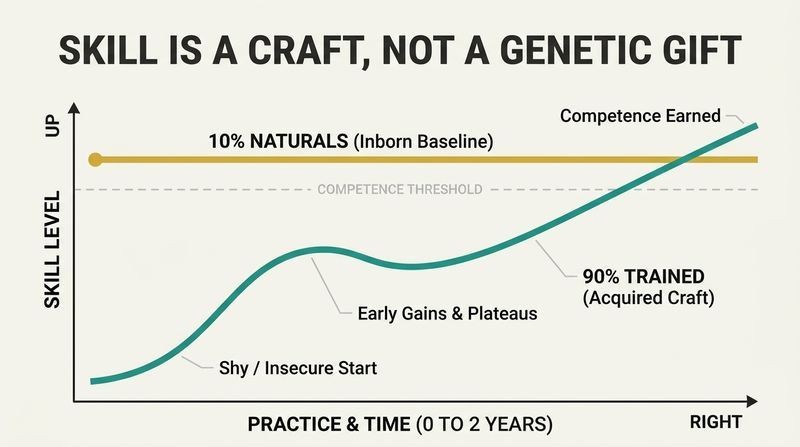
Reject the born-with-it myth. Roosh opens with his own transformation: a shy, insecure college kid who ran to his mother's leg around strangers and avoided girls for years, believing seduction was a genetic gift. His estimate is that fewer than 10% of men are true naturals who charm effortlessly. Everyone else must study and drill it like any craft.
Treat it like the gym. His controlling analogy is bodybuilding: fast early gains, euphoric confidence spikes, then plateaus and slumps requiring constant effort. He warns beginners it takes roughly two years of relentless practice to become competent across all stages. The tennis-player metaphor drives it home: a low-talent player who trains six hours daily can still earn a living on the circuit, just never rank in the top ten.
The core premise aligns with decades of skill-acquisition research: deliberate practice, not raw talent, predicts expertise in most learnable domains. Framing social skill as trainable is genuinely empowering for anxious men and echoes cognitive-behavioral therapy's stance that avoidance, not deficiency, sustains social phobia. What is worth flagging is the frame itself. By treating human connection as a technical skill to be optimized for a quota of conquests, the book smuggles in a transactional model of intimacy. The growth mindset is sound; the goal it is bolted onto (women as skill-validation targets) is where thoughtful readers should apply their own judgment.
Your game outweighs your looks in the eyes of most women
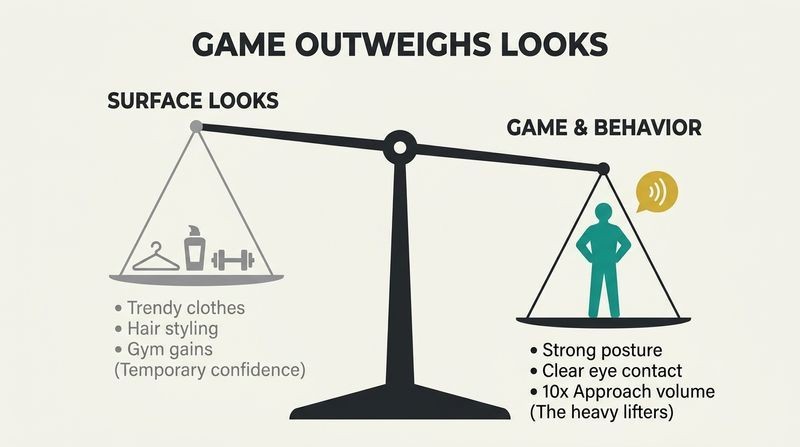
Attraction is perceived, not fixed. Roosh insists looks matter far less than men assume. He points out that the same face reads differently to different women: what one finds ugly, another reads as character or protectiveness. Insecurity, he argues, leaks through slouched posture and weak eye contact, broadcasting unworthiness more loudly than any big nose or bald spot.
Evidence from his own timeline. He notes that photos from a year into his journey showed him more polished and stylish than his later scruffier self, yet he got far less sex back then. The lesson: gel, trendy clothes, and gym gains give short-term confidence boosts, but personality and behavior do the heavy lifting. An unattractive man simply approaches ten women where a handsome one approaches three.
Social psychology partly supports this. The halo effect and confidence signaling do shape perceived attractiveness, and body language reliably communicates status. But the claim is overstated. Meta-analyses on attraction consistently show physical appearance as a dominant first-filter, especially in the loud, visual bar and club venues Roosh himself recommends. He even concedes handsome men need fewer approaches, which quietly undercuts the thesis. The honest synthesis: looks set your baseline odds, while demeanor moves you meaningfully within that band. Reframing appearance as non-fatal is psychologically useful; declaring it nearly irrelevant is motivational exaggeration.
The alpha's real power is genuine willingness to walk away
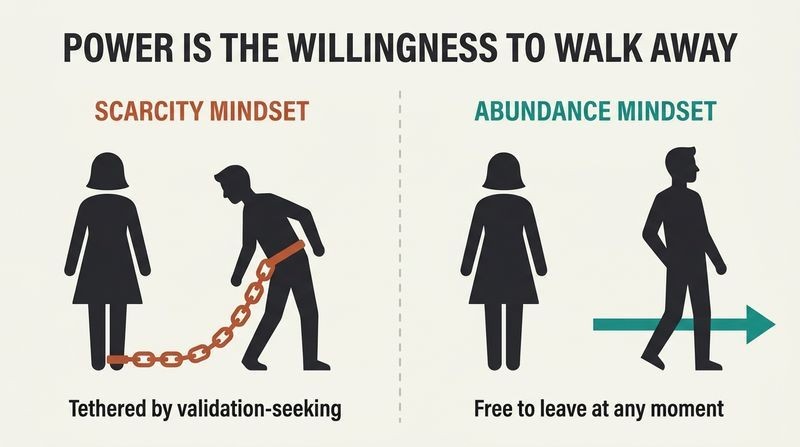
Intent, not behavior, separates alpha from beta. Roosh's alpha male pursues what he wants without seeking permission or validation, keeps his own needs first, and does not qualify or apologize for his desires. The beta fears rejection, prioritizes others, and rationalizes failure. Crucially, the same act (buying a drink, holding a door) can be alpha or beta depending on why you do it: to please her (beta) or to serve your own goal (alpha).
Abundance beats scarcity. The single most powerful signal, he argues, is authentic readiness to leave, believing you will never see or hear from her again. Women sense faked indifference. He cites Lenny Kravitz, Matthew McConaughey, and Leonardo DiCaprio: rich and handsome peers exist everywhere, so their edge must be this mindset.
Stripped of the loaded alpha/beta labels (borrowed from outdated wolf-pack science that the original researcher, David Mech, later disowned), a real insight survives: non-neediness and internal validation are attractive. This dovetails with attachment theory, where secure, self-regulated individuals appear more desirable than anxious ones, and with negotiation research showing the party willing to walk holds leverage. The weakness is the zero-sum, dominance-obsessed framing. Healthy relationships are not perpetual leverage contests, and the abundance mindset curdles into contempt when women become interchangeable inventory. The useful kernel: stop outsourcing your self-worth to any single person's approval.
Approach anxiety is an evolutionary relic you must override
Your fear is ancient hardware. Citing the book Mean Genes, Roosh explains that our tribal ancestors risked gossip, exile, or even death for approaching the wrong woman. So evolution wired men to freeze unless a woman signals clear interest first. The pounding heart and flushed face before saying hello are that outdated survival circuit misfiring in a modern bar where the worst outcome is mild awkwardness.
Dive in, skip the baby steps. He rejects gradual desensitization (practice eye contact, then smiling, then hi). Instead, make your next conversation one with a woman you actually want, shocking your system. There is never a perfect moment; waiting only lets her group grow or her leave. His mantra borrows Teddy Roosevelt: do what you can, with what you have, where you are.
The evolutionary account is plausible and pedagogically effective, though it should be read as a just-so story rather than settled science. The behavioral prescription, however, is well-grounded: exposure therapy is the gold-standard treatment for social anxiety, and flooding (confronting the feared stimulus directly rather than in tiny increments) can accelerate habituation. Naming the fear as ancestral hardware is a clever externalization technique that reduces shame, similar to how therapists help clients depersonalize intrusive thoughts. The reframe converts a paralyzing verdict about the self into a manageable, expected physiological event.
Rejection is volume and data, never a verdict on your worth
She rejects a stranger's snapshot, not you. Roosh argues a woman who blows you off after one minute is rejecting who she thinks you are from a tiny slice of information, not your actual self, which only years-long acquaintances can truly reject. His prescribed reflex after any rejection is a blunt It's her loss, repeated until the brain believes it, which raises your perceived value and stops you from scrapping good material after one bad result.
Outliers do not count. He recounts getting punched in the face by a drunk woman outside a Baltimore club, his literal worst case. Only his ego was bruised. In statistics, extreme events are outliers that do not move the trend. Look at your last ten approaches, not the one disaster. When beginning, expect to approach twenty women per number; with skill, three.
The statistical framing is genuinely useful and mirrors how elite salespeople and improv performers survive rejection: track base rates, not individual misses. Depersonalizing rejection also aligns with cognitive restructuring, where the distortion of personalization is directly challenged. There is real wisdom in not editing your repertoire based on a single data point (a classic overfitting error). The caveat is that It's her loss can shade from healthy detachment into defensive grandiosity that blocks genuine feedback. The skilled version keeps the resilience while still asking, honestly and later, whether a pattern of rejections signals something worth adjusting.
Lower your activation energy so approaching becomes automatic
Borrow a chemistry concept. Every reaction must clear an energy hump before it proceeds; enzymes lower that barrier. Roosh maps this onto approaching: your brain, loaded with knowledge and experience, is the enzyme that lowers the activation energy of talking to a stranger until it happens naturally instead of never.
Stay always on. Mood determines whether you approach, so he treats himself like a computer left running to avoid slow boot-ups. The game starts at the toothbrush, not the cologne. Small levers cut the barrier:
1. Dress so you would feel comfortable talking to a woman anywhere
2. Groom daily, not just before weekends
3. Prime an extroverted, risk-taking state before leaving home
4. When solo, warm up by chatting cashiers and strangers all day
5. Set a hard approach quota (say ten) before you may go home
The activation-energy metaphor is scientifically loose but pedagogically excellent, translating an abstract barrier into something you can deliberately shrink. The underlying behavioral principle is friction reduction, the same mechanism behind habit design: BJ Fogg and James Clear both show that making a desired behavior easier to start dramatically raises its frequency. The always-on grooming point connects to enclothed cognition research, where what we wear measurably shifts our psychological state. The quota device is a commitment mechanism that outsources willpower to a pre-set rule. Stripped of context, this is a broadly transferable framework for beating avoidance on any anxiety-inducing action.
Cultivate The Vibe: emotional control and play beat status
Personality is the strongest hook. The Vibe is Roosh's term for the attitude that attracts most women without adjusting for type. Its pillars: appreciating life (so rejection feels trivial), emotional control (keeping intellect dominant over reactive emotion), valuing your time (walking from anyone not worth it), and playfulness (dry, teasing humor that bonds).
Do not brag your resume. Roosh recounts his worst slump: after acquiring a motorcycle, a bartending gig, and a DJ career, he started leading with those accomplishments and results cratered. Returning to personality-based, information-withholding attraction fixed it. Be a Russian doll of hidden layers, he says, so a woman keeps digging. Emotional control also signals non-neediness: when you do not react like every other man to her tests, she invests more to earn a reaction.
The counterintuitive gem here is that broadcasting achievements backfires. This tracks with signaling theory: overt status displays read as effortful and needy, whereas understated confidence signals abundance. It also connects to the psychology of mystery and the scarcity of information, where curiosity gaps sustain interest. Emotional non-reactivity is essentially affect regulation, a trait linked in relationship research to perceived stability and desirability. The playfulness pillar echoes findings that humor, especially the confident teasing kind, reliably boosts attraction. The critique: The Vibe risks becoming a performance of detachment, and manufactured mystery can tip into evasiveness that erodes the genuine rapport it is meant to build.
Survive the first thirty minutes with threads, not memorized lines
You will carry the conversation. Roosh warns that for at least thirty minutes you do 70%-plus of the talking, and any silence over ten seconds kills the interaction, because a woman uncertain about you has no motivation to rescue a lull. The fix is threads: topics that branch into other topics, letting you hop endlessly rather than dead-end. He organizes them into themes like people, current environment, travel, the future, and qualification (subtly testing whether she meets your standards).
Routines fill the gaps. Routines are scripted, optimized bits, like his signature mock breakup (delivering fake bad news that it will not work out, then the good news that he saved money on car insurance). He compares good game to improv comedy: a huge toolbox of staple bits delivered fresh, never recited word-for-word with dead eyes.
The improv analogy is the most transferable idea here and is backed by how conversationalists actually operate: fluent talkers run on reusable modules, not spontaneous genius. Cognitive load theory explains why canned openers help beginners, freeing working memory for real-time reading of the other person. The thread-hopping technique mirrors what communication researchers call topic laddering. The obvious tension is authenticity: scripted routines optimized across hundreds of women are, by definition, not about the individual in front of you, and the qualification theme deliberately manufactures insecurity. The skill is real; whether it serves connection or manipulation depends entirely on intent and honesty.
Strike while the iron is hot; a phone number is a consolation prize
Decisions decay fast. Roosh's central sales insight: after people decide, they rationalize the choice, but before deciding, the brain injects doubt to talk them out. He tells of two men who enthusiastically promised to buy his motorcycle and both vanished. If men reverse a 3,000 dollar decision, a woman can far more easily reverse a decision about casual sex. So you must capitalize before doubt, a friend, or an ex-boyfriend intervenes.
Escalate physically and same-day. Numbers convert poorly (even skilled players see under half return calls), so he treats them as a fallback. The real move is escalating the same encounter: incremental touching (hip probes lengthening over time), venue changes that distort time and manufacture familiarity, then extraction to a private space. The man who goes out for a number goes home with only a number.
The decision-decay principle is legitimate behavioral science: this is the same urgency exploited by limited-time offers, and it echoes research on choice-supportive rationalization and pre-decision ambivalence. Venue-changing to compress perceived time is a clever application of the mere-exposure and familiarity effects. Where this section demands scrutiny is the collision between persuasion and consent. Engineering a partner's impulsive decision specifically to outrun their own deliberation is ethically fraught when the decision is sexual. Reasonable persuasion for a coffee is one thing; deliberately racing someone past their own second thoughts about sex sits close to a line that modern affirmative-consent standards draw firmly.
Match her tempo on phone and text to never signal neediness
Communication is a mirror game. Roosh's rule: never show more affection or eagerness than she does. Contact her 2-4 days after meeting (his sweet spot is two), between 8 and 9 p.m., and never first on a Friday or Saturday when she wants to appear busy. Keep it purely logistical: the goal of the first call or text is only to set a date, not to entertain or build attraction, which fails over a screen.
Regulate response times. If she takes thirty minutes, take twenty to forty. Send at odd minutes (4:27, not 4:30) so your careful timing looks natural. Never double-text a non-reply. His restart text, a light, low-stakes question days after she goes cold, gauges responsiveness without begging. He reports text converts around 75% versus 66% for calls.
The mirroring rule has real grounding: reciprocity of self-disclosure and interest is one of the most robust findings in relationship science, and over-investment early does read as low value. Response-time modulation, though, is where the strategy borders on absurd and self-defeating. Timing texts to the odd minute to disguise deliberation reveals the paradox at the book's heart: enormous calculated effort deployed to simulate effortlessness. There is also a sample-bias problem with the conversion stats, drawn from one practitioner's self-report. The durable lesson is minimalism and non-neediness in early digital contact; the elaborate stopwatch choreography is likely more anxiety-generating than the neediness it aims to cure.
Persistence through resistance is the model's most dangerous claim
Roosh's late-game engine. He distinguishes two refusals: a permanent no (never overcome it) and a temporary not yet (which he claims persistence can). His prescribed method is the restart: on hitting resistance, pull back, reassure her, return to kissing, then re-attempt the same escalation ten to fifteen minutes later, repeating indefinitely until either progress or a sincere, unmistakable stop. He frames a woman's resistance as logical fear of seeming easy, to be moved back into the emotional realm.
The stated boundary. The book explicitly states that having sex with a woman who does not want to is rape and says never use physical force or continue after stop. Yet the entire framework treats reluctance as an obstacle to grind down, advising you should feel like a creep or you are not pushing hard enough.
This is where an honest editor must be direct rather than expansive. A model that treats repeated no as a temporary state to overwrite is fundamentally incompatible with affirmative-consent standards now embedded in law, campus policy, and clinical ethics. The book's own disclaimer against force cannot be reconciled with its instruction to repeatedly re-attempt an act a partner has already declined; enthusiastic, ongoing, freely given consent is the actual standard, and it is the opposite of wearing someone down. Readers should understand this section not as advanced technique but as a serious liability, ethically and legally. Persistence in the face of stated reluctance is not seduction; it is coercion by another name.
Build a niche so people are drawn to you instead of chased
Excellence is its own magnet. Roosh runs the average player's math: roughly 4-8 numbers a month, converting to maybe two dates, yielding perhaps 3-8 partners a year at real cost in time and money. To beat average, he says, develop a niche: a craft, career, or scene mastery that pulls people toward you. His own writing, he claims, brought him more women than anything else.
End game is no game. The final stage is effortlessness: you stop tracking moves, stop wondering if she likes you, and simply live an interesting life while opportunities arrive. It arrives only after years of the deliberate practice, experimentation (change one variable at a time, like a bread baker perfecting a recipe), and accumulated experience that quietly guides your hundredth approach with the weight of ninety-nine behind it.
The niche argument is the book's most broadly life-affirming note and its least controversial: cultivating genuine competence and passion makes you magnetic, a claim supported by research on passion, mastery, and the attractiveness of purpose-driven people. The one-variable-at-a-time experimentation method is sound applied empiricism, the logic of A/B testing imported into self-improvement. There is quiet irony in a seduction manual concluding that the surest path is to stop optimizing for seduction and instead become a substantive person. That may be the most useful takeaway of all, and it inadvertently exposes how much of the preceding tactical machinery becomes unnecessary once the underlying life is genuinely built.
Analysis
Bang is a first-person seduction manual structured as a linear pipeline (internal, early, middle, late, and end game) aimed at anxious, under-experienced men seeking more casual sex. Its enduring interest is not the tactics but the psychology it accidentally documents. Beneath the crude packaging sit several genuinely evidence-aligned ideas: skill acquisition through deliberate practice, exposure as the cure for social anxiety, non-neediness and reciprocity as attraction drivers, and the value of building real competence. These are the parts that overlap with legitimate CBT, negotiation theory, and habit science, and they explain the book's cult persistence among a certain readership.
The book's fatal flaw is philosophical and ethical, not tactical. It models human intimacy as a persuasion funnel to be optimized for conquest, which reduces women to interchangeable targets and reframes reluctance as sales resistance. The late-game persistence doctrine, instructing readers to repeatedly re-attempt escalation past a partner's refusal while feeling like a creep, is irreconcilable with affirmative consent and is the single most important thing a reader must reject outright. The author's own disclaimer that sex without desire is rape sits in unresolved contradiction with his core method, and no honest summary can paper over that gap.
Read critically, the book is a revealing cultural artifact of the mid-2000s pickup-artist subculture, a movement that commodified social skill and, at its worst, coercion. Its transferable value is narrow: the material on reframing rejection, lowering the activation energy of feared action, emotional non-reactivity, and cultivating a niche can serve anyone facing social avoidance in any domain, from sales to public speaking. Its relational philosophy should be discarded. The irony the text itself surfaces (that the final stage is to stop gaming and simply become an interesting person) undercuts most of what precedes it and points toward a healthier truth the author nearly reaches but never fully embraces.
Review Summary
Bang receives mixed reviews, with some praising its practical advice for men seeking casual encounters, while others condemn it as misogynistic and manipulative. Supporters appreciate the straightforward approach and confidence-building tips, while critics argue it objectifies women and promotes harmful behavior. The book's controversial nature stems from its explicit focus on sexual conquest and questionable tactics. Some readers find value in the dating strategies, while others view it as morally reprehensible. The polarizing content has sparked debates about gender dynamics and ethical dating practices.
People Also Read







Glossary
Game
Learnable seduction skill setRoosh's umbrella term for the trainable skills and mindsets used to meet, attract, and sleep with women. He divides it into stages (internal, early, middle, late, end) and insists it is a craft mastered through practice rather than an innate gift, comparing it to bodybuilding or learning an instrument.
Internal Game
Beliefs shaping your behaviorThe mental component: the thoughts and self-beliefs that govern how you act and how others respond. Roosh argues it must be worked on first (correcting beliefs about looks, talent, and worth) but is mastered last, because the mind lags months behind lived experience and needs repeated real-world proof.
The Vibe
Optimal attractive attitudeRoosh's coined attitude that attracts most women regardless of type, built on appreciating life, emotional control, valuing your time, and playfulness. It attracts through personality rather than status, looks, or money, and is subcommunicated through words and body language rather than stated outright.
Alpha and Beta males
Dominant versus submissive mindsetsRoosh's borrowed hierarchy. The alpha pursues his desires without seeking permission or validation and is always willing to walk away; the beta fears rejection, prioritizes others, and rationalizes failure. He stresses the difference is often intent, not behavior, and that any man can adopt alpha beliefs.
Activation energy (of approaching)
Barrier to starting an approachA biochemistry metaphor Roosh applies to approaching women: the energy hump that must be cleared before the behavior happens. Confidence, experience, comfortable grooming, and an extroverted mood act as enzymes that lower this barrier until approaching becomes automatic rather than something that never occurs.
Threads
Branching conversation topicsTopics that lead naturally into other topics, letting you hop around without dead ends. Roosh groups them into themes (people, current state, travel, future, qualification, screwball) and uses them to fill the critical first thirty minutes with attraction-building conversation created on the fly, never memorized.
Routines
Scripted attraction-building bitsPre-optimized, static conversational pieces delivered like an improv comedian's staple jokes, such as the mock breakup routine. Unlike fluid threads, routines are longer and rehearsed, designed to display value and humor while filling early conversation, though delivered naturally to avoid sounding recited.
Magic time
Average wait per venue spotRoosh's term for the built-in average time a given spot in a bar, club, or coffee shop takes before an approach opportunity appears. He advises finding a good spot and staying longer than its magic time rather than restlessly spot-hopping, which looks bad and misses opportunities.
Restart (technique)
Re-attempting after resistanceRoosh's late-game method: on encountering physical resistance, pull back, reassure her, return to earlier kissing and touching, then re-attempt the same escalation minutes later, repeating until progress or a clear stop. This framework treats reluctance as an obstacle to overcome and conflicts sharply with affirmative-consent standards.
Restart text
Reviving a cold prospectA light, low-stakes question (such as asking how her weekend went) sent days after a woman cancels, refuses, or goes cold. Its purpose is to gauge her responsiveness and enthusiasm without appearing needy, so you can decide whether asking her out again is worthwhile.
FAQ
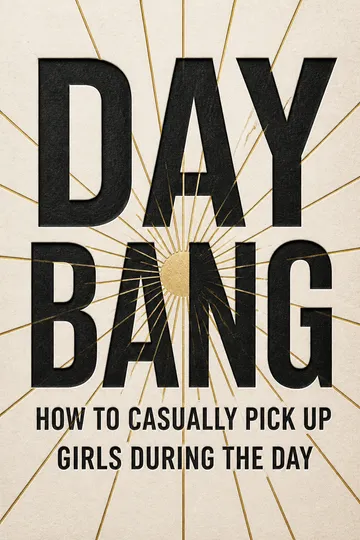
What's "Bang: More Lays in 60 Days" about?
- Author's Journey: The book is a personal account by Roosh V, detailing his transformation from a socially awkward young man to someone skilled in the art of seduction.
- Game Theory: It introduces the concept of "game," which is the skill of attracting women through learned behaviors and strategies.
- Step-by-Step Guide: The book is structured to guide readers through different stages of interaction with women, from initial approach to closing the deal.
- Self-Improvement Focus: It emphasizes self-improvement and confidence-building as key components of success with women.
Why should I read "Bang: More Lays in 60 Days"?
- Practical Advice: The book offers practical, actionable advice for men looking to improve their dating lives.
- Personal Growth: It encourages readers to step out of their comfort zones and develop social skills that can be beneficial beyond dating.
- Unique Perspective: Roosh V provides a candid and sometimes controversial perspective on dating and relationships.
- Comprehensive Approach: It covers a wide range of topics, from internal mindset to specific techniques for different social settings.
What are the key takeaways of "Bang: More Lays in 60 Days"?
- Internal Game: Confidence and mindset are crucial; believing in your worth and capabilities can significantly impact your interactions.
- Approach Techniques: The book provides specific openers and strategies for initiating conversations with women in various settings.
- Persistence and Adaptability: Success often requires persistence and the ability to adapt to different situations and responses.
- Escalation and Closing: It emphasizes the importance of physical escalation and knowing when and how to close the deal.
What is the "Internal Game" concept in "Bang: More Lays in 60 Days"?
- Mindset Matters: Internal game refers to the thoughts and beliefs that influence your behavior and how others perceive you.
- Confidence Building: The book stresses the importance of building confidence through experience and self-improvement.
- Overcoming Limiting Beliefs: It encourages readers to challenge and overcome beliefs that hinder their success with women.
- Foundation for Success: A strong internal game is presented as the foundation for effective external game and interactions.
How does Roosh V suggest approaching women in "Bang: More Lays in 60 Days"?
- Direct and Indirect Openers: The book provides examples of both direct and indirect openers to start conversations.
- Environmental Openers: It suggests using observations about the environment to naturally initiate dialogue.
- Confidence and Timing: Approaches should be confident and timely, without overthinking or waiting for the "perfect moment."
- Adaptability: Being able to adapt your approach based on the woman's response is crucial for success.
What is the "Vibe" in "Bang: More Lays in 60 Days"?
- Positive Energy: The Vibe is about exuding positive energy and a playful nature that attracts women.
- Emotional Control: It involves maintaining emotional control and not letting rejections or setbacks affect your demeanor.
- Interesting Personality: The Vibe includes being interesting and engaging, often through storytelling and humor.
- Non-Neediness: Demonstrating that you are not needy and that you value your time and attention.
What are some key routines mentioned in "Bang: More Lays in 60 Days"?
- Opinion Openers: These are used to engage women by asking for their opinion on a topic, leading to deeper conversation.
- Break-Up Routine: A playful routine where you jokingly "break up" with a woman to create intrigue and humor.
- Strawberry Game: A psychological game that reveals a woman's views on intimacy and passion through metaphorical questions.
- Palm Reading: A routine that involves reading a woman's palm to create physical contact and build rapport.
How does "Bang: More Lays in 60 Days" address rejection?
- Rejection as Learning: The book frames rejection as a necessary step toward success, providing valuable learning experiences.
- Mindset Shift: It encourages adopting a mindset where rejection is seen as the woman's loss, not a personal failure.
- Persistence: Emphasizes the importance of persistence and not letting rejection deter future attempts.
- Non-Personal: Rejection is often not personal, as it can be due to factors beyond your control, such as her mood or circumstances.
What is the "Late Game" strategy in "Bang: More Lays in 60 Days"?
- Physical Escalation: Late game focuses on physical escalation and overcoming resistance to achieve intimacy.
- Persistence: It involves being persistent but respectful, understanding that women may need more encouragement to proceed.
- Creating Comfort: Building a comfortable and safe environment is crucial for moving the interaction forward.
- Handling Resistance: The book provides strategies for handling resistance without being forceful or aggressive.
How does Roosh V suggest handling phone and text communication in "Bang: More Lays in 60 Days"?
- Timing: Contact should be made 2-4 days after meeting, avoiding weekends for initial contact.
- Voicemail Strategy: Leave simple, straightforward voicemails that encourage a callback without over-explaining.
- Text Messaging: Use text for logistical purposes, keeping messages short and to the point to set up dates.
- Response Regulation: Match her response times to avoid appearing too eager or needy.
What are the best quotes from "Bang: More Lays in 60 Days" and what do they mean?
- "Rejection is a beautiful thing." This quote emphasizes the importance of viewing rejection as a learning opportunity rather than a setback.
- "The approach is the most important part of your game." It highlights the critical role of initiating interactions in the dating process.
- "Confidence is believing you're capable and worthy of success." This underscores the necessity of self-belief in achieving dating success.
- "The willingness to walk away, above all other factors, does more to tell a woman of your high value than any amount of money can." It stresses the importance of not being overly attached to outcomes, which can increase perceived value.
What is the "End Game" in "Bang: More Lays in 60 Days"?
- Mastery of Game: End game is when you no longer need to consciously think about your moves or routines.
- Options and Abundance: You have multiple options and are unfazed by ambiguous or absurd female behavior.
- Living the Life: It involves living a life that naturally attracts women without needing to actively pursue them.
- Effortless Success: Success with women becomes more about existing and being yourself than about specific strategies.
Download PDF
Download EPUB
.epub digital book format is ideal for reading ebooks on phones, tablets, and e-readers.








































