


Key Takeaways
Greatness requires both steel and velvet, never one alone
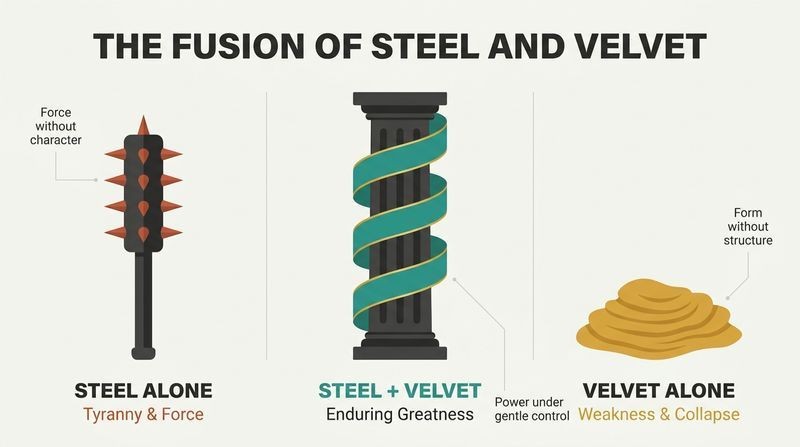
The central thesis borrows from Carl Sandburg's Lincoln. Andelin argues the ideal man blends steel (strength, decisiveness, leadership, courage, physical vigor) with velvet (gentleness, tenderness, attentiveness, humility, refinement). Steel without velvet produces tyrants: Napoleon, Caesar, Hitler commanded confidence and force but lacked character and compassion, so history brands them enemies rather than heroes. Velvet without steel produces forgettable nonentities who never build anything.
Only the fusion endures. He compares steel to a skyscraper's structural frame and velvet to its finishing and landscaping: raw force without beauty startles, beauty without a frame collapses. His exemplars are Jesus, who drove out moneychangers yet welcomed children, and Lincoln, described as "hard as rock and soft as drifting fog." The heavy hands trained to play violin capture the ideal: crushing power governed by gentle control.
The steel-and-velvet duality echoes a recurring theme across psychology and myth. Jung's integration of anima and animus, Robert Bly's later "Iron John" work on wild-yet-tender masculinity, and modern research on "benevolent" versus "hostile" dominance all circle the same insight: raw power reads as threat until tempered by warmth. Studies of leadership credibility (Amy Cuddy's work on warmth-plus-competence) find people trust warmth first, then strength. Where Andelin's framework strains is in tying these universal traits rigidly to biological sex. The blend he prescribes for men is arguably the blend that makes any human, of any gender, both effective and beloved.
A man's failures at home outweigh every triumph outside it
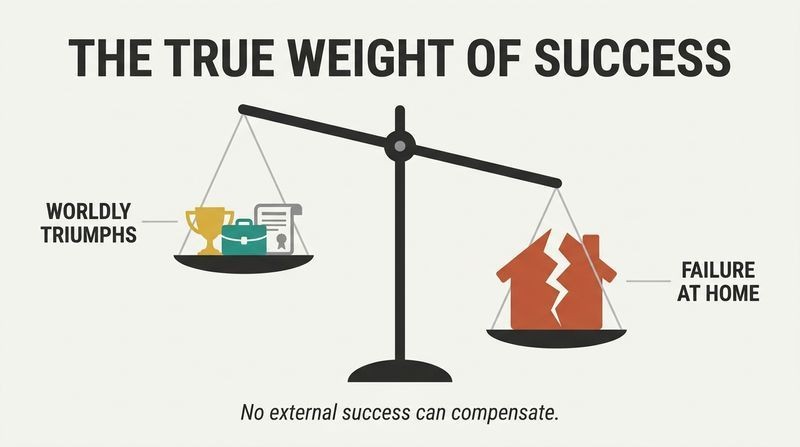
Andelin ranks the family role above all worldly achievement. He defines man's primary calling as guide, protector, and provider, and insists no success in science, industry, or government can atone for a broken marriage or wayward children. The measure of a man, he writes, is the child who runs to greet him at the door and the wife who smiles at his return. He warns of midlife despair: men who chase career acclaim and neglect the home reach fifty feeling they "missed the boat," then chase pleasure or other women to fill the void.
Fulfillment is relocated inward. Real satisfaction comes not from money, honors, or security but from proving one's worth through responsibility met, obstacles overcome, and character refined within the family.
The empirical core here has aged better than the book's gender politics. The Harvard Study of Adult Development, tracking men for over 80 years, found that relationship quality, not career success or wealth, best predicted late-life health and happiness. Andelin intuited this decades early. His prescription that fulfillment flows from responsibility rather than acquisition also anticipates Viktor Frankl's logotherapy and modern self-determination theory, which link meaning to contribution beyond the self. The dated element is the exclusively male breadwinner frame. The durable element is his warning against the hollow trade of trading presence at home for status abroad.
People pressure you precisely to test whether your firmness is real
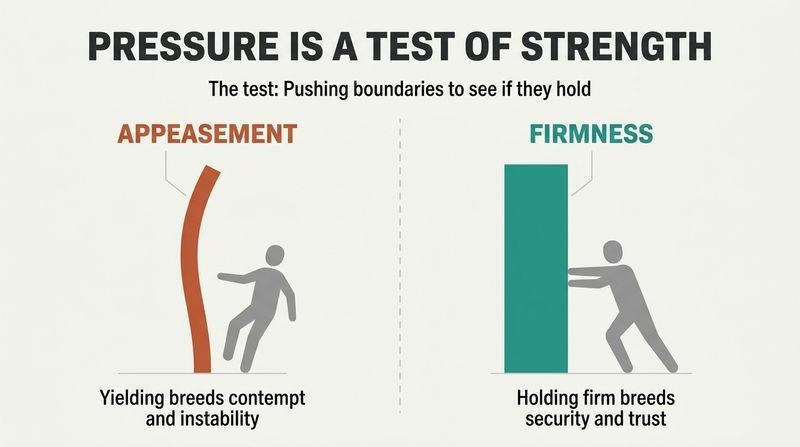
Andelin calls holding to convictions the supreme leadership quality. Women and children, he argues, nag, plead, and dominate not because they want to win but because they are checking whether the strength they need actually exists. He tells of a kind, devoted husband who compromised on every demand, going into debt for things his wife "just had to have." The more he yielded, the more her respect curdled into contempt, until a 25-year marriage collapsed. His gentleness, ironically, destroyed the union.
Firmness read as security. This explains, in his framing, why a woman may cling to a difficult man whose steadiness anchors her while abandoning a pushover who showered her with kindness. In custody disputes, he claims, children choose the firmer parent. Firmness, not appeasement, breeds trust.
Stripped of its gendered packaging, this is sound behavioral science. Developmental psychology's authoritative parenting model (Diana Baumrind) found children thrive under high warmth plus high, consistent boundaries, and flounder under permissive appeasement, exactly Andelin's claim about firmness breeding security. Testing behavior is real: kids escalate to locate the limit. Where the framing curdles is casting an adult wife as someone whose pressure should be managed like a child's testing. Modern relationship research (Gottman) favors mutual influence over unilateral firmness. The transferable kernel: chronic capitulation erodes respect, and boundaries held calmly signal reliability better than either tyranny or surrender.
Volunteer the second mile and the burden stops feeling heavy
The principle comes from Jesus's instruction about Roman conscription. Roman soldiers could force a Jew to carry a pack one mile; Christ told them to carry it two. Andelin extracts a psychological law: the only way to drain the misery out of obligation is an abundant willingness to do more than required. Half-hearted compliance yields nothing but resentment. Full-hearted excess yields satisfaction.
Applied to family duty. The man who grudgingly provides feels chained; the man who throws himself past the minimum, taking pride in solving his own problems rather than leaning on wife, relatives, or the state, discovers the work becomes lighter and even joyful. This pairs with his companion idea, "he who loseth his life shall find it": self-forgetting immersion in duty is the paradoxical route to selfhood.
This reframes a resentment trap that psychologists now understand well. The misery of obligation often comes not from the task but from the felt loss of autonomy. Self-determination theory shows that when people reframe a "have to" as a chosen "want to," motivation and satisfaction rise sharply, precisely Andelin's second-mile mechanism. Going beyond the required amount restores a sense of agency, converting coercion into ownership. Athletes call it discretionary effort; Stoics called it amor fati, loving what you must do anyway. The caution: the same logic can rationalize overwork and martyrdom. Voluntary excess heals; compelled or performative excess quietly breeds the very resentment it claims to cure.
Value people visibly and they rise to the worth you assign
Andelin retells the parable of Johnny Lingo. On a Polynesian island, brides were bargained for in cows; an ordinary woman fetched one, a prized one three or four. One girl had been so belittled by her own father that she stopped combing her hair and hid from mockery. When Johnny came to marry her, he stunned everyone by paying eight cows, publicly declaring her worth. Under that esteem she transformed, unfolding into a poised, radiant woman.
The mechanism is expectation. Treat a woman like a queen, he argues, and she becomes queenly; criticize, ignore, or call her "the old lady," and her spirit withers on the vine. He blames much of women's discontent on men who failed to honor them. Esteem, freely and openly given, calls out the better self.
This is the Pygmalion effect, decades before Rosenthal and Jacobson's 1968 classroom experiment showed that teachers' raised expectations measurably lifted students' actual performance. The self-fulfilling prophecy is well documented: people calibrate toward the worth reflected back at them. Johnny Lingo's public price signal also maps onto modern research on labeling and identity. Where Andelin's version narrows unnecessarily is direction. The effect runs both ways and across every relationship, spouse to spouse, manager to employee, parent to child. The uncomfortable corollary he half-acknowledges: contempt is equally self-fulfilling. Chronic belittling manufactures the very inadequacy the critic then points to as justification.
Love unproven by sacrifice reads as duty, not devotion
Andelin separates two loves the English word blurs. Christian love is loyal concern for another's welfare; romantic love is the tender feeling that draws a couple together. A woman needs both daily, and counts affection sincere only when a man does something costing him effort, money, or convenience to prove it. He cites O. Henry's "Gift of the Magi," where each spouse sells their prized possession to buy the other a gift.
Attentiveness is the everyday proof. Notice her hair and figure, remember her birthday, bring perishable flowers precisely because their short life signals thoughtful sacrifice. He surprised his own wife by remodeling her kitchen while she was away; she wept and called it one of her happiest moments. The refrain of his chapter: little things mean a lot, and indifference wounds more than any insult.
The core claim, that love must be enacted to register, aligns strikingly with Gary Chapman's later "Five Love Languages" and with behavioral economics on costly signaling: a gesture's credibility rises with its cost to the giver, which is exactly why cheap talk persuades no one and perishable flowers do. Attachment research adds that responsiveness, being noticed and attended to, is a stronger predictor of relationship satisfaction than grand romantic peaks. The tension Andelin skirts is reciprocity. He frames attentiveness as a man's unilateral duty toward a somewhat passive recipient, whereas durable bonds run on mutual, bidirectional proof. Still, the anti-complacency warning lands: assuming the marriage certificate speaks for you is how devotion quietly dies.
Self-mastery, not knowledge or desire, is what actually changes you
Andelin names willpower the foundation of character. He observes that most failures to improve are not from lacking knowledge, priorities, desire, or time, but from lacking a trained will. The biblical rich young man knew he should give up his wealth and wanted eternal life, yet couldn't override his attachment. Insight without will accomplishes nothing.
He prescribes deliberate will-training. Do this before crisis strikes, in small reps:
1. Do something unpleasant regularly, like a cold shower, purely to exercise resolve.
2. Deprive yourself of a pleasure you could have.
3. Impose quotas: rise early, finish set tasks on time.
4. Pursue deliberately difficult goals rather than easy ones.
He adds prayer and fasting as spiritual reinforcements, citing Christ's 40-day fast and Alcoholics Anonymous's reliance on a higher power for strength beyond one's own.
Andelin treats the will like a muscle, and modern psychology partly agrees. Roy Baumeister's research framed self-control as a trainable, exercisable resource, and studies found that practicing small disciplines (posture, tidy speech) spilled over into unrelated domains, echoing his cold-shower reps. The deliberate-difficulty prescription anticipates Angela Duckworth's grit and the deep-practice literature. That said, the pure-willpower model has been challenged: the ego-depletion findings failed key replications, and behavior-change science now favors environment design, habit cues, and identity shifts over raw grinding resolve, the very tools James Clear popularized. Andelin's own nod to fasting, prayer, and AA hints he sensed willpower alone is fragile without external structure and community.
Rewarding unequal effort equally destroys the will to strive
Andelin defines justice as rendering exactly what is due, and warns against "equating." He tells of two sisters. One saved for months, skipping treats, to buy a cedar chest. The younger, who had spent everything on candy and ice cream, wanted one too, so the parents bought her an identical chest. This, he argues, was a grave injustice to the frugal daughter and a corrupting lesson to the spendthrift. The same error appears at birthday parties where every child gets a prize regardless of who won.
Equating kills incentive. He extends this into a critique of redistributive politics: take from the striver to give the idle, and something in the striver cries injustice. Children have an acute sense of fairness, so the home is where justice is first learned or first betrayed.
The behavioral evidence supports the incentive concern. Studies of effort and reward show that decoupling outcome from contribution can depress motivation, and even capuchin monkeys reject unequal pay for equal work (Brosnan and de Waal), suggesting fairness intuitions run deep. But Andelin conflates two distinct fairness principles that psychology keeps separate: equity (reward by contribution) and equality (reward by need). Both are legitimate in different contexts. A workplace runs on equity; a family caring for a sick child runs on need. His cedar-chest lesson is sound about earned achievement, yet applying the same logic wholesale to social policy ignores that some inequalities stem from luck and circumstance, not idleness, a nuance he underweights.
You accomplish vastly more when you stop needing the credit
Andelin contrasts two motives for public service. One man serves to win acclaim, status, and fame; the other to benefit mankind. The acclaim-seeker, driven by ego, may lie, cheat, defame rivals, and neglect his own family in pursuit of recognition, destroying society even while claiming to build it. The benefit-seeker steps aside gladly when someone else has a better idea and rejoices when a rival reaches the goal first, because the goal, not the glory, is the point.
His maxim: it is hard to measure the good a person can do if he does not care who gets the credit. He points to Gandhi, an unremarkable, frail young man who moved millions precisely because his motive was pure service rather than self-promotion. The invention of the jet engine or the washing machine had no single glory-hoarding author.
The credit-blindness maxim has become a leadership staple, later echoed in Jim Collins's "Level 5" leaders, who channel ambition into the institution rather than the self and deflect credit outward while absorbing blame. Andelin's psychological read is shrewd: the hunger for acclaim narrows vision and corrupts means, whereas mission-focus expands what's possible through collaboration. Adam Grant's research on "givers" outperforming "takers" over the long run offers empirical backing. One honest complication Andelin himself raises: healthy ambition and the desire for status are natural and even useful drives. The art isn't extinguishing the ego but subordinating it to the work, a harder and more interesting discipline than pure selflessness.
Act confident before you feel it, and the feeling follows
Andelin argues confidence is a manner you assume, not a feeling you wait for. Walk with a firm step, speak steadily, hold your head high, and hide your fears, because a self-assured leader is easy to follow while a visibly doubtful one is not. He notes that battlefield generals and even a widowed mother of six inwardly trembled yet projected assurance, and in doing so summoned hidden ability and steadied those who depended on them.
Confidence is also built, not just faked. He prescribes avoiding failure patterns by concentrating on your genuine talents, building small success spirals where one win fuels the next, allowing in advance for inevitable mistakes, and dismantling inferiority complexes rooted in money, education, or looks by judging people for what they are, not what they have. He warns this "air of confidence" must never curdle into bragging, which betrays the opposite.
The "act as if" prescription is now backed by a substantial literature on embodied cognition and behavioral activation: adopting expansive posture and decisive action can shift internal states, and therapies for anxiety often reverse the wait-to-feel-ready trap by having patients act first. His success-spiral idea maps neatly onto Bandura's self-efficacy theory, where mastery experiences are the strongest source of belief. The sharpest distinction he draws, confidence versus bragging, matches findings that overt self-promotion signals insecurity while quiet assurance signals competence. The caveat modern practice adds: performed confidence works as a bridge to real competence, not a permanent substitute for it. Faking without ever building underneath eventually collapses under scrutiny.
Analysis
Published in 1972 as the male companion to Helen Andelin's bestselling "Fascinating Womanhood," this book is a religiously grounded, unabashedly patriarchal manual arriving precisely as second-wave feminism crested. That timing is the key to reading it. Andelin writes in explicit reaction against "Women's Lib," the 24 million working American wives, and a diagnosed epidemic of weak, "jellyfish" husbands. His theology is Mormon-inflected biblical literalism: man is divinely appointed guide, protector, and provider, woman his subordinate helpmeet. Many specific claims are now indefensible, most glaringly the assertion that working mothers, blurred gender roles, and weak fathers cause homosexuality, and the framing of a wife as someone to be managed like a testing child. A modern reader must quarantine these from the book's transferable psychology.
What survives quarantine is surprisingly durable. The steel-and-velvet synthesis anticipates the warmth-plus-competence research on credibility and the authoritative-parenting model. The relocation of fulfillment from career to relationships matches the Harvard longitudinal findings. The second-mile reframe, the Pygmalion mechanism in Johnny Lingo, costly-signaling in proven love, and credit-blindness in leadership all foreshadow ideas later formalized by academic psychology and popularized by Collins, Grant, and Chapman.
The book's deepest structural flaw is essentialism: it welds universally admirable human traits (gentleness, courage, self-mastery, attentiveness) to biological sex, then treats the resulting division as cosmic law. Strip the essentialism and much of the advice reads as sound counsel for any adult building character and intimacy. The book is thus best approached archaeologically and selectively: a fascinating artifact of a threatened mid-century masculinity, wrapped around a core of practical wisdom about responsibility, discipline, and the enacted rather than merely felt nature of love. Read critically, it instructs; read literally, it distorts.
Review Summary
Man of Steel and Velvet receives mixed reviews, with ratings ranging from 1 to 5 stars. Some readers praise its insights on masculinity, leadership, and relationships, while others criticize it as outdated and sexist. Positive reviews highlight the book's advice on balancing strength and tenderness, its Christian perspective, and its impact on readers' lives. Negative reviews argue that the book promotes rigid gender roles and conservative values. Several readers note that while the book contains valuable ideas, it also includes controversial or dated viewpoints.
People Also Read


Glossary
Steel and Velvet
Ideal blend of strength, gentlenessAndelin's central metaphor, borrowed from Carl Sandburg's description of Lincoln, for the complete man. Steel denotes strength, leadership, decisiveness, courage, character, and physical vigor; velvet denotes gentleness, tenderness, attentiveness, humility, and refinement. Steel alone breeds tyrants, velvet alone breeds nonentities, and only their fusion produces genuine greatness, exemplified for him by Jesus and Abraham Lincoln.
The Second Mile
Voluntary effort beyond requirementA principle drawn from Jesus's teaching that if compelled to carry a load one mile, carry it two. Andelin uses it to argue that grudging, minimum compliance with duty breeds resentment and yields no satisfaction, while abundant, willing effort beyond what is required drains the misery out of obligation and produces genuine fulfillment.
Christian Love versus Romantic Love
Two distinct loves women needAndelin's distinction between two emotions the English word love blurs. Christian love is steadfast, loyal concern for another person's welfare in all circumstances. Romantic love is the tender, affectionate feeling drawing a couple together. He argues a wife needs both daily, and that romantic gestures ring hollow if not underpinned by reliable Christian love.
Johnny Lingo (Eight Cows)
Parable of esteem transforming worthA story Andelin retells of a Polynesian man who paid an unheard-of eight cows for a bride everyone, including her own father, considered worthless. His public declaration of her value transformed the neglected, hiding woman into a poised, radiant one. It illustrates his claim that treating a woman as a queen calls out her better self, an early folk version of the Pygmalion effect.
Equating
Rewarding unequal effort equallyAndelin's term for the injustice of giving people identical rewards regardless of their differing effort or merit, as when parents buy an idle child the same prize a diligent sibling earned through sacrifice. He argues equating destroys incentive and corrupts character, and extends the critique to redistributive social policy that transfers from strivers to the idle.
Self-Mastery
Trained willpower over impulseFor Andelin the foundation of noble character: the disciplined will that lets a person apply knowledge, conquer appetites, and reach goals. He insists most failure stems not from lacking desire or knowledge but from an untrained will, and prescribes building it through deliberate small disciplines, prayer, and fasting rather than waiting for crises to demand it.
FAQ
What is "Man of Steel and Velvet" by Aubrey Andelin about?
- Core theme: The book explores how men can achieve true manhood by balancing strength ("steel") with gentleness ("velvet"), creating a noble and well-rounded character.
- Masculine responsibility: It emphasizes the importance of men’s roles as guides, protectors, and providers in the family and society.
- Complementary roles: Andelin discusses the complementary nature of masculinity and femininity, warning against the blurring of these roles.
- Purpose: The book aims to guide men in developing character traits that benefit themselves, their families, and society as a whole.
Why should I read "Man of Steel and Velvet" by Aubrey Andelin?
- Timeless principles: The book offers enduring guidance on masculinity, character, and leadership, addressing modern challenges of weak or irresponsible manhood.
- Balanced manhood: It provides practical advice for cultivating both strength and gentleness, helping men become respected leaders and compassionate partners.
- Relationship insights: Readers gain a deeper understanding of women’s needs and how to foster loving, secure relationships.
- Personal growth: The book encourages self-mastery, humility, and refinement, which are essential for mental health, happiness, and success.
What are the key takeaways from "Man of Steel and Velvet" by Aubrey Andelin?
- Ideal man concept: True manhood requires a balance of "steel" (strength, decisiveness, courage) and "velvet" (gentleness, humility, tenderness).
- Divine roles: Men are divinely appointed as heads of their families, responsible for guiding, protecting, and providing.
- Social consequences: Weak or absent male leadership leads to family discord, youth rebellion, and societal problems.
- Leadership principles: Effective leadership involves firmness, consultation, consistency, and reliance on God.
- Masculinity development: Masculinity is developed through fulfilling family roles, building society, and cultivating masculine character traits.
How does Aubrey Andelin define the "ideal man" in "Man of Steel and Velvet"?
- Steel qualities: The ideal man demonstrates strength, endurance, decisiveness, and moral courage, willingly assuming responsibility for his family and society.
- Velvet qualities: He also possesses gentleness, kindness, humility, and tenderness, showing respect and affection to women and children.
- Balanced integration: True greatness comes from integrating both steel and velvet, avoiding harshness or weakness.
- Role model: The ideal man is both a firm leader and a loving, approachable presence in the home.
What are the fundamental roles of a man according to "Man of Steel and Velvet" by Aubrey Andelin?
- Guide: Men are the divinely appointed heads of their families, responsible for leadership, decision-making, and setting family policies.
- Protector: Men must protect women and children from physical dangers, evil influences, and emotional hardships.
- Provider: Providing for the family’s necessities and managing finances is a sacred obligation for men.
- Builder of society: Beyond the family, men are called to contribute to the betterment of society through service and leadership.
What are the key "steel" qualities of manhood in "Man of Steel and Velvet" by Aubrey Andelin?
- Self-mastery: Control over passions, desires, and fears is foundational for noble character and personal growth.
- Chastity: Sexual purity is emphasized as essential for personal strength, spiritual health, and societal stability.
- Honesty and dependability: Integrity, reliability, and keeping promises are vital for trustworthiness in family and work.
- Fairness and moral courage: Justice, unselfishness, and the courage to do right despite risks are crucial steel traits.
- Self-dignity: Maintaining composure and self-respect, even under criticism, reflects strong character.
What are the "velvet" qualities in "Man of Steel and Velvet" by Aubrey Andelin, and why are they important?
- Gentleness and tenderness: These qualities soften masculine strength, making a man approachable and emotionally supportive.
- Attentiveness: Thoughtfulness and observance of others’ needs, shown through chivalry and small acts of kindness, are emphasized.
- Youthfulness: A spirit of optimism, humor, and curiosity keeps a man vibrant and engaged with life.
- Humility and refinement: Recognizing limitations, showing respect, and cultivating good manners enhance dignity and relationships.
How does "Man of Steel and Velvet" by Aubrey Andelin advise men to lead women and children effectively?
- Assume leadership firmly: Men must confidently take and maintain their leadership role, teaching family members to honor this order.
- Teach and provide direction: Fathers should instruct and guide their families, consulting them but making final decisions themselves.
- Display confidence and humility: Leaders should inspire trust, listen patiently, and admit mistakes when necessary.
- Protect family rights and feelings: Men should be fair, considerate, and avoid unnecessary harshness, strengthening family bonds.
What guidance does "Man of Steel and Velvet" by Aubrey Andelin offer about men as protectors and providers?
- Divine responsibility: Men are physically and morally equipped to protect women and children, making protection a sacred duty.
- Modern challenges: Protection now includes guarding against sexual assault, corrupting influences, and emotional burdens.
- Chivalry and harmony: Acts of protection foster love and respect, while neglecting this role causes family discord.
- Financial management: Providing for the family and managing finances responsibly is a fundamental aspect of manhood.
How does "Man of Steel and Velvet" by Aubrey Andelin describe masculinity and its development?
- Definition of masculinity: Masculinity is defined by physical strength, masculine character traits, and abilities that distinguish men from women.
- Development methods: Masculinity is developed through fulfilling roles as guide, protector, and provider, as well as building character and skills.
- Avoiding feminine mannerisms: Men are encouraged to set challenging goals and avoid behaviors that blur gender distinctions.
- Benefits of masculinity: True masculinity brings fulfillment to men, admiration from women, and stability to society.
What does Aubrey Andelin say about understanding women in "Man of Steel and Velvet"?
- Distinct needs: Women have unique needs for Christian love (loyalty and concern) and romantic love (tender affection).
- Love’s expression: Love must be cultivated and expressed daily through words, actions, and sacrifice.
- Respect and security: Treating women with respect, allowing for mistakes, and providing security are essential.
- Sexual needs: Women require tenderness and emotional connection in sexual relations, not just physical gratification.
What are the best quotes from "Man of Steel and Velvet" by Aubrey Andelin and what do they mean?
- On manhood: “What a piece of work is man! ... In action how like an angel! In appearance how like a god!” —Shakespeare. This highlights the nobility and potential of man.
- On self-mastery: “He who rules within himself and rules his passions, desires and fears is more than a king.” —Milton. Mastery over oneself is the highest form of power.
- On humility: “We are all ignorant, only on different subjects.” —Abraham Lincoln. True humility means recognizing our limitations and being open to learning.
- On life’s rewards: “Life is a just employer, He gives you what you ask. But once you have set the wages, Why, you must bear the task.” —Jessie B. Rittenhouse. Our efforts determine our rewards in life.
Download PDF
Download EPUB
.epub digital book format is ideal for reading ebooks on phones, tablets, and e-readers.








































