

Key Takeaways
Seduction techniques fail; embodied masculine power is the real magnet
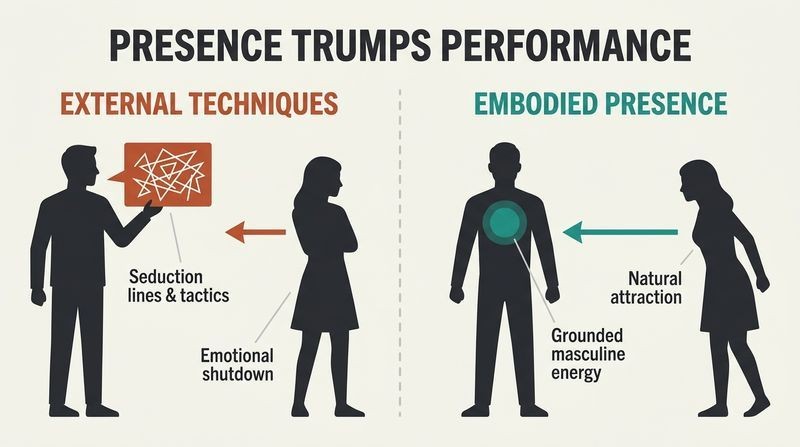
Karen Brody, a woman who coaches men on love, argues that most men approach women in a mode of hot pursuit, trying to conquer, possess, and win, which shuts women down rather than opening them. Her clients arrive asking, in effect, "What do I say to make her want me?" as if women were riddles to solve. She refuses to just hand over lines, comparing it to giving a man a rifle without teaching him to use it.
The premise: most men have raw power they never access, like owning a Ferrari but driving a Volkswagen. The book is not about pacifying women or hiding your desire. It is about a man opening to his own masculine energy first, because only then can he actually love and evoke love in return.
The framing echoes self-determination theory: authenticity and internal locus of control are more attractive than performed strategy. It also anticipates the failure mode of pickup-artist culture, where scripted tactics produce hollow results. What is worth flagging is the heavy gender essentialism running throughout. Brody treats "masculine" and "feminine" as near-fixed polarities rather than culturally shaped and individually variable traits. Readers can extract the durable insight, that self-possession beats neediness, without swallowing the biological determinism whole. The garden metaphor she uses, that a relationship blooms only with genuine emotional and sexual nutrients rather than "roses wrapped in plastic," reframes effort as cultivation instead of transaction.
Her emotional flow needs your steady banks, or it floods

Brody's foundational concept is polarity: masculine and feminine energies attract in proportion to their difference. She likens feminine essence to a river, flowing and unpredictable, and masculine energy to the riverbanks that give it shape. Without banks, the river is not a river; it is a flood.
The practical payoff is that expressing a polar quality tends to animate its opposite in your partner. Gaze deeply and she radiates. Offer clear direction and she softens into receptivity. Give her something solid to throw her passion against and she relaxes. She offers a quiz sorting traits into masculine (directed, focused, steady) and feminine (radiant, receptive, spontaneous), noting that in "depolarized" relationships, where a woman must supply her own masculine energy around a passive man, sexual charge quietly dies.
This mirrors David Deida's teachings and, more loosely, Jung's anima and animus. Esther Perel's work on erotic desire supports a narrower version: desire feeds on otherness, distance, and mystery, which pure sameness erodes. That is a genuine tension with Gottman's finding that lasting marriages rest on friendship and shared power. The reconciliation is that polarity may govern erotic charge while partnership governs stability, and a couple needs both. Brody's model becomes shaky when she implies these energies map cleanly onto biological sex; healthier is to read "masculine" and "feminine" as poles either partner can occupy.
See her three ways: her femininity, her unique beauty, her hidden pain
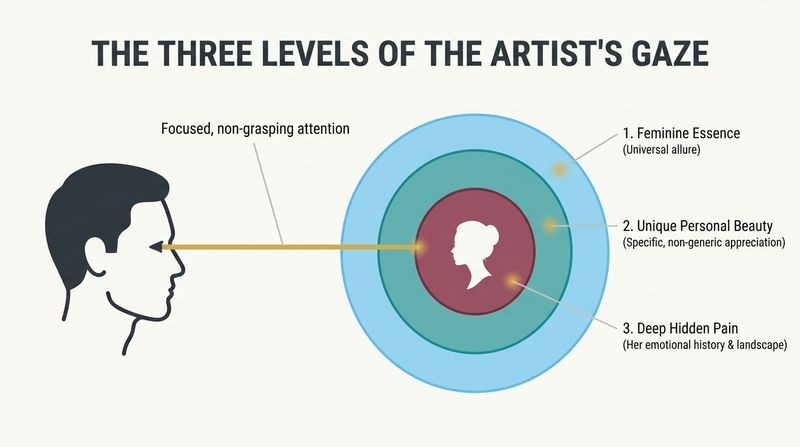
The Artist is the man who truly sees a woman, and Brody says women ache to be seen more than almost anything. She names three levels of seeing:
1. Her feminine essence, the universal quality that sexually attracts you.
2. Her unique physical beauty, seen past your default triggers of breasts, legs, or ass to something specific and personal.
3. Her deep inner beauty, her emotional landscape, history, and pain.
Her story of Chris, a photographer who made her feel naked while fully clothed simply through focused, non-grasping attention, illustrates the power of being witnessed without being grabbed at. The complaint "you don't know me" signals a missing Artist. Her eye-gazing practice, sitting knee to knee and gazing into the left eye, trains this presence.
Simone Weil called attention the rarest and purest form of generosity, and Brody essentially operationalizes that in erotic terms. Psychology backs the mechanism: Kohut's concept of mirroring describes how being accurately reflected by another builds a coherent self, and couples research links "feeling understood" to relationship satisfaction more than agreement does. The move past generic triggers toward specific, personal seeing is genuinely useful advice. The limitation is that Brody places the entire burden of seeing on the man while framing the woman as the one waiting to be perceived, a one-directional model that mature intimacy usually outgrows.
Name exactly what you love, and keep choosing her every day
The Poet gives language to what the Artist sees. Vague praise like "you're beautiful" falls flat; women crave specificity, because a personal detail proves you actually see her. Brody frames three moves: choosing her, celebrating her, and inviting her somewhere in mind, body, and heart.
Choosing is not a one-time event. Her seashell parable, a man who searches beaches for the one perfect shell, captures the fantasy of being deliberately found rather than settled for. She contrasts this with the "wide-net fisherman," the insecure man who casts broadly hoping any woman bites. "You know I love you" is, she argues, a creative failure. Her cautionary tale is Patrick, a wealthy suitor whose flowers and proposals felt hollow because he was in love with being in love, not with the specific woman.
This maps onto the words-of-affirmation love language, but Brody sharpens it: unspecific praise reads as flattery, while precise praise reads as evidence of attention. Signaling theory in economics supports her: a costly, hard-to-fake signal (a detail only a close observer could know) carries more information than a cheap generic one. The insistence that choosing must be renewed rather than banked is psychologically sound, echoing research that relationship security depends on ongoing responsiveness, not past declarations. The risk she underplays is that verbalized celebration can tip into performance, which sensitive partners detect and distrust, precisely the Patrick problem she diagnoses.
Deferring with 'whatever you want' quietly drains her desire
The Director's gift is leadership, which Brody insists women crave even as culture has trained men out of it. When a woman asks "where should we eat?" she is often requesting direction, not delegating research. Answer "wherever you want" and you leave a vacuum she must fill, sliding her into a managing, mothering role. Her blunt line: women do not have sex with their children.
The archetype has three parts: having a personal vision (she even prescribes a solo "vision quest" of removing all distractions until purpose emerges), taking the lead like the man stepping first in a tango, and welcoming her input rather than fearing it. Her portrait of Vlad, a restaurateur who led travel plans with ease yet also knew when to follow, shows leadership as a dance, not domination.
Brody blames the confusion on second-wave feminism conflating equality with sameness, a contested historical read, though her underlying point about decisiveness stands on firmer ground. Decision-fatigue research shows that carrying every choice is genuinely depleting, so a partner who reliably initiates reduces cognitive load. Esther Perel's clinical observation that the caretaker-dependent dynamic is one of the great desire-killers directly supports the "mother/child" warning. The insight generalizes beyond gender: initiative and clear preference are attractive in anyone. The weakness is prescriptive rigidity; some couples thrive on shared or rotating leadership, and framing one partner as permanent captain can mask avoidance dressed as strength.
A mission bigger than her magnetizes; being her everything repels
The Warrior fights for what he believes in. Brody distinguishes him from a soldier who follows orders; the Warrior sets his own rules aligned with an inner sense of right, citing Gandhi, King, and Mandela as warriors whose battlefield was justice. Anger, she says, is only starter fuel; love is what sustains a long fight.
Her key claim is counterintuitive: a masculine man has a "life-mission hole" larger than his "relationship hole," and sacrificing the mission for the woman eventually makes him feel weak and unattractive to her. Her friend Patrick, a bored accountant, became magnetic to her only after a bike accident pushed him to quit and work for animal welfare. She also insists the Warrior protect her, physically and emotionally, teaching "martial scanning," a relaxed alert awareness in public.
This resonates with Viktor Frankl's thesis that meaning, not comfort, organizes a life, and with terror-management research showing purpose buffers existential anxiety. The paradox Brody names, that pursuing your mission (and thus her less) can increase her desire, aligns with attachment findings that a secure partner with independent engagement is more attractive than a fused, needy one. The obvious danger is that "I have a mission" can rationalize neglect or workaholism, and she partly guards against this by insisting love, not ego, must drive the fight. The Gandhi-as-warrior reframing is inspiring but stretches the archetype to cover almost any conviction.
Trust is built one kept promise at a time
The Sage's gift is integrity and unbreakable trust, which Brody calls the frame and carriage of a relationship. Small broken promises leave invisible cracks that eventually make the whole structure unsafe to inhabit. Her clients Jenn and Peter fought about parenting, but the real wound was years of Peter's unkept promises about trips and a bigger house.
She offers a sharp asymmetry: hold yourself to your word as a bond, but do not hold a woman to the same standard, because women live by an "emotional truth" that shifts with feeling. Wanting sushi in the morning and pizza at night is not a broken promise; it is a changing present-moment truth. The Sage also trusts what he knows and acts without guarantees, and does the right thing even when, like Tim biding his time against a predatory boss, the right thing is patient restraint.
Trust as an accumulating, repeated game is exactly how game theory and attachment research model it: reliability across iterations builds a secure base far more than grand gestures. The consistency point is strong and well-supported. The gendered double standard on keeping one's word is the book's most debatable move; framing women as governed by mutable emotional truth while men are governed by binding fact risks infantilizing women and can excuse real unreliability. A fairer reading is that all partners distinguish between casual expressed preferences and genuine commitments, a distinction Brody herself makes usefully in her "conscious communication" restating technique.
A man in a self-made cage can't be trusted; live at your edge
The Dark Knight lives at his edge, the unfamiliar territory where he is fully awake rather than coasting on autopilot. Brody insists a woman senses when a man has caged himself, and that a man who has traded his freedom for security is subtly lying, even to himself, which she felt in her bitter, dutiful stepfather.
Freedom, she argues, is a state of being, not a roster of sexual partners; it comes from recognizing you are always choosing. Sam blamed his abusive wife yet refused to leave, playing victim. Ron issued edicts about weekend trips and got sabotaged, until he communicated that leaving her mattered, and she began supporting his trips. Her surgeon client David admitted he never wanted medicine, and a cascade of events freed him to open a vineyard. When a man is free, she says, a woman is inspired to love freely.
This is existentialism in erotic dress. Sartre's "bad faith," denying one's own freedom by hiding behind circumstance, is precisely Brody's Sam. Csikszentmihalyi's flow research grounds the "edge" idea empirically: peak engagement occurs where challenge meets capacity, not in comfort or overwhelm. Terror-management studies also suggest that consciously facing mortality can intensify aliveness and connection, supporting her "make love as if for the last time" practice. The soft spot is falsifiability: the claim that a woman always feels an uncaged man and that a settled man is "lying" cannot be tested, and it can be weaponized to justify restlessness or abandoning commitments as pseudo-freedom.
Own your sexuality: sex is a gift you give, not a prize you beg for
The Lover fully owns his sexuality instead of being dragged by it, like the dog-park man calmly commanding his off-leash dog versus the anxious owner yanked around on a leash. Ownership has three parts:
1. Recognize your sexual choice; how you respond to her "no" (not collapsing, sulking, or bargaining) determines your power in her eyes.
2. Have a sexual purpose beyond release, as her client Marcello found once he traded the "sex addict" label for a goal of genuine intimacy.
3. Give sex as a gift, taking responsibility for the depth of the encounter while she supplies its energy and flavors.
Depth comes through attunement: listening for her "core rhythm," keeping your eyes open to read her body, and acting on creative impulse rather than repeating a goal-driven routine. Her partner Phil refused obligation sex, which broke her pattern of using sex for reassurance.
The bargaining-for-sex dynamic she diagnoses is corrosive precisely because it imports market logic into intimacy, and behavioral research on transactional framing shows it crowds out intrinsic desire. Her attunement practice parallels responsive parenting and sensory mindfulness: presence and real-time reading beat scripted performance. The division of labor, man owns depth and woman owns energy, is elegant and memorable but essentializing, and plenty of couples reverse or share those roles. The strongest, most portable claim is that non-neediness around rejection preserves attraction, which aligns with findings that perceived desperation lowers desirability while secure self-worth raises it.
Every masculine strength has a dark twin that manipulates instead of loves
Brody pairs each archetype with a shadow, the same energy severed from the heart and used for conquest. The Artist's shadow is Picasso, who saw women deeply then broke them, calling them goddesses or doormats. The Poet's shadow is the man in love with romance itself. The Director's shadow is Lester from the film Casino, who directed a woman purely to feed his needs. The Warrior's shadow is Phillip, a lawyer who coerced desperate clients into sex. The Sage's shadow is Brett, who wielded "honest" declarations of unavailability as a weapon against intimacy. The Dark Knight's shadow is the trained pickup artist. The Lover's shadow is a Tantra teacher who seduced his own students.
Her distinguishing test: boys diminish women to feel powerful, while men empower women, which feeds real power.
This is Jung's shadow made practical, and it doubles as a self-diagnostic checklist: any gift can invert into manipulation once intention curdles. The line between charisma and the dark triad (narcissism, Machiavellianism, psychopathy) is genuinely thin, and personality research confirms these traits are initially attractive precisely because they mimic confidence and decisiveness. Brody's explanation for why women stay with shadow men, that a single "drop of water" of what they crave keeps them stranded in the desert, is a poignant account of intermittent reinforcement, one of the most powerful and addictive behavioral schedules known. The unavoidable difficulty is that her good/shadow distinction rests on intention, which is hard to verify from the outside.
Analysis
Open Her sits within the modern "masculine embodiment" lineage that runs from Robert Bly's Iron John through Jungian archetype work to David Deida, but its distinguishing feature is authorship: a woman writing to men, claiming to report what the feminine actually wants. That vantage is the book's marketing hook and its epistemic vulnerability. Brody generalizes from personal relationships and a coaching practice, presenting anecdote as pattern and pattern as near-law. The result reads as intuitively resonant and clinically unproven in equal measure.
Structurally, the seven archetypes form a developmental ladder: seeing (Artist) and voicing (Poet) precede directing (Director) and fighting (Warrior), which require the trust of the Sage, the aliveness of the Dark Knight, and culminate in the sexual integration of the Lover. Each chapter follows an identical rhythm of memoir, definition, three practices, and a shadow, which aids retention while flattening nuance.
The book's intellectual spine is polarity: attraction as a function of maintained difference. This is defensible and partly supported by Perel's work on desire, but Brody repeatedly slides from "masculine and feminine energies" to "men and women," collapsing a useful metaphor into biological prescription. The most contestable content is the asymmetric ethics of the word (men bound, women fluid) and the recurring framing of women as awaiting activation, which sit uneasily with egalitarian and same-sex relationships the model barely acknowledges.
Yet the durable value is real. Non-neediness around rejection, specific rather than generic appreciation, decisive initiative, purpose beyond the relationship, reliability compounding into trust, freedom as chosen responsibility, and the shadow as self-diagnostic are cross-culturally sound relationship principles dressed in evocative, memorable imagery. Read as poetry and heuristic rather than science, the book equips a certain kind of passive, approval-seeking man with a vocabulary for reclaiming agency, which may be its most honest purpose.
Review Summary
Open Her receives mixed reviews, with many praising its insights into masculine archetypes and their impact on relationships. Readers appreciate the unique female perspective on masculinity and find the book helpful for self-reflection and personal growth. Some criticize it for being subjective, lacking scientific basis, and potentially reinforcing gender stereotypes. Critics also note its repetitive nature and occasional disconnect from reality. Overall, the book is seen as thought-provoking, offering valuable perspectives on masculine-feminine dynamics, though its approach may not resonate with everyone.
People Also Read






Glossary
The Seven Masculine Archetypes
Brody's seven-part model of masculinityBrody's framework of seven masculine energies (Artist, Poet, Director, Warrior, Sage, Dark Knight, Lover) that a man can activate to arouse a woman's love and desire. They are not a checklist for perfection but energies to embody, each meeting a specific feminine longing and each carrying a shadow version that manipulates rather than loves.
The Artist
The man who truly seesThe archetype whose gift is deeply seeing a woman on three levels: her universal feminine essence, her unique physical beauty seen past default triggers, and her deep inner beauty of history and pain. He reflects her back to herself, making her feel known rather than merely looked at.
The Poet
Gives voice to what he seesThe archetype who translates seeing into specific language, choosing a woman deliberately, celebrating her publicly, and inviting her somewhere in body, mind, and heart. Vague praise fails; the Poet names precise details, proving genuine attention rather than generic flattery.
The Director
Leadership and directionThe archetype whose gift is leadership: having a personal vision, taking the initiative like a man stepping first in a tango, and welcoming a woman's input without fearing it. When a man refuses to lead, Brody argues, a woman is forced into a masculine, mothering role that kills sexual charge.
The Warrior
Fights for what he believesThe archetype who aligns his actions with his deepest truth and fights for a cause and for his woman's protection. Distinguished from a soldier who follows orders, the Warrior sets his own rules from love, not anger, and needs a life mission larger than the relationship itself.
The Sage
Integrity and unbreakable trustThe archetype whose gift is trust, built action by action through keeping one's word, trusting one's own knowing enough to act without guarantees, and doing the right thing even when difficult. The Sage treats his word as a binding foundation on which a woman can safely surrender.
The Dark Knight
Lives at his edgeThe archetype who lives at his edge, the unknown territory where he is fully alive rather than coasting, and who befriends danger and death instead of caging himself for security. Freedom, for the Dark Knight, is a chosen state of being, and his uncaged aliveness inspires a woman to love freely.
The Lover
Owns his sexuality with integrityThe archetype who fully owns his sexuality rather than being controlled by it, taking responsibility for his choices, holding a purpose beyond release, and offering sex as a gift. He is responsible for the depth of the sexual encounter and attunes to a woman's body rather than performing a routine.
Feminine essence
A woman's flowing, radiant energyBrody's term for the universal feminine quality, described as flowing, emotional, radiant, receptive, and unpredictable like a river. It is what sexually attracts the masculine, is elicited by masculine steadiness and direction, and is suppressed when a woman must supply her own masculine structure.
Wide-net fisherman
Man who pursues any womanBrody's term for the insecure man who, lacking confidence to pursue the specific woman he wants, casts a broad net hoping any woman will have him. Because the choice is not deliberate, the women he catches sense they were settled for rather than chosen, which erodes their respect and desire.
Core rhythm
Her body's natural pleasure tempoThe distinctive pace at which a woman's body most fully responds during lovemaking, which a man discovers by attuning rather than imposing his own tempo. Brody compares it to matching a dance partner's music; missing it, moving too fast or too slow, keeps her from relaxing into pleasure.
Living at your edge
Engaging your growth frontierThe practice, central to the Dark Knight, of operating at the boundary of the known and safe, where a man is fully awake and self-generating rather than on autopilot. The edge may be professional, personal, or emotional, and living there signals aliveness that a woman finds trustworthy and attractive.
FAQ
What is Open Her: Activate 7 Masculine Powers to Arouse Your Woman's Love & Desire by Karen Brody about?
- Open Her is a relationship guide for men, focusing on how to embody seven masculine archetypes to deeply connect with women and arouse their love and desire.
- The book emphasizes authentic masculine presence, not manipulation, as the key to opening a woman’s heart and sexuality.
- Karen Brody provides practical stories, exercises, and insights to help men understand and express their masculine power in ways that transform relationships.
- The book is designed for intelligent, sensitive men seeking to become better partners and lovers by understanding what women truly desire.
Why should I read Open Her by Karen Brody?
- The book offers a unique feminine perspective, revealing what women genuinely long for in men—qualities often overlooked or misunderstood.
- It provides actionable practices and real-life examples to help men develop confidence, emotional intelligence, and sexual integrity.
- Open Her addresses common relationship frustrations and offers a roadmap from confusion to clarity and power in love.
- Reading it can lead to deeper self-awareness, healing, and more satisfying, passionate connections with women.
What are the key takeaways from Open Her by Karen Brody?
- Masculine power, when expressed with love and respect, can transform relationships and foster authentic intimacy.
- The seven masculine archetypes—The Artist, The Poet, The Director, The Warrior, The Sage, The Dark Knight, and The Lover—each represent essential energies that attract and fulfill women.
- Trust, integrity, and emotional presence are foundational for a woman’s surrender and deep connection.
- Embodying these archetypes is a lifelong journey of self-discovery, growth, and conscious practice.
What are the Seven Masculine Archetypes in Open Her and why are they important?
- The archetypes are The Artist, The Poet, The Director, The Warrior, The Sage, The Dark Knight, and The Lover, each representing a distinct aspect of masculine energy.
- Together, they form a complete masculine presence that women find deeply attractive and trustworthy.
- Each archetype offers unique ways to engage, inspire, and open women emotionally and sexually.
- Mastery of these archetypes creates dynamic polarity, deepens intimacy, and expands a man’s capacity to love and be loved.
How does Open Her by Karen Brody define and use The Artist archetype?
- The Artist archetype is about a man’s ability to truly see and appreciate a woman’s unique beauty and feminine essence.
- This deep seeing goes beyond physical attraction, making a woman feel radiant, alive, and emotionally connected.
- The Artist acts as a loving mirror, reflecting a woman’s true self back to her, which awakens her desire and confidence.
- The healthy Artist empowers women, while the shadow side involves manipulation or exploitation of a woman’s need to be seen.
What is the role of The Poet archetype in Open Her by Karen Brody?
- The Poet gives voice to what he sees and feels, expressing love and appreciation through heartfelt words and actions.
- Specific, authentic compliments and invitations deepen intimacy and trust, making a woman feel uniquely chosen and celebrated.
- The Poet’s language must be genuine and attuned to the woman’s qualities, avoiding generic or manipulative expressions.
- The shadow side is using words to manipulate or feed ego rather than genuinely celebrate the partner.
How does Open Her by Karen Brody describe The Director archetype and masculine leadership?
- The Director embodies confident, skillful leadership in relationships, initiating and setting direction with clarity and care.
- Women desire men who can lead decisively and thoughtfully, providing a stable framework for feminine energy to flow.
- Leadership is a dance of giving and receiving, balancing control with openness to a woman’s input.
- The shadow side includes either controlling behavior or abdication of responsibility, both of which undermine trust and desire.
What does Open Her by Karen Brody teach about The Warrior archetype and its appeal?
- The Warrior is defined by courage, commitment, and a willingness to fight for what matters with integrity and love.
- His power is rooted in passion and alignment with truth, inspiring respect and deep attraction in women.
- The Warrior’s energy brings vitality and purpose to relationships, standing strong even in the face of opposition.
- The shadow side involves abuse of power or manipulation, which may be intoxicating but ultimately destructive.
How does Open Her by Karen Brody explain The Sage archetype and the importance of trust?
- The Sage represents integrity, honesty, and unbreakable trust, creating a safe container for love and surrender.
- Trust is built action by action, through consistent alignment of words and deeds, not by grand gestures alone.
- Keeping promises, both big and small, is crucial for building a woman’s confidence and love.
- Trustworthiness is an internal quality, demonstrated daily, and is the foundation for deep emotional and sexual intimacy.
What is the significance of The Dark Knight archetype in Open Her by Karen Brody?
- The Dark Knight lives at his edge, embracing fear, risk, and the unknown to be fully alive and present.
- This archetype excites women by signaling courage, authenticity, and a willingness to face emotional and creative challenges.
- Living at your edge means not hiding behind safety or routine, but leaning into personal fears and growth opportunities.
- The Dark Knight’s code is to go more deeply in when there is no way out, expanding capacity for intimacy and desire.
How does Open Her by Karen Brody define The Lover archetype and sexual ownership?
- The Lover fully owns his sexuality, taking responsibility for his desires and channeling sexual energy consciously.
- Sex is seen as a gift given in love, creating profound opening and healing for a woman.
- The Lover integrates all other archetypes—seeing, expressing, directing, fighting for, and trusting—to create deep connection and freedom.
- Having a higher purpose for sex, beyond mere pleasure, elevates intimacy and sustains desire in relationships.
What practical exercises and advice does Open Her by Karen Brody offer for embodying the masculine archetypes and overcoming challenges?
- The book provides exercises like “Finding and Flipping the Feminine Essence Switch,” eye gazing, and vision quests to help men embody the archetypes.
- Men are encouraged to articulate specific reasons for choosing their partner, celebrate her, and invite her into new experiences.
- Practices for sexual attunement include listening deeply, responding creatively, and leading with purpose during intimacy.
- The book addresses common obstacles such as resistance from partners, feeling insincere, and relationship limits, advising authenticity, patience, and ongoing self-honoring.
Download PDF
Download EPUB
.epub digital book format is ideal for reading ebooks on phones, tablets, and e-readers.








































