

Key Takeaways
Orgasm is your capacity to receive pleasure, not the climax finale
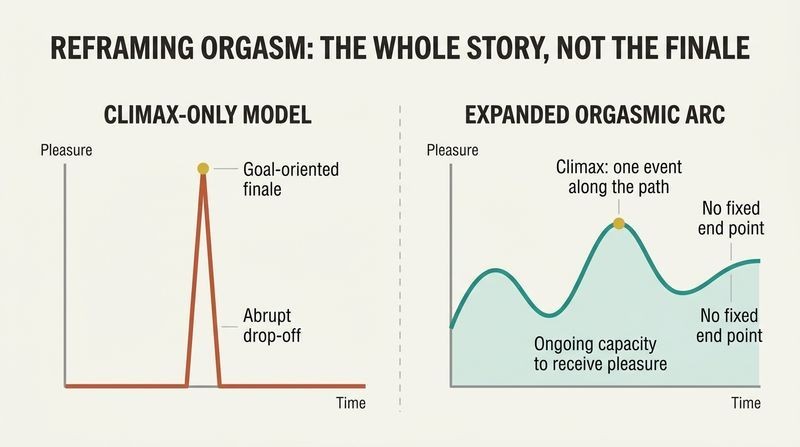
Climax is one line of the book, not the whole story. Daedone's most radical claim is that orgasm and climax are not synonyms. Orgasm is the body's ongoing ability to receive and respond to pleasure, a state that can last minutes or hours, with peaks and valleys, beginning and no fixed end. Climax is just one possible event inside it.
From this redefinition flows her headline assertion: she has never met a woman who is not, right at this moment, orgasmic. Women are not broken or frigid; they have been measured against a male template (penis plus stimulation equals predictable ejaculation) that does not fit female anatomy. Reading sex only for climax, she argues, is like reading only the last sentence of a novel. The real nourishment lives in the whole arc.
The reframe echoes a real gap in sexual science. Research consistently finds an orgasm gap: in heterosexual encounters women climax far less often than men, largely because intercourse alone rarely stimulates the clitoris adequately. Sex educator Emily Nagoski makes a parallel case in Come As You Are, distinguishing arousal from desire and challenging the linear model. Daedone's move is rhetorically powerful and clinically humane, lifting the burden of dysfunction off women. The risk is semantic overreach: by defining orgasm so broadly that everyone always qualifies, the word loses diagnostic precision and can dismiss women who genuinely want climactic release and feel unheard.
Treat sex as art you feel your way through, not a recipe you follow
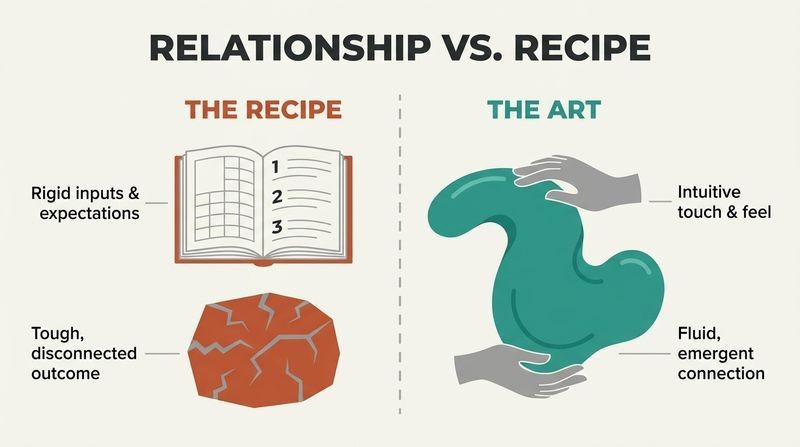
Two kitchens, two philosophies. Daedone learned to cook two ways. In Home Economics class she followed recipes exactly and earned an A. In her Ukrainian grandmother's kitchen she was told she had killed the food with the recipe, then taught to knead dough by feeling how it wanted to be handled. Her grandmother's lesson: anything you get into genuine relationship with reveals its secrets.
Most people approach sex like a science, expecting that the right inputs guarantee a replicable orgasm. When the formula fails, they try harder, follow the recipe more rigidly, and knead the dough into a tough lump. The artist instead asks what this particular encounter wants, stays curious, and lets the result emerge. There is no guaranteed outcome, only the experience of intimate, responsive relationship.
The science-versus-art binary is a useful corrective to formulaic sex manuals, though it is somewhat overdrawn. Expert performance in any domain, from jazz to surgery, blends rigorous technique with intuitive feel; mastery is not the absence of method but its internalization. Daedone herself teaches a precise stroke before granting permission to improvise, which mirrors how musicians drill scales before they riff. The deeper insight aligns with Csikszentmihalyi's flow research: goal-fixation produces self-conscious performance anxiety, while present-moment absorption produces both better experience and, paradoxically, better results. Letting go of the outcome often delivers the outcome.
OM is a 15-minute clitoral stroke with zero goal, not foreplay
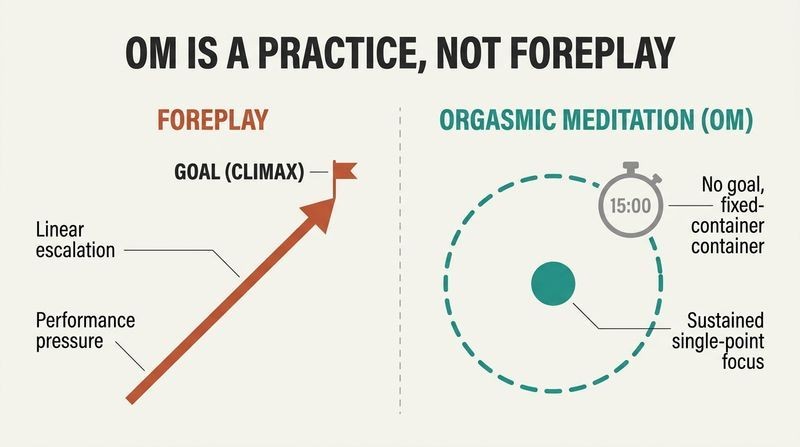
The whole practice fits in a paragraph. Orgasmic Meditation, the book's core technique, is deliberately anticlimactic. The woman undresses from the waist down and lies back with knees butterflied open. Her fully clothed partner sits beside her, looks at and describes her genitals (the Noticing step), then strokes the upper left quadrant of her clitoris with a lubricated fingertip using the lightest possible touch for exactly fifteen minutes.
There is no expectation of climax, no reciprocity, no nudity for the stroker. Both partners place attention on the single point of contact. At the end, the stroker grounds her by pressing firmly on her genitals, then each shares a frame, a verbal snapshot of one vivid sensation. Daedone compares OM to yoga: not a replacement for regular exercise, but a different discipline that quietly transforms everything else.
What is striking is the engineered safety of the container: fixed time, fixed roles, a hard stop. This structure resembles clinical sensate focus therapy developed by Masters and Johnson, which removes performance pressure by banning intercourse and assigning non-goal-directed touch. The 8,000 nerve endings Daedone cites for the clitoris is widely repeated though based on extrapolation rather than direct human count; recent anatomical studies suggest the figure may be higher, around 10,000. Context matters enormously here: OneTaste, the organization built around OM, later faced serious federal allegations regarding labor and coercion. The practice and the institution should be evaluated separately, with consent and autonomy treated as non-negotiable.
Strip down, feel sensation, ask for what you want: the three ingredients
Subtraction beats addition. Daedone reduces Slow Sex to three skills practiced in OM and then exported to ordinary sex. First, strip down: remove expectations, the harder-and-faster reflex, vibrators, fantasy, and even the requirement of romance, leaving only bare sensation. Second, pay attention: sensation is the star, but most people have a broken sensory detector and reach for a sensation, not an emotion (a heavy warmth under the thighs, not just anxiety). Third, ask for what you desire, the single hardest step, especially for women trained to suppress hunger.
She borrows the Slow Food movement's logic. Just as that movement replaced fast, cheap convenience with fresh ingredients and true flavor, Slow Sex replaces porn-style thrashing and accessories with two people, their nerve endings, and one precise stroke.
The naming-sensations-not-emotions distinction is quietly sophisticated and maps onto interoception, the brain's perception of internal bodily states, now a hot topic in affective neuroscience. Low interoceptive awareness correlates with anxiety, alexithymia, and blunted emotional regulation; practices that sharpen body-sensing show measurable benefits. Daedone's claim that vibrators numb the clitoris is more contested. Clinical evidence is mixed; most sex therapists view vibrators as benign or beneficial, with any desensitization typically temporary. Her broader point survives the quibble: a culture that solves every dissatisfaction by adding stimulation trains us out of subtle perception, and the cure is attention, not amplification.
Attention is salt: amplify it instead of cranking up speed and pressure
The flower wilts in ninety seconds. Daedone hands students a flower and asks them to observe it for ninety seconds. Every time, they report it looked more vibrant at the start than the end. Attention wanes; the new painting becomes invisible by day three; the thrilling partner becomes routine in three years. Most people respond to this fading by adding volume, like someone losing their hearing who keeps turning up the television until the windows rattle.
Her counterintuitive fix: when sensation drops, do not add pressure or speed, add attention. Attention is the seasoning that turns bland food gourmet. In OM, when the stroke feels like nothing, both partners look more carefully at what is already there rather than reaching for more intensity. Attention, she insists, is a trainable skill with no ceiling, capable of making interest grow over years instead of decaying.
This is hedonic adaptation, one of the best-documented findings in psychology: humans rapidly return to baseline after both pleasures and hardships, which is why lottery winners and the newly disabled drift back toward prior happiness. Daedone's proposed escape, deepening attention rather than chasing novelty, parallels mindfulness research showing that savoring and present-focus blunt adaptation's erosion. It also echoes Esther Perel's work on long-term desire, where familiarity, not lack of stimulation, dampens eros. The strong claim that attention has no limit is inspirational rather than proven, but the practical heuristic, subtract distraction before adding intensity, is sound and broadly transferable beyond the bedroom.
Behind every woman's complaint hides a desire she was shamed into hiding
Desire paralysis is learned. Daedone argues women receive almost no reinforcement for voicing sexual desire, fearing they will seem needy, promiscuous, or threatening to a fragile male ego. So they short-order their wants, ordering what they think they are allowed, divided in half, and leave resentment to fester in the gap. She recalls being shamed at age five for an odd impulse and learning to redirect all her energy toward being a good girl, stuffing desires into a drawer she later could not unlock.
Her remedy is direct excavation. A complaint, she says, is the moat around the palace of a woman's hunger; behind it sits a tender desire guarded because it has never been treated with dignity. The fix is asking, repeatedly and gently, what she actually wants, until the true desire lands with a felt thunk in the body.
The gendered socialization Daedone describes is well supported. Studies of sexual communication find women report more difficulty asserting preferences, and the good girl script is documented across developmental and feminist psychology. Reframing complaint as encrypted desire is a clever therapeutic move resembling Nonviolent Communication, which teaches that every criticism is a tragically expressed unmet need. One caution: placing the decoding burden on the male partner (ask again and again until she releases it) risks romanticizing a dynamic where women remain indirect and men become mind-readers. A healthier endpoint is women practicing direct request, which Daedone elsewhere champions, rather than perfecting the art of being coaxed.
Women's brains go silent during orgasm, so safety must come first
Safeporting builds the container. Daedone cites brain imaging suggesting that during orgasm a man's brain lights up mostly in pleasure centers, while in a woman several major regions go quiet, especially those governing inhibition, vigilance, and threat-scanning. The implication: a woman cannot fully let go unless she feels safe, because letting go literally means switching off her alarm system.
This is why OM front-loads ritual and predictability. The practice introduces safeporting, the habit of announcing every action before doing it (I am going to touch you now). No surprises except orgasmic ones. The carefully built nest, the fixed fifteen minutes, the supportive pillows, and the grounding press at the end all serve the same function: a woman who knows exactly what is coming and that nothing will be demanded of her can relax into sensation rather than managing the encounter.
The neuroscience traces to Gert Holstege's PET studies, which did show deactivation in the amygdala and prefrontal regions during female orgasm. The findings are real but were small-sample and have been somewhat oversimplified in popular retellings; the safety-as-prerequisite gloss is interpretation layered onto correlation. Still, the practical wisdom is robust and aligns with polyvagal theory, which holds that the nervous system must read cues of safety before it can downshift into the social, receptive state. Predictability reduces cognitive load. Anyone designing intimacy, therapy, or even high-trust teams can borrow the principle: announce intentions, eliminate ambush, and the guarded system finally exhales.
Use Yes/And requests so feedback never bruises a partner's ego
Sugar before the ask. Daedone found that the fear of hurting a partner is the top reason people, especially women, stay silent about what they want in bed. Her solution is a scripted communication style called Yes/And: affirm something that already feels good, then request a shift, never a but. For example, the pressure feels wonderful, and would you move slightly left. The stroker answers requests by simply approving and adjusting, and can offer yes-or-no questions (would you like it firmer) that are easy to answer without leaving the orgasmic state.
Two other communication tools round it out. Speaking sensations means describing felt experience without judgment (a warm current radiating from my chest), which cracks open intimacy by revealing the interior. Sharing frames, done at the close, locks a single vivid moment into memory and bridges body and mind.
Yes/And is lifted straight from improvisational theater, where accepting and building on a partner's offer keeps the scene alive, and refusal kills it. Importing it into sex is genuinely clever. The structure also mirrors validated couples-therapy techniques: Gottman's research shows that softened startup, raising an issue gently rather than with criticism, predicts whether conflict conversations succeed. Replacing but with and is a small linguistic hack with outsized effect, because but deletes everything before it while and preserves both truths. The deeper claim, that learning to ask in the low-stakes OM container transfers to phone calls with your mother and workplace conflict, is plausible and matches how skills generalize through deliberate practice.
What men crave most from a woman is her genuine, unmanufactured approval
The gender chapters reveal a surprising symmetry. Daedone polls workshop men and women separately, then has them teach each other. The men's recurring message stunned the women: a man gauges how well he is doing by the happiness of the woman he is with, and what turns him on is her authentic approval. The woman a man chooses, the men report, is simply the one who is nice to him, who visibly appreciates him, regardless of credentials.
Her companion lessons for men: for a woman everything is connected, so sex is never just sex; women want sex as much as men but not the narrow menu on offer; what a woman truly wants is access to attention, not gifts. And men are simpler and more easily wounded than women assume. They feel the barbs women think slide off, and they communicate on one channel, meaning only what they literally say.
These chapters trade in heterosexual generalizations that will strike some readers as essentialist, and the evidence is anecdotal workshop data, not controlled study. Yet several threads rhyme with broader findings. The notion that men experience worth through a partner's happiness connects to research on male provider identity and to Terrence Real's work on covert male depression and shame. The claim that women routinely underestimate how much barbed comments land matches studies showing men underreport emotional hurt due to socialization. The literal-communication point oversimplifies, but it usefully warns against expecting partners to decode hints. Read as conversation-starters rather than laws, the lists have real utility.
Make desire your compass and say yes to every stroke life deals
The four-month orgasm is really a lifelong one. Daedone's closing promise, learning to have a four-month orgasm, is a teaser for living orgasmically every day. The mechanism is OM as rehearsal: fifteen daily minutes of receptivity, attention, and following desire build habits that are 180 degrees opposed to the striving, controlling default of ordinary life.
Two principles complete the philosophy. First, use desire as a compass. She feared that feeding desire would unleash a hedonistic beast, but discovered that consistently fed desire eventually grows full and calm, like an ecosystem reaching equilibrium rather than a war zone. Second, learn to get off on any stroke. In life as in OM, you cannot choose which strokes (good days, bad days) arrive. Practicing saying yes aloud to every stroke, even the unwanted ones, reveals nourishment in the downstrokes and yields freedom from preference.
Saying yes to every stroke is acceptance reframed as eros, and it converges with Acceptance and Commitment Therapy, which finds that fighting unwanted internal experience amplifies suffering while willing acceptance reduces it. The desire-fills-up-then-quiets observation contradicts the scarcity model of appetite and aligns with research on how indulgence under permission can normalize rather than inflame cravings, as seen in intuitive-eating studies where banned foods lose their grip once allowed. The weakest link is the leap from a structured fifteen-minute genital practice to a generalized life philosophy of effortless flow and synchronicity, which drifts toward magical thinking. Stripped of the metaphysics, the durable core is practical: cultivate present attention, follow authentic wanting, stop resisting what is.
Analysis
Slow Sex sits at the intersection of sexual self-help, contemplative practice, and feminist reclamation. Structurally it is a workshop transcribed: philosophy first (sex as art, orgasm redefined), then a concrete technique (Orgasmic Meditation), troubleshooting, a ten-day program, gendered field notes, and a closing life-philosophy. Its central intellectual move is a single redefinition: divorce orgasm from climax. Everything else cascades from that, including the destigmatizing claim that every woman is already orgasmic and the relocation of sexual attention from male-template performance to female-centered sensation.
The book's genuine contributions are threefold. It applies mindfulness, attention training, present-moment absorption, the felt body, to a domain usually governed by goal-fixation and performance anxiety, paralleling clinical sensate focus and flow research. It provides scripts (safeporting, Yes/And, sharing frames) that lower the activation energy for sexual communication, the documented weak point in most relationships. And it reframes female desire suppression as learned rather than innate, which is therapeutically liberating.
The weaknesses are equally clear. Evidence is largely anecdotal, drawn from testimonials and workshop observation; cited science (the clitoral nerve count, the orgasm brain-deactivation study) is real but oversimplified. The gender essentialism of the his-and-hers chapters will alienate readers outside a heterosexual frame, despite brief nods to same-sex practitioners. The asymmetry of the practice (women receive, men stroke, reciprocity deferred) is defended thoughtfully but remains contestable.
The gravest context the text cannot supply: OneTaste, the organization Daedone founded and promotes throughout, later became the subject of serious federal allegations involving coerced labor and abuse, and Daedone was convicted in 2025. This does not automatically invalidate the somatic insights, mindful attention, present-focused touch, and direct request have independent merit, but it demands that readers separate technique from institution and treat enthusiastic, fully autonomous consent as the precondition for anything in these pages.
Review Summary
Slow Sex by Nicole Daedone receives mixed reviews, with an average rating of 3.77/5. Readers appreciate its focus on mindfulness and deeper connection in sexual relationships. Many find the orgasmic meditation (OM) technique intriguing and potentially transformative. Critics note repetitive content, gender stereotypes, and a lack of scientific backing. Some readers feel the book is gimmicky or oversimplified. Despite these criticisms, many readers recommend the book for couples seeking to improve their intimacy and sexual experiences.
People Also Read







FAQ
1. What is "Slow Sex: The Art and Craft of the Female Orgasm" by Nicole Daedone about?
- Focus on Female Orgasm: The book centers on the philosophy and practice of Slow Sex, with a particular emphasis on the female orgasm and how to access deeper, more nourishing sexual experiences.
- Introduction to Orgasmic Meditation (OM): It introduces Orgasmic Meditation (OM), a partnered practice where a man strokes a woman’s clitoris for 15 minutes, aiming for connection and sensation rather than climax.
- Shift from Goal-Oriented Sex: Daedone challenges the conventional, goal-driven approach to sex, advocating for slowing down, tuning in, and savoring every moment.
- Practical Guide and Program: The book provides a step-by-step, ten-day OM starter program, troubleshooting advice, and exercises to enhance both OM and “regular” sex.
- Broader Life Application: Beyond sex, the book explores how the principles of Slow Sex can lead to greater intimacy, fulfillment, and happiness in all areas of life.
2. Why should I read "Slow Sex: The Art and Craft of the Female Orgasm" by Nicole Daedone?
- For Deeper Intimacy: The book offers a pathway to more meaningful, connected, and satisfying sexual experiences, especially for women who feel unfulfilled by conventional sex.
- Practical, Actionable Techniques: Readers receive clear, step-by-step instructions for Orgasmic Meditation and other Slow Sex practices that can be implemented immediately.
- Reframes Sexuality: Daedone provides a new perspective on sex, focusing on sensation, presence, and communication rather than performance or climax.
- Addresses Common Sexual Issues: The book tackles common problems like lack of desire, difficulty achieving orgasm, and performance anxiety, offering solutions rooted in attention and communication.
- Life-Changing Philosophy: The Slow Sex approach is positioned as a gateway to greater joy, vitality, and connection in all aspects of life, not just the bedroom.
3. What is Orgasmic Meditation (OM) as described in "Slow Sex" by Nicole Daedone?
- Structured Partnered Practice: OM is a 15-minute practice where a (usually male) partner lightly strokes the upper left quadrant of a woman’s clitoris, with both partners fully clothed except the woman from the waist down.
- Focus on Sensation, Not Climax: The goal is not orgasm in the traditional sense, but to feel and share sensation, connection, and presence in the moment.
- Safeporting and Communication: The practice involves clear communication, with the stroker announcing each step and both partners encouraged to share sensations and requests.
- Ritualized Setup: OM includes a specific setup (“nesting”), a noticing phase (describing the genitals), grounding at the end, and sharing “frames” (memorable sensations) after the session.
- Transferable Skills: The skills developed in OM—attention, communication, and sensation—are meant to enhance all forms of sexual and relational intimacy.
4. What are the three key ingredients of Slow Sex according to Nicole Daedone?
- Stripping Down to Essentials: Remove all expectations, techniques, and “extras” (like vibrators, fantasy, or romance scripts) to focus on the raw experience of sensation and connection.
- Paying Attention to Sensation: Cultivate deep, sustained attention to physical sensations in the body, especially during sex, rather than getting lost in thoughts or goals.
- Asking for What You Desire: Practice identifying and voicing your true sexual desires, even if it feels vulnerable or unfamiliar, to foster authentic intimacy and satisfaction.
5. How does "Slow Sex" by Nicole Daedone redefine the concept of orgasm, especially for women?
- Orgasm as Ongoing State: Orgasm is redefined as the body’s ability to receive and respond to pleasure, not just the moment of climax.
- Female Orgasm is Always Present: Daedone asserts that every woman is inherently orgasmic and capable of experiencing pleasure at any moment.
- Climax vs. Orgasm: The book distinguishes between climax (a peak event) and orgasm (a continuous, nuanced experience), encouraging savoring the whole journey.
- Emphasis on Sensation: The focus shifts from achieving a specific outcome to feeling and enjoying every stroke, sensation, and moment of connection.
6. What is the Ten-Day OM Starter Program in "Slow Sex" and how does it work?
- Daily Practice Structure: The program prescribes two 15-minute OM sessions per day, plus journaling, for ten days to build skill and comfort with the practice.
- Focused Exploration: Each day introduces a new focus (e.g., clitoral mapping, speaking sensations, playing with pressure or speed) to deepen understanding and sensation.
- Journaling for Integration: Participants are encouraged to write about their experiences, sensations, and frames to track progress and insights.
- Designed for All Levels: The program is suitable for both beginners and those with more experience, providing a structured, supportive entry into OM.
- Goal of Sustainable Practice: By the end of ten days, couples or individuals are equipped to continue OM as a regular, nourishing part of their lives.
7. What are the main differences between "Slow Sex" and conventional sex, according to Nicole Daedone?
- From Goal to Process: Slow Sex prioritizes feeling every stroke and moment over reaching climax as quickly as possible.
- Attention Over Technique: The focus is on presence, sensation, and communication rather than following scripts, positions, or performance-based techniques.
- Connection vs. Performance: Slow Sex is about authentic connection and mutual enjoyment, not about looking or sounding a certain way.
- Sustainable Turn-On: The approach aims to build and sustain sexual energy, rather than expending it all in a single peak moment.
- Inclusive of All Experiences: There is no “right” or “wrong” outcome—every session is valuable, whether it includes climax or not.
8. What are the most common challenges or questions people have when starting Orgasmic Meditation, and how does "Slow Sex" address them?
- Worry About Climax: Many women fear not climaxing means failure; the book reassures that climax is not the goal and that sensation and connection are the true measures of success.
- Discomfort with Genital Exposure: Women often feel self-conscious about being looked at; Daedone encourages acceptance and healing through non-judgmental observation and communication.
- Difficulty Feeling Sensation: Numbness or lack of sensation is common at first; the book advises patience, practice, and focusing on even the smallest sensations.
- Performance Anxiety for Men: Men may worry about “doing it right”; the book suggests focusing on their own pleasure and sensation, and using communication to guide the stroke.
- Concerns About Reciprocity: Some worry OM is “one-sided”; Daedone explains that both partners benefit, and that male stroking is introduced later for balance.
9. How does "Slow Sex" by Nicole Daedone address communication and asking for what you want during sex?
- Encourages Honest Expression: The book teaches that voicing desires, sensations, and requests is essential for authentic intimacy and satisfaction.
- Yes/And Communication: Partners are taught to affirm what feels good before making a request for change, reducing defensiveness and increasing connection.
- Speaking Sensations: Both partners are encouraged to describe physical sensations in real time, fostering presence and mutual understanding.
- Overcoming Shame and Fear: Daedone addresses the cultural conditioning that makes it hard, especially for women, to ask for what they want, and provides exercises to build this skill.
- Transferable to Life: The communication skills developed in OM are shown to improve relationships and self-advocacy outside the bedroom as well.
10. What are the key takeaways and life lessons from "Slow Sex: The Art and Craft of the Female Orgasm" by Nicole Daedone?
- Sensation is the Gateway: Deep, sustained attention to sensation is the foundation of both sexual and overall fulfillment.
- Orgasm is a State, Not an Event: True orgasm is about ongoing receptivity to pleasure, not just a single peak moment.
- Desire as Compass: Following and voicing your authentic desires leads to greater intimacy, satisfaction, and happiness.
- Letting Go of Recipes: There is no one-size-fits-all formula for sex; the best experiences come from presence, curiosity, and responsiveness.
- Sex as Art, Not Science: The most nourishing sex is creative, intuitive, and relational, rather than mechanical or goal-driven.
11. How can the principles of "Slow Sex" by Nicole Daedone be applied to "regular" sex and everyday life?
- Bring Slow Sex Ingredients: Apply stripping down, attention to sensation, and open communication to all sexual encounters, not just OM.
- Savor the Journey: Focus on enjoying every moment and stroke, rather than rushing to climax or following a script.
- Use Desire as a Guide: Let your authentic wants and needs shape your sexual and relational experiences, both in and out of the bedroom.
- Practice Holding and Presence: Learn to “hold” high sensation and connection, rather than dissipating it quickly, for deeper fulfillment.
- Extend to Life: The skills of attention, communication, and receptivity cultivated in Slow Sex can enhance relationships, creativity, and overall well-being.
12. What are the best quotes from "Slow Sex: The Art and Craft of the Female Orgasm" by Nicole Daedone, and what do they mean?
- “The most important thing you will ever do in this life is to really taste a tomato.” – This metaphor encourages savoring every experience, especially sex, with full attention and presence.
- “Every woman, like every person, is orgasmic at every moment.” – Daedone redefines orgasm as an ever-present capacity for pleasure, not just a rare event.
- “Sex
Download PDF
Download EPUB
.epub digital book format is ideal for reading ebooks on phones, tablets, and e-readers.








































