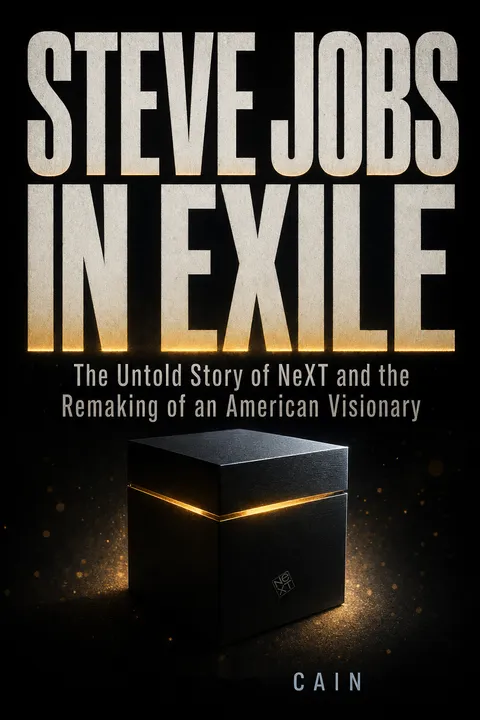
Key Takeaways
1. Exile Forged a New Steve Jobs
I didn’t see it then, but it turned out that getting fired from Apple was the best thing that could have ever happened to me. The heaviness of being successful was replaced by the lightness of being a beginner again, less sure about everything. It freed me to enter one of the most creative periods of my life.
A forced reset. Steve Jobs's ouster from Apple in 1985, after a power struggle with CEO John Sculley, plunged him into a period of deep reflection and uncertainty. Stripped of his operational role and decision-making authority, he felt betrayed and adrift, leading him to consider retirement or even politics. This unexpected exile, however, became a crucible for his personal and professional transformation.
Into the wilderness. Jobs spent the summer of 1985 traveling, reading, and walking, seeking new direction. He explored diverse interests, from Italian architecture to Soviet factories, before realizing his passion still lay in building and creating. This period of detachment from Apple's daily grind allowed him to shed the "heaviness of being successful" and embrace the "lightness of being a beginner again," fostering a renewed sense of creativity.
New beginnings. His renewed focus led him to found NeXT, a company dedicated to building powerful computers for higher education. This venture, born from his exile, would ultimately become the "best thing that could have ever happened" to him, providing the challenging environment necessary for his growth and setting the stage for his eventual, transformative return to Apple.
2. Perfectionism Clashed with Market Realities
Sometimes I go for ‘best’ when I should go for ‘better,’ and end up going nowhere or backwards.
Uncompromising vision. Jobs's relentless pursuit of perfection at NeXT led to groundbreaking designs and advanced technology, but often at the expense of practicality and market timing. He insisted on features like a magnesium alloy case, a silent optical drive, and a custom chip architecture, pushing boundaries but also driving up costs and delaying releases. This uncompromising approach, while yielding beautiful products, made them prohibitively expensive and often late to market.
Missed opportunities. NeXT's computers, like the iconic black Cube, were technologically superior but failed to gain widespread adoption due to their high price and limited software ecosystem. Jobs's desire for "best" meant he often overlooked "better" incremental improvements that could have captured market share. This led to a cycle of missed deadlines, dwindling cash reserves, and a growing "Deep Shit List" of existential threats.
A hard-won lesson. The eventual collapse of NeXT's hardware division in 1993 forced Jobs to confront the limitations of his perfectionism. He later acknowledged that the market had shifted, and his vision for a new hardware company had closed "even before we started the company." This painful lesson in market timing and the balance between innovation and practicality would profoundly influence his strategy upon returning to Apple.
3. Focus: A Double-Edged Superpower
His focus made him different from anyone else I’ve worked with. It was a superpower. But like a lot of strengths, it could be a double-edged sword. He sometimes let his focus get in his own way.
Unwavering intensity. Jobs's singular focus was legendary, allowing him to cut through distractions and reduce complex problems to their essence. Whether scrutinizing the quality of paper in a brochure or the shadow cast by a car fender, he was perpetually searching for insight and excellence. This intensity drove his teams to achieve what seemed impossible, pushing the boundaries of design and technology.
Bruising leadership. However, this superpower often manifested as a "double-edged sword." His exacting standards extended to everyone, from waiters to top executives, and he struggled to show grace. This led to the "hero-shithead rollercoaster" dynamic, where praise could quickly turn into public humiliation, alienating talented individuals and contributing to high turnover at NeXT.
Self-sabotage. At NeXT, Jobs's intense focus sometimes "got in his own way," leading him to obsess over details that hindered the company's viability. His micromanagement of hardware design, his refusal to compromise on features, and his tendency to alienate potential partners demonstrated how his strength, unchecked, could become a significant weakness, impacting both product development and crucial business relationships.
4. NeXT's Software Laid Apple's Future Foundation
Despite these problems, NeXT succeeded in laying the unseen foundation for everything that came after for Apple and for the technology industry at large.
A hidden gem. While NeXT's hardware struggled commercially, its software, NeXTSTEP, was years ahead of its time. Built on a robust Unix kernel and featuring object-oriented programming, it offered unparalleled stability, multitasking capabilities, and a revolutionary development environment. This elegant architecture allowed small teams to build powerful applications with unprecedented speed and flexibility.
Enabling innovation. NeXTSTEP's innovative tools, like Interface Builder and AppKit, allowed developers to create applications by dragging and dropping pre-built components, significantly reducing coding time. This approach was a "breakthrough" for software development, enabling rapid prototyping and iteration. Though initially confined to NeXT's niche hardware, this software prowess would prove invaluable.
Apple's salvation. When Apple acquired NeXT in 1996, it wasn't just buying a struggling computer company; it was acquiring the "unseen foundation" for its future. NeXTSTEP became the core of Mac OS X, providing Apple with the modern operating system it desperately needed. This technology, refined and integrated, would later power the iTunes Store and the iPhone, demonstrating NeXT's profound, albeit indirect, impact on the technology industry.
5. Adversity Sparked Humility and Growth
When [Steve] was desperate, that was his absolute best.
Financial terror. NeXT's constant struggle for survival, marked by dwindling cash reserves and the collapse of its hardware division, pushed Jobs to his limits. He personally guaranteed millions in loans and poured his own fortune into keeping both NeXT and Pixar afloat. This financial terror, coupled with personal betrayals and the public perception of failure, forced a profound internal shift.
A softening leader. In these desperate times, Jobs's infamously hard edges began to soften. Colleagues observed him becoming "humble" and "self-reflective," occasionally admitting "I blew it." This newfound vulnerability was a stark contrast to his earlier, unyielding persona. He started listening more to his team and customers, recognizing that his vision alone wasn't enough.
Learning from mistakes. The NeXT years taught Jobs invaluable lessons about leadership and pragmatism. He learned to delegate, trust his lieutenants, and prioritize survival over purity. This period of intense adversity, though painful, forged a more resilient, empathetic, and effective leader, preparing him for the monumental task of rescuing Apple.
6. Overplaying His Hand Cost Crucial Alliances
Steve had overestimated his power. And he knew it. Years later, he confided in Pixar cofounder Ed Catmull that he had learned a lesson from the collapse of the IBM deal: Never overplay your hand.
Alienating partners. Jobs's early confidence and desire for control led him to repeatedly overplay his hand in negotiations, costing NeXT crucial partnerships. He alienated IBM by rejecting a 125-page contract and refusing to compromise on NeXTSTEP's development, despite IBM's potential to provide massive distribution. Similarly, he snubbed Ross Perot's government connections, dismissing lucrative contracts due to his distrust of federal agencies.
Lost opportunities. These missteps meant NeXT missed out on opportunities that could have scaled its software and hardware. The IBM deal, for instance, could have made NeXTSTEP the industry standard, preempting Microsoft Windows. By prioritizing his personal vision and control over strategic collaboration, Jobs inadvertently limited NeXT's reach and accelerated its financial struggles.
A painful lesson. The collapse of these alliances, particularly the IBM deal, was a "painful education" for Jobs. He learned that even with superior technology, a small company needed leverage and strategic partnerships to compete with industry giants. This lesson in humility and the importance of collaboration would be critical to his later success at Apple, where he would forge alliances he once deemed unthinkable.
7. NeXT Hardware Secretly Birthed the World Wide Web
I could do in a couple of months what would take more like a year on other platforms, because on the NeXT, a lot of it was done for me already.
An unexpected platform. In 1990, Tim Berners-Lee, a scientist at CERN, chose a NeXT Cube to develop his groundbreaking project: the World Wide Web. The Cube's advanced development environment, object-oriented programming, and stable Unix foundation allowed him to rapidly build the first web browser and server software. NeXT's architecture, with its "unnecessary" abstraction layers, proved to be the perfect incubator for this unforeseen revolution.
Accelerated development. Berners-Lee found that NeXT's tools significantly accelerated his work, enabling him to achieve in months what would have taken a year on other systems. The intuitive Interface Builder and Objective-C language allowed him to focus on the core innovation of hyperlinks and network connections, rather than wrestling with low-level code.
A missed opportunity. Despite its pivotal role, NeXT largely overlooked the web's potential. Jobs initially dismissed it as "not his idea" and even killed an internal project for consumer internet connectivity. While Berners-Lee's invention spread from a single black Cube to millions of screens worldwide, NeXT remained focused on enterprise software, missing the chance to capitalize on the very revolution its technology had enabled.
8. Family Life Matured the Visionary
Having Reed has been a different experience for me that I won’t even attempt to put into words. It’s as if I never saw the color green before and all of a sudden when Reed was born, I could see the color green.
A personal turning point. The birth of his son, Reed, in 1991, and his marriage to Laurene Powell, marked a profound shift in Jobs's personal life. These milestones brought a new perspective, softening his hard edges and fostering a deeper sense of empathy. He began to find profound satisfaction in everyday family decisions, like choosing a washing machine, which he once would have dismissed as trivial.
Shifting priorities. Jobs's intense focus, once solely directed at technology, expanded to encompass his family. He started coaching soccer games and remembering birthdays, behaviors uncharacteristic of his earlier self. This personal growth, away from the industry spotlight, allowed him to find meaning beyond professional achievements, recognizing that "life is fleeting."
A more balanced leader. This maturation translated into his professional life. Colleagues observed a more empathetic and less bruising boss, one who would visit sick employees in the hospital and offer support. The "hero-shithead rollercoaster" began to smooth out, as he learned to temper his demands with care, recognizing the human impact of his leadership.
9. The Hero's Journey: A Return Transformed
He came back, he learned from the experiences and mistakes he made.
Exile and struggle. Jobs's journey from Apple's co-founder to its exiled leader, and then to the head of two struggling companies, mirrored a classic hero's journey. He faced immense adversity, financial peril, and personal betrayals, forcing him to confront his flaws and learn from his mistakes. This period of "struggle in the wilderness" was essential for his growth.
Lessons learned. The NeXT years taught Jobs invaluable lessons:
- The importance of pragmatism over uncompromising perfection.
- The necessity of strategic partnerships and not overplaying his hand.
- The value of listening to his team and customers.
- The power of delegation and trusting lieutenants.
- The balance between vision and market reality.
Redemption and return. When Apple acquired NeXT in 1996, Jobs returned not as the "prodigal son" but as a transformed leader. He was still demanding and visionary, but now tempered by failure and humility. This new Steve, forged in the fires of exile, was equipped with the wisdom and skills needed to lead Apple's "renaissance," proving that personal transformation was key to his ultimate success.
10. Total Control: The Ultimate Lesson for Apple
The iPhone proved that the whole stack strategy could work so long as you had the power to enforce it.
The NeXT blueprint. NeXT's struggles reinforced Jobs's conviction that true innovation required controlling the entire product ecosystem—hardware, software, and services. At NeXT, he attempted this with insufficient resources, leading to dependence on suppliers and market forces. This painful experience taught him that "total control requires total capability."
Strategic compromises. Upon his return to Apple, Jobs initially made pragmatic compromises:
- Partnering with Microsoft for software.
- Keeping Intel processors.
- Working within existing supply chains.
These tactical retreats bought him the time and resources to rebuild Apple's foundation.
The iPhone's triumph. A decade of patient institution-building culminated in the iPhone. With this device, Jobs finally achieved his integrated vision: Apple designed the chip architecture, controlled manufacturing through managed partners, dictated terms to cellular carriers, and owned the software, hardware, and services end-to-end. The iPhone demonstrated that the "whole stack strategy" could work, but only when backed by the power and resources to enforce it, a lesson directly learned from NeXT's challenges.
Review Summary
People Also Read





Download PDF
Download EPUB
.epub digital book format is ideal for reading ebooks on phones, tablets, and e-readers.








































