


Key Takeaways
The parent-child bond is the soil; everything else grows from it
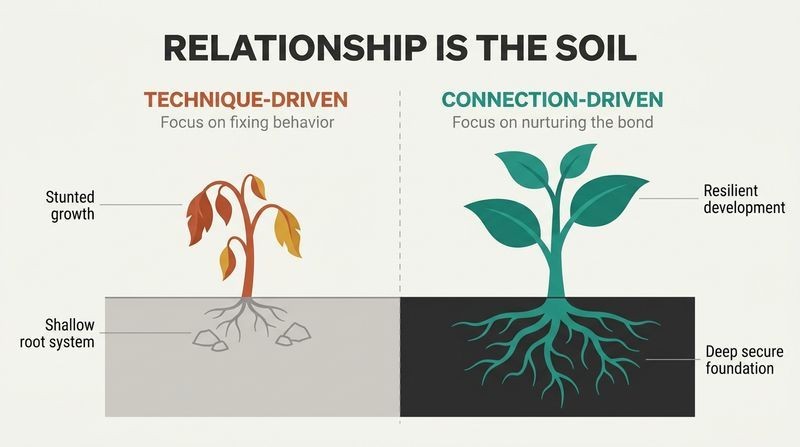
Relationship over technique. Perry, a psychotherapist of twenty years, refuses to write a book about potty-training or sleep hacks. Her thesis: parenting is not a project to optimize or a child to fix, but a lifelong relationship to nurture. If children were plants, the relationship would be the soil that either supports growth or stunts it. Without a bond they can lean on, a child's sense of security collapses.
The long view. She invites parents to stop treating children as chores to feed, wash, and put to bed, and instead see them as people with whom you will have decades of connection. The comedian Michael McIntyre joked that parenting is a daily battle over four basic tasks. Perry argues those battles shrink when the underlying relationship is strong.
What's striking is how Perry inverts the entire self-help parenting genre, which typically sells control and compliance. Her stance echoes attachment research from Bowlby and Ainsworth: the quality of early relational security predicts emotional regulation far more than any parenting method. It also resonates with Carl Rogers's idea that unconditional positive regard, not correction, drives healthy development. The risk is that relationship-centric advice can feel impossibly vague to an exhausted parent at 3 a.m. Perry's genius is grounding the abstraction in the concrete: liking your child, not merely loving them, becomes the measurable north star.
Your anger at your child is often a message from your own childhood
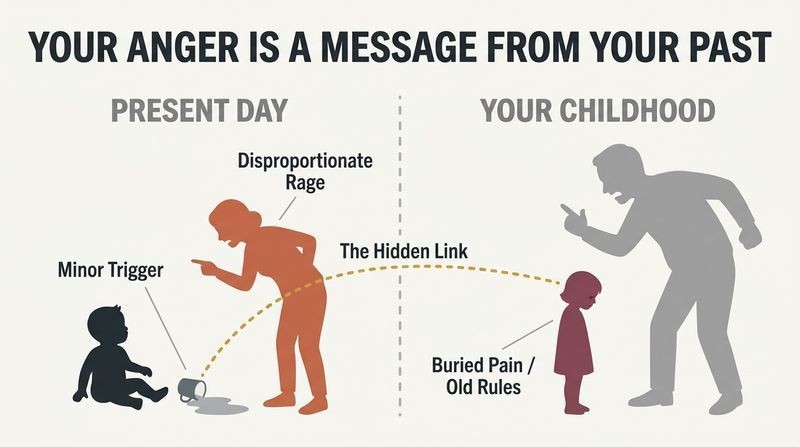
Emotional time warps. Perry argues that when a child triggers disproportionate rage, resentment, or panic, treat it as a warning light: your buttons, not the child's behavior, are the problem. Tay, a seasoned psychotherapist, exploded at her daughter for being stuck on a climbing frame, only to realize her fury belonged to her own mother, who had smothered her and left her feeling incapable. A week later she apologized, and her daughter confessed she had thought her mother simply didn't care.
The chain of inheritance. We unconsciously short-circuit to anger to avoid re-feeling old despair, loneliness, or neediness. Oskar raged when his adopted toddler dropped food, until he remembered his grandfather rapping his knuckles for the same. Naming the buried feeling breaks the transmission to the next generation.
This is psychodynamic theory made practical, and it aligns with Daniel Siegel and Mary Main's finding that a parent's own coherent narrative of their childhood is the single best predictor of secure attachment in their child, more than what actually happened to them. The mechanism Perry describes, projecting unprocessed pain onto a child, is what clinicians call reenactment. A useful caution: not every irritation is a repressed trauma. Sometimes a tired parent is just tired. Perry's framework is most powerful for the charged, recurring reactions that feel bigger than the moment warrants.
Ruptures are inevitable; the repair is what actually raises the child
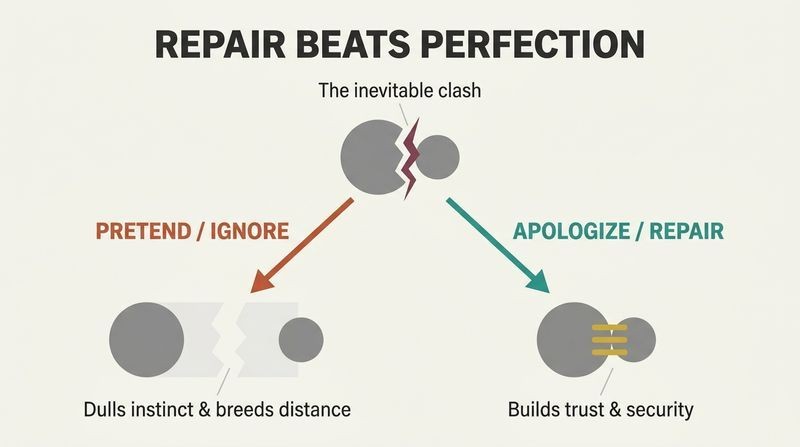
Repair beats perfection. Perry insists no parent stays perfectly attuned. What matters is not the mistake but the mending. When you snap, misjudge, or wound your child, you can change your response, or, if they are old enough, simply apologize. A parent once asked if apologizing undermines authority. Perry's answer: children need parents who are real and authentic, not infallible. Pretending you are never wrong dulls a child's instincts and teaches them to over-adapt to anyone.
Never too late. Even years afterward, acknowledging where you got it wrong can mean a great deal, even to an adult child. Mark, who wanted to desert his son the way his own father deserted him, repaired the rupture by grieving in therapy first, then re-engaging as a present father.
The rupture-and-repair concept comes from developmental research by Ed Tronick, whose Still Face experiments showed babies distressed within three minutes when a parent went unresponsive, yet recovered quickly once warmth returned. This is quietly liberating: the goal is not flawless parenting but a high ratio of repair to rupture. It parallels Gottman's marriage research on repair attempts. One extension worth naming: repair models accountability itself. A child who watches a parent own a mistake learns that being wrong is survivable, a foundation for resilience and for honest relationships later in life.
Contain your child's feelings instead of repressing or drowning in them
Three ways to respond. Perry names three parental reactions to a child's emotion:
1. Repressing: shushing, saying be brave, dismissing the feeling as unimportant.
2. Overreacting: becoming as hysterical as the child, so they feel their emotion has overwhelmed you.
3. Containing: staying alongside the feeling, calm and optimistic, neither denying nor being engulfed.
Why containment matters. Containing means witnessing anger or grief, naming it, and staying steady. The most common cause of adult depression, Perry argues, is not present circumstances but never having learned as a child that bad feelings pass and can be shared. Kate resisted the urge to call her toddler a fusspot; by six he soothed himself, saying give me a hug while my knee stings. We learn to self-soothe only by being soothed.
Containment derives from psychoanalyst Wilfred Bion's theory that a caregiver metabolizes a baby's overwhelming feelings and returns them in digestible form. Modern affective neuroscience supports this: co-regulation literally builds the prefrontal circuits that later enable self-regulation. The parallel to Dr. Tom Boyce's earthquake study is telling: children who drew frightening, honest pictures stayed healthier than those who drew cheery ones, suggesting expression, not suppression, protects even the immune system. The practical wisdom here challenges a culture obsessed with cheering kids up. Sitting with a child's distress feels counterintuitive, even negligent, yet it is precisely what teaches emotional tolerance.
People want to be felt with, not fixed or distracted away
Felt with, not dealt with. When a child says we never go out, the instinct is to argue: but we went to Legoland last week! Perry says acknowledge the feeling instead: you sound bored and fed up. Denying unhappiness digs it a layer deeper. Dave stopped telling his daughter not to fuss about her car seat and instead crouched down, saying it's really hard to see Max in your seat. Her stubbornness dissolved, like steering into a skid to regain control.
Distraction is manipulation. Pointing at a squirrel to divert a crying child is insincere and insults their intelligence. Perry allows distraction only as honest comfort, like stroking a forehead during an injection. Otherwise it teaches children they cannot hold attention on difficult things, discouraging concentration itself.
This maps precisely onto emotion-focused and nonviolent communication research: validation de-escalates, contradiction inflames. It also echoes the counseling maxim that reflective listening outperforms advice-giving. Perry's insight that adults crave the same treatment (imagine a partner responding to your bad day with look, a squirrel) universalizes the lesson elegantly. The provocative claim is her hard line on distraction, a technique many respected parenting guides endorse for toddlers. Perry's distinction is about intent: distraction as sincere comfort versus distraction as a trick to shut feelings down. That nuance saves the argument from purism, though tired parents may reasonably find the standard demanding.
Argue by defining yourself, not attacking the other person
Fact tennis loses. Perry dissects how families fight. In fact tennis, partners lob reasons across the net (it's unhygienic, no it isn't) until someone runs out of ammunition and feels humiliated, not loved. Other losing styles: distraction, martyrdom, and outright persecution. None builds a safe home, and conflict puts children into emergency mode, unable to be curious or learn.
Use I-statements. The repair is to lead with feeling, not blame: I feel fed up coming home to unwashed dishes, not you always leave a mess. When Keith snapped at his son for asking to inherit his leather jacket, the real issue was Keith's fear of aging, hidden behind a fact. John Gottman's Love Lab found couples who ignore each other's small bids for connection split up; a three-in-ten response rate predicted divorce.
The I-statement technique traces to Thomas Gordon's Parent Effectiveness Training, and Gottman's bids research is among the most replicated findings in relationship science. What Perry adds is the systemic point: children are downstream of the parental relationship. A UK survey she cites found 70 percent of teenagers, but only 33 percent of parents, believed parents getting along was crucial to happy children, a striking perception gap. The deeper principle, owning your feelings rather than weaponizing facts, is essentially emotional honesty. It disarms defensiveness because no one can dispute how you feel, only whether your facts are right.
All behaviour is communication; there are no bad kids, only unmet feelings
Convenient versus inconvenient. Perry drops good and bad as labels for behavior, using convenient and inconvenient instead. A tantrum is not manipulation; young children cannot plot malice, they simply are their feelings, lacking words. Behind every outburst is a feeling seeking expression. The job is to decode it, name it, and offer a better channel: you can tell me you're angry, it's easier to hear than screaming.
Four skills to develop. Behaving well requires four capacities that mature at different rates:
1. Tolerating frustration
2. Flexibility
3. Problem-solving
4. Seeing things from another's viewpoint
Children are most brittle just before mastering a new stage. Perry rejects sticker charts and bribes as manipulation that teaches manipulation, favoring a collaborative method: define the problem, find the feeling, validate it, brainstorm solutions together.
This reframes discipline through a lens shared by Ross Greene's Collaborative and Proactive Solutions model, whose motto, kids do well if they can, treats misbehavior as a lagging skill rather than defiance. Neuroscience backs the developmental angle: the prefrontal cortex governing impulse control matures into the mid-twenties. Perry's rejection of reward charts is more contentious; behaviorist research shows token systems can work short-term. But her deeper point, drawn from self-determination theory, is that extrinsic rewards can crowd out intrinsic motivation and the genuine empathy we actually want. Teach the value of people, she argues, not the value of stickers.
You cannot spoil a baby by answering every cry
Coercive cries demand response. A baby's cry is biologically coercive, like a zebra's alarm to the herd, engineered so caregivers cannot ignore it. Perry insists wants and needs are identical for an infant; a baby cannot survive alone. Babies whose cues are consistently met develop what she calls a secure attachment, trusting that companionship is reliable. Skin-to-skin studies show contact babies cried an average of sixty seconds while cot babies cried over eighteen minutes.
Silence is not success. Left to cry, babies eventually dissociate and stop, but cortisol stress levels stay high. Sleep training, Perry argues, does not eliminate the need for you, only the crying out for you, by conditioning the child to give up. She champions sleep nudging instead: incremental steps toward separation, always within the child's comfort baseline, retreating if they become distressed.
This is the book's most polarizing stance, pitting attachment-oriented researchers like Darcia Narvaez against studies (Gradisar, Price) showing graduated extinction causes no measurable long-term harm and improves parental mental health. Perry acknowledges the debate exists but lands firmly on the precautionary side. The cortisol-desynchrony finding she cites (Middlemiss) had a small sample and has been questioned. Still, her reframing of independence is valuable and counterintuitive: security, not enforced separation, breeds autonomy. A child certain you will return separates more readily. Exhausted parents deserve compassion here; Perry's insistence that co-sleeping saves nighttime labor is a pragmatic olive branch.
Set boundaries by describing yourself, not labeling your child
Love plus boundaries. Children need both, not one or the other. A boundary is the line you set before hitting your limit, the point where you lose control and frighten them. Set it calmly and early: I cannot allow you to play with my keys, then remove the keys. The crucial technique is defining yourself rather than the child. Say I'm not comfortable with more television, so I'm switching it off, not you've watched too much, which invites fact tennis.
No empty threats. Follow through every time, so your child learns you mean what you say. Perry warns against inventing worthy reasons (it's your bedtime) when the truth is personal (I want the evening to myself). Faking objectivity teaches children to hide their real feelings behind justifications, poisoning honest communication later.
Defining yourself echoes Virginia Satir and Murray Bowen's family-systems concept of differentiation: stating your own position without controlling others. It is also strikingly aligned with modern radical-honesty and assertiveness training. The counterintuitive move is admitting selfishness (I want peace) rather than dressing it as the child's need. This models emotional transparency and, Perry argues, prevents reason wars. A subtle strength: boundaries framed as self-definition are harder to argue with and less shaming than labels, which children internalize as identity. The one tension is consistency; following through every time demands a reserve of energy that solo or depleted parents may struggle to sustain.
Punishing lies breeds better liars, not honest children
Lying is developmental. All children lie, usually starting around age four when they discover they can hold an alternative reality in mind, a genuine cognitive feat. Perry's daughter's headteacher warned parents bluntly: your child will lie, and your job is not to make a huge deal of it. Children lie to escape trouble, to please, to create private space in adolescence, or to voice an emotional truth (Perry's toddler said her goldfish died when really her mother was grieving an aunt).
The peeping study. Researcher Victoria Talwar tested two West African schools, one gently corrective, one that beat children for misdeeds. In the punitive school, every child lied fast and convincingly. Harsh regimes do not produce honesty; they manufacture skilled, fluent liars while shutting down a child's willingness to confide.
Talwar's research is genuinely robust and widely cited in developmental psychology, and the finding is counterintuitive enough to change behavior. It connects to the broader literature on punishment: fear teaches concealment, not conscience. Perry's point about parental hypocrisy is sharp, too. We instruct children never to lie, then coach them to thank Granny for the ugly scarf, so the real lesson is a sophisticated social calculus about when lying is sanctioned. The developmental reframe (lying as evidence of theory-of-mind, the ability to model what others know) is empowering. It lets parents respond with curiosity about the feeling beneath the lie rather than moral panic.
Catch your inner critic before you hand it down to your kids
The voice we inherit. Perry notes children copy what we do, not what we say, including our self-talk. Her earliest memory is her mother picking faults at the mirror; years later her own teenage daughter caught her doing the same. Elaine's mother could never take a compliment (told her lasagne was delicious, she'd reply no flavour, too much cheese), and passed her not-good-enough vibe to three daughters.
How to defang it. Elaine's method, which Perry endorses:
1. Recognize the critical voice.
2. Refuse to argue with it; treat it like an awkward colleague entitled to their opinion.
3. Expand your comfort zone by doing what it says you can't.
Elaine took up painting despite the voice, focusing on what she enjoyed rather than judging results, and found unexpected confidence in life generally.
This intersects with cognitive-behavioral therapy's cognitive defusion, especially the acceptance-and-commitment idea of noticing thoughts without obeying them. The intergenerational transmission of the harsh inner voice mirrors research on how parental self-criticism predicts child self-criticism. Perry's contribution is motivational: framing self-compassion not as indulgence but as protecting your child. It parallels Kristin Neff's finding that self-compassion outperforms self-esteem for resilience. The practical loop, act against the voice to gather counter-evidence, is behavioral activation in miniature. A modern extension: children now also absorb the ambient self-criticism of social media culture, making a parent's modeled self-acceptance more countercultural, and more valuable, than ever.
Let children lead their own play and separate at their own pace
Play is a child's work. Following Montessori, Perry says never interrupt a concentrating child pushing a toy truck; they are building the capacity to focus and complete tasks. Children need few toys, not many. Barry Schwartz's research showed people were happier choosing from six chocolates than thirty; too much choice paralyzes. The average Western child has over 150 toys and gets 70 more yearly, which overwhelms rather than delights. A plastic lemon bottle beat the fancy dolls' house.
Help, don't rescue. When five-month-old Freya strained for a ping-pong ball, her father encouraged rather than fetching it, letting her master the reach herself. Rescuing a capable child robs them of agency; ignoring a helpless one is neglect. Watch for cues. Mixed-age play teaches more than same-age play, and boredom can seed creativity.
The overload finding aligns with Schwartz's Paradox of Choice and with studies showing fewer toys produce deeper, more sustained play. Perry's help-not-rescue principle is essentially scaffolding, Vygotsky's zone of proximal development, where a caregiver supports just beyond current ability without doing the task. It also anticipates the autonomy-supportive parenting shown to build intrinsic motivation. The mixed-age insight draws on Peter Gray's work on self-directed learning across ages. One caution: the anti-screen, anti-structure stance can read as nostalgic in a digital world. Perry hedges wisely, calling total screen denial its own deprivation, and locating creativity in the unstructured, slightly boring spaces modern childhoods increasingly lack.
Analysis
Philippa Perry's book is best understood as a work of applied psychodynamics disguised as a parenting guide. Its structural cleverness is that it barely discusses children's practical care; instead it turns the lens relentlessly back on the parent. This is the book's boldest and most defensible move. Drawing on attachment theory (Bowlby, Ainsworth), Bion's containment, Winnicott's good-enough mother, and Tronick's rupture-and-repair, Perry synthesizes a coherent thesis: emotional attunement, not technique, is the active ingredient in raising a mentally healthy human, and the chief obstacle is the parent's own unexamined childhood.
What distinguishes the book within a crowded genre is its refusal to sell control. Where most parenting literature promises compliance through routines, charts, and consequences, Perry frames those very tools as manipulation that models manipulation. Her reframes are memorable precisely because they are contrarian: tantrums are communication, clinginess is secure attachment maturing, lying is cognitive achievement, and answering every cry cannot spoil a baby.
The book's limitations are worth naming. Its sleep-training stance overstates thin evidence (the cited cortisol study is small and contested), and the relational ideal it champions presumes a reserve of parental time, energy, and support that many, especially single or impoverished parents, simply lack. Perry acknowledges this but cannot resolve it. The near-total reliance on anonymized clinical anecdotes gives emotional resonance but little statistical ballast; a skeptic could reasonably ask how representative Tay, Mark, and Lucas are.
Yet the core is durable and increasingly validated. The finding that a parent's coherent narrative of their own past predicts their child's security better than the past itself is among the most robust in developmental science, and Perry translates it into actionable self-inquiry. The book's real gift is a mindset: see the child as a person to relate to across a lifetime, expect to fail, and treat repair as the work. That reframe survives its weaker empirical claims and lands as quietly radical.
Review Summary
Readers praise Perry's compassionate approach and practical advice for improving parent-child relationships. Many found the book eye-opening, helping them understand their own childhood experiences and how they impact their parenting. Some critics felt the book placed too much emphasis on intensive parenting and made sweeping generalizations. Overall, most readers found valuable insights to enhance their parenting skills and create stronger bonds with their children.
People Also Read





Glossary
Rupture and repair
Mending relational breaks builds trustThe idea that misunderstandings, hurts, and misattunements are inevitable in any close relationship, and that what matters for a child's wellbeing is not avoiding these ruptures but reliably repairing them, whether by changing your behavior or by apologizing. Perry argues repair can happen years later and still means a great deal, even to an adult child.
Containing
Staying steady with big feelingsA parent's capacity to acknowledge and hold a child's emotions, naming and accepting them, without either dismissing the feeling (repressing) or being overwhelmed by it (overreacting). Borrowed from psychoanalysis, containment teaches a child that difficult feelings are survivable and will pass, building the foundation for later self-soothing and good mental health.
Diaphobia
Fear of genuine two-way dialoguePerry's term for an unconscious resistance to being affected or impacted by another person, especially one's child. A diaphobic parent talks at a child rather than with them, avoids reciprocal give-and-take, and treats the child as someone to direct rather than relate to. It often originates in the parent's own childhood, where their feelings went unacknowledged.
Coercive cry
Biologically irresistible infant alarmAn infant's cry, understood as a survival mechanism that all mammals are wired to respond to, like a herd animal's alarm signal. Because a baby cannot distinguish wants from needs and cannot survive alone, Perry argues the cry demands response, and that ignoring it forces the baby to dissociate while stress hormones remain elevated.
Sleep nudging
Gradual, consent-based separation at nightNeuroscientist Darcia Narvaez's alternative to sleep training. Starting from a child's comfort baseline (for example, nursing to sleep), the parent makes the smallest possible step toward separation, repeats it until it becomes the new baseline, then nudges further, always retreating if the child becomes distressed. It aims for the child to associate bed with comfort rather than loneliness.
Convenient and inconvenient behaviour
Reframing good and bad conductPerry's replacement for the labels good and bad. Since she believes no one is born bad and all behavior is communication, she describes conduct as convenient or inconvenient to others. Inconvenient behavior signals a feeling a child cannot yet express or a developmental skill not yet mastered, calling for decoding rather than punishment.
Regulators and facilitators
Two parenting temperament stylesFrom Joan Raphael-Leff's work. Regulators are more adult-centric and routine-led, believing children feel secure when the same thing happens at the same time daily. Facilitators are more child-centric, prioritizing a predictable response to the baby's cues over a predictable schedule. Perry says neither is superior and roles are fluid; honesty about your own leaning matters most.
Love bombing
Concentrated one-to-one attention resetPsychologist Oliver James's technique for resetting a strained parent-child dynamic. For a set period (a day or weekend) with a clear beginning and end, the child, within reason, decides what to do while the parent showers them with expressed love and attention. It interrupts cycles of negative attention and re-establishes a rhythm of give and take.
Fact tennis
Lobbing reasons to win argumentsPerry's name for a dysfunctional argument style where each person volleys facts and reasons across an imaginary net, aiming to win points rather than understand each other. It leaves the loser feeling humiliated and unloved. The antidote is sharing feelings using I-statements rather than blaming or citing objective-sounding justifications.
Defining yourself, not the child
Set boundaries via I-statementsPerry's core boundary-setting principle: state your own feeling or limit rather than labeling the child. Say I'm not comfortable with more television, so I'm turning it off, not you've watched too much. It models emotional honesty, avoids shaming the child with fixed labels, and gives them nothing to argue against.
FAQ
What's The Book You Wish Your Parents Had Read about?
- Focus on Relationships: The book emphasizes the importance of the parent-child relationship over specific parenting techniques, exploring how upbringing influences parenting styles.
- Healing Past Wounds: It discusses how unresolved childhood issues can affect parenting, encouraging reflection to avoid repeating negative patterns.
- Emotional Awareness: Recognizing and validating feelings in both parents and children is highlighted as crucial for healthy relationships and mental health.
Why should I read The Book You Wish Your Parents Had Read?
- Insightful Perspective: Offers a unique view on parenting that encourages self-reflection and understanding of one's emotional landscape.
- Practical Guidance: Provides exercises and advice to improve parent-child relationships, rooted in psychological principles and real-life examples.
- Long-term Benefits: Aims to help parents create a nurturing environment that benefits children's mental health in the long run.
What are the key takeaways of The Book You Wish Your Parents Had Read?
- Parenting Legacy: Understanding how childhood experiences influence parenting is crucial for reshaping parenting legacies.
- Importance of Feelings: Validating emotions is essential for healthier relationships and better emotional regulation.
- Rupture and Repair: Mistakes in parenting are inevitable, but addressing and repairing them is what truly matters.
How does The Book You Wish Your Parents Had Read address the impact of childhood experiences on parenting?
- Reflecting on the Past: Encourages parents to understand how their childhood shapes their parenting, helping to break negative cycles.
- Emotional Triggers: Discusses how children can trigger unresolved feelings, leading to inappropriate reactions.
- Creating a New Legacy: Empowers parents to adopt healthier behaviors and attitudes for positive outcomes.
What is the concept of "rupture and repair" in The Book You Wish Your Parents Had Read?
- Inevitability of Ruptures: Misunderstandings and conflicts are natural in relationships, including those with children.
- Importance of Repair: Repairing relationships after a rupture strengthens bonds and teaches valuable conflict resolution skills.
- Modeling Behavior: Demonstrating repair teaches children about emotional intelligence and healthy relationships.
How does The Book You Wish Your Parents Had Read define "attachment styles" and their importance?
- Types of Attachment Styles: Outlines secure, insecure/ambivalent, avoidant, and dismissive styles, shaped by early caregiver interactions.
- Secure Attachment: Fosters trust and healthy relationships, leading to positive self-esteem and social skills.
- Impact on Relationships: Understanding attachment styles helps parents foster secure attachments with their children.
What is the concept of diaphobia in The Book You Wish Your Parents Had Read?
- Definition of Diaphobia: Described as a fear of real dialogue, hindering effective communication between parents and children.
- Impact on Relationships: Can lead to insecure attachment styles if parents struggle to respond to emotional needs.
- Overcoming Diaphobia: Encourages recognizing interaction patterns and working towards open communication.
How does The Book You Wish Your Parents Had Read suggest handling tantrums?
- Recognizing Feelings: Advises acknowledging the feelings behind a tantrum rather than just stopping the behavior.
- Staying Calm: Remaining calm helps children feel safe and understood, de-escalating the situation.
- Problem-Solving: Engages in dialogue post-tantrum to help children articulate feelings and find acceptable expressions.
What strategies does The Book You Wish Your Parents Had Read suggest for setting boundaries?
- Define Yourself: Express personal feelings and needs when setting boundaries, avoiding labeling behavior as 'bad'.
- Calm and Firm Approach: Ensures children understand limits without feeling shamed.
- Consistency is Key: Following through with boundaries fosters security and understanding of expectations.
How does The Book You Wish Your Parents Had Read address the importance of play?
- Play as Learning: Emphasizes play as essential for development, creativity, and social skills.
- Encouraging Independence: Allowing children to lead play fosters independence and self-confidence.
- Quality Time: Engaging in play strengthens bonds and provides meaningful interactions.
What role does empathy play in parenting according to The Book You Wish Your Parents Had Read?
- Understanding Feelings: Empathy helps parents validate children's feelings, crucial for emotional development.
- Modeling Empathy: Demonstrates empathy, teaching children social skills and emotional intelligence.
- Repairing Ruptures: Essential in repairing relationships, ensuring both parties feel heard and understood.
What are the best quotes from The Book You Wish Your Parents Had Read and what do they mean?
- “Children do not do what we say; they do what we do.”: Highlights the importance of modeling behavior for children.
- “It is not the rupture that is so important, it is the repair that matters.”: Emphasizes addressing and mending conflicts to maintain strong bonds.
- “If you want your children to have the capacity for happiness, the thing that may get in the way more than many others is your self-critic.”: Suggests fostering a positive self-image in parents for healthier emotional environments.
About the Author
Other books by Philippa Perry


Download PDF
Download EPUB
.epub digital book format is ideal for reading ebooks on phones, tablets, and e-readers.








































