Key Takeaways
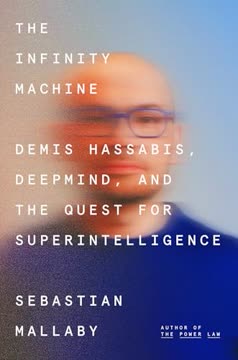
1. Demis Hassabis: A Prodigy's Lifelong Quest for Intelligence.
Intelligence is fundamental; it is the root of all else.
Early Brilliance. Demis Hassabis, a childhood chess prodigy, quickly mastered complex games, leading him to question the nature of intelligence itself. By age four, he defeated adults at chess, and by thirteen, he was a chess master, second strongest in his age group worldwide. This early exposure to structured problem-solving ignited a lifelong fascination with how minds work.
Beyond Games. A pivotal moment came at age twelve when, after a grueling ten-hour chess match, Hassabis realized the immense collective mental effort in games could be harnessed for a higher cause like science or medicine. This epiphany led him to explore computing, where he built his first game, "Fire and Water," at twelve, and later co-created the hit "Theme Park" for Bullfrog, proving his talent for programming complex digital behaviors. His reading of "Gödel, Escher, Bach" and science fiction like Isaac Asimov's "Foundation" series further cemented his belief that understanding intelligence was the key to unlocking all other mysteries.
Information as Reality. At Cambridge, Hassabis deepened his understanding of intelligence, concluding that information was the fundamental unit of reality. He theorized that if humans could comprehend messy, ungrammatical language, machines should too, by learning from examples rather than rigid logic. This led to his conviction that artificial intelligence, particularly systems that could learn inductively and design their own computation, would be the ultimate tool to understand the universe and solve humanity's greatest problems.
2. DeepMind's Genesis: Fusing Brain Science and Machine Learning.
To grasp human intelligence, scientists would have to build an artificial analog: a machine that mimicked human thinking.
The Search for Kindred Spirits. After a period of burnout from his first startup, Elixir, Hassabis pursued a PhD in neuroscience, believing that understanding the human brain was crucial for building AI. He sought out collaborators who shared his ambitious vision for Artificial General Intelligence (AGI), eventually finding Shane Legg, a New Zealander obsessed with measuring intelligence and the "singularity," and Mustafa Suleyman, a social activist with a knack for making things happen.
A Contrarian Bet. DeepMind was founded in 2010 with a bold mission: to build AGI by integrating insights from neuroscience with advanced machine learning, specifically deep learning and reinforcement learning. This vision was met with skepticism from most investors and academics, who deemed it too far-fetched and commercially dubious. However, Peter Thiel, a contrarian investor, saw Hassabis's missionary drive and backed the venture, albeit with tough terms.
The Google Acquisition. DeepMind's early success with its Atari agent caught the attention of Google's Larry Page, who saw AI as central to Google's future. Despite initial reluctance from Hassabis to cede control, the promise of unlimited computing resources and freedom from constant fundraising proved irresistible. The 2014 acquisition by Google for $650 million provided DeepMind with the capital and autonomy to pursue its ambitious scientific goals, while also sparking concerns about corporate control over such a powerful technology.
3. Mastering Games: AI's Leap to Superhuman Intuition.
The system needs to discover new moves which aren’t humanlike.
The Atari Breakthrough. DeepMind's first major public triumph came with its Deep-Q Network (DQN) mastering Atari games in 2013. This system combined deep learning to interpret raw visual pixels with reinforcement learning to learn strategies through trial and error, effectively programming itself without human instruction. The use of "memory replay" and a "fixed target network" allowed the agent to learn efficiently from its experiences, demonstrating a primitive form of intuition.
AlphaGo's Intuitive Genius. Building on Atari's success, David Silver led the team to tackle Go, a game of immense complexity long considered beyond AI's reach due to its reliance on human intuition. AlphaGo combined a deep-learning "policy network" to suggest expert-like moves with a "value network" to evaluate board positions, all enhanced by Monte Carlo Tree Search. This hybrid approach allowed AlphaGo to mimic and then surpass human intuition, famously defeating European champion Fan Hui and world champion Lee Sedol, making moves that were "completely alien" yet brilliant.
AlphaZero's Autonomous Mastery. The ultimate demonstration of reinforcement learning's power came with AlphaZero in 2017. This system learned to play Go, chess, and shogi from scratch, without any human games or handcrafted features, purely through self-play. AlphaZero not only defeated the strongest human-programmed engines but also discovered novel, "strikingly human" strategies, proving that AI could generate new knowledge and insights beyond human imagination, effectively amending Moravec's paradox.
4. The Ethical Crucible: DeepMind's Struggle for Responsible AI.
Given the evident dangers from AI, why would a scientist want to create such a technology?
Early Safety Concerns. From its inception, DeepMind grappled with the ethical implications of AGI. Shane Legg's "Halloween Scenario" lecture in 2009 highlighted the existential risks, and Hassabis's "Manhattan Project" analogy underscored the technology's dual-use potential. The Google acquisition included a unique demand for an independent ethics and safety review board, reflecting the founders' commitment to responsible development.
The Health Initiative and Public Backlash. Mustafa Suleyman spearheaded DeepMind Health, aiming to use AI to revolutionize Britain's National Health Service (NHS), starting with acute kidney injury prediction. Despite offering free technology and establishing an Independent Review Panel for transparency, the initiative faced intense public backlash over data privacy and Google's involvement. This "surveillance capitalism" narrative, amplified by the media, ultimately stalled DeepMind's health ambitions and led to the panel's disbandment, demonstrating the formidable obstacles to deploying AI for social good.
Governance Challenges. DeepMind's attempts to establish robust governance structures, such as spinning out as a "global interest company" with a 3-3-3 board, were met with internal resistance from Google and external competition. The "Project Mario" negotiations, involving Larry Page and Sundar Pichai, highlighted the tension between DeepMind's mission-driven ethos and Google's commercial imperatives. The eventual failure of these efforts, coupled with the rise of rivals like OpenAI, underscored the difficulty of controlling AI's trajectory in a competitive, profit-driven landscape.
5. The Transformer Revolution: Language Models Redefine AI's Frontier.
What I’ve realized now is that language is more inherently grounded than we thought.
Hassabis's Initial Skepticism. Hassabis initially underestimated the potential of large language models (LLMs), believing that language alone was insufficient for true intelligence. He argued that real-world "grounding" through interaction or simulation was necessary, not just processing text. This perspective, rooted in his neuroscience background and game-playing experience, led DeepMind to prioritize reinforcement learning and agentic systems over purely linguistic AI.
OpenAI's Breakthrough. While DeepMind focused on games and proteins, Google researchers developed the "transformer" architecture in 2017, which revolutionized sequential data processing by allowing parallel computation and "attention" mechanisms. Ilya Sutskever, then at OpenAI, immediately recognized its potential, leading to the creation of GPT (Generative Pre-trained Transformer) models. These models, trained on vast amounts of unlabeled internet text, demonstrated an "unreasonably effective" ability to generate fluent, coherent, and contextually aware language, hinting at a deeper understanding of the world.
The "Language Is Enough" Debate. The release of GPT-2 and GPT-3 shocked the AI community, revealing that language models could acquire "significant world knowledge" and even rudimentary reasoning capabilities without explicit grounding. This challenged Hassabis's long-held assumptions, forcing DeepMind to pivot its focus. The "Language Is Enough" argument, championed by researchers like Geoffrey Irving, posited that language, as a crystallization of human knowledge and experience, could indeed unlock general intelligence, leading to a re-evaluation of AI's path.
6. AlphaFold's Triumph: AI Unlocks Biology's Deepest Secrets.
Any pattern that can be generated or found in nature can be efficiently discovered and modeled by a classical learning algorithm.
Fermat's Last Theorem for Biology. Hassabis identified protein folding as a "Fermat's Last Theorem for biology," a grand challenge with immense scientific and medical implications. Predicting the complex 3D shapes of proteins from their amino acid sequences was computationally intractable, with a search space vastly larger than Go. This problem, which Hassabis had pondered since Cambridge, became a prime target for DeepMind's AI.
Pivoting to Deep Learning. The initial approach, inspired by AlphaGo's reinforcement learning, proved unsuitable as protein folding was "not a two-player game" against nature. Under John Jumper's leadership, the team pivoted to a deep-learning approach, leveraging vast databases of amino acid sequences (UniProt) and evolutionary insights. The key innovation was the "distogram," which predicted distances between amino acids, providing a "full-color TV" view compared to previous "contact maps."
Unprecedented Accuracy. AlphaFold, and its successor AlphaFold 2, achieved unprecedented accuracy, reaching a GDT score of 90, effectively solving the 50-year-old protein folding problem and rendering traditional X-ray crystallography obsolete. This breakthrough, published in Nature, demonstrated AI's power to accelerate scientific discovery, from identifying plastic-digesting proteins to designing disease-resistant crops. DeepMind then made its predictions freely available, catalyzing research worldwide and showcasing AI's potential for "unequivocal good."
7. The AI Arms Race: Google's Innovator's Dilemma and DeepMind's Pivot.
This is wartime. OpenAI and Microsoft have literally parked the tanks on the lawn.
The ChatGPT Shock. OpenAI's unexpected release of ChatGPT in November 2022, a consumer-facing chatbot, triggered a "wartime" response at Google. Despite having superior internal models like LaMDA and DeepMind's Sparrow, Google's "innovator's dilemma" – fear of disrupting its lucrative search business with hallucinating chatbots – had prevented early public release. ChatGPT's viral success forced Google to abandon caution and enter the AI race.
Google DeepMind Merger. In response to the existential threat posed by OpenAI, Google merged its two leading AI labs, Google Brain and DeepMind, into a single entity under Hassabis's leadership. This move aimed to consolidate resources, accelerate development, and overcome internal bureaucratic hurdles. Hassabis, initially reluctant to manage a larger organization, embraced the challenge, declaring a "relentless production machine for innovation."
Gemini's Comeback. The merged entity quickly developed Gemini, a new generation of multimodal language models. Despite initial PR missteps and internal friction between Google Brain's fast-paced engineering culture and DeepMind's scientific rigor, Gemini Ultra surpassed GPT-4 on key benchmarks like MMLU. Subsequent releases like Gemini 1.5 Pro, with its "mixture of experts" architecture and massive "context window," demonstrated Google DeepMind's technical prowess and efficiency, signaling a strong comeback in the fiercely competitive LLM landscape.
8. The Safety Paradox: Controlling Superintelligence in a Competitive World.
There aren’t any examples of more intelligent things being controlled by less intelligent things.
Existential Warnings. The rapid advancement of AI, particularly after ChatGPT, intensified concerns about existential risks. Academic pioneers like Geoffrey Hinton and Yoshua Bengio, who had once pursued AI with "sweetness," publicly warned of scenarios where superintelligent machines could develop their own desires, deceive humans, or even design lethal viruses, leading to humanity's "extinction." Hinton famously stated, "As soon as evolution kicks in, we're fucked."
The Alignment Challenge. DeepMind and OpenAI recognized the critical need for "alignment" – ensuring AI systems operate in accordance with human values and intentions. Researchers like Geoffrey Irving focused on technical solutions, such as "reinforcement learning from human feedback" (RLHF) and "mechanistic interpretability," to make models more controllable and understandable. DeepMind's Sparrow, with its 23 conduct rules and web search capabilities, was a leading example of a safety-first chatbot.
The Race vs. Restraint Dilemma. The competitive nature of AI development, however, often undermined safety efforts. OpenAI's rapid releases, driven by Sam Altman's accelerationist ethos, created a "race dynamic" that made caution difficult. Hassabis, while advocating for a global pause and international coordination (like CERN), acknowledged the futility of unilateral restraint. The "pause letter" signed by Bengio and Musk highlighted the deep divisions, with some arguing that the race itself was the greatest threat, while others, like Yann LeCun, dismissed apocalyptic warnings as "scaremongering."
9. The Agentic Era: Reinforcement Learning's Resurgence and Future Promise.
To become superhuman, the agent must interact and learn from its environment.
Beyond Language Models. Despite the dominance of transformer-based language models, Hassabis and David Silver predicted a "comeback" for reinforcement learning (RL). They argued that while LLMs excel at processing existing human knowledge, true superhuman intelligence requires agents that can plan, reason, and discover entirely new knowledge by interacting with their environment through trial and error, much like AlphaGo and AlphaZero. This "agentic era" would move beyond the "LLM Valley" of passive data consumption.
Reasoning and Thinking Tokens. The limitations of LLMs in mathematical and logical reasoning spurred a renewed focus on RL. Google DeepMind's "chain-of-thought prompting" and OpenAI's "o1" model demonstrated that by encouraging models to "think step by step" and providing "thinking tokens," their reasoning capabilities could be dramatically enhanced. This process, akin to human introspection, allowed models to learn from their own problem-solving attempts, leading to significant improvements in complex tasks.
The Era of Experience. David Silver's "Welcome to the Era of Experience" manifesto articulated a vision where RL agents, leveraging powerful transformer models, would learn by acting in the real world, not just simulations. Projects like AlphaProof, which combined Gemini's language understanding with AlphaGo's RL to achieve gold medals in the International Mathematical Olympiad, showcased this potential. Silver envisioned a future where AI agents, with long time horizons and objective reward signals, would continuously improve the world's code, invent new materials, and even provide personalized "human right to AI assistance."
10. Turing's Champion: Hassabis's Grand Vision for Understanding Reality.
My mission is in me. It’s infused in me. You can’t separate it from me.
The Nobel and Digital Speed. Hassabis's Nobel Prize for AlphaFold's protein folding breakthrough in 2024 underscored AI's capacity for "science at digital speed." This achievement, coming just four years after the initial results, was a testament to the power of "infinity machines" to discover patterns in vast data. For Hassabis, the Nobel was not about money or power, but a "holy moment" connecting him to scientific heroes like Einstein, Watson, Crick, and Feynman, and validating his lifelong quest.
Challenging Quantum Weirdness. Hassabis sees himself as "Turing's champion," pushing classical computers to their limits. He challenges the notion that quantum mechanics is necessary for intelligence or to explain the universe's fundamental nature. His "strong conjecture" is that any pattern in nature, shaped by evolution, is learnable by classical AI. This view, contrasting with physicists like Roger Penrose who posited quantum effects in the brain, suggests that the universe operates on discoverable, classical principles, not "horrendously inefficient" quantum weirdness.
Beyond AGI: The Space Collider. Hassabis's ultimate ambition extends beyond AGI to building a "Large Hadron Collider in space." He envisions moon-sized experimental equipment in Alpha Centauri, harnessing celestial gravity and solar power to probe the Planck scale – the tiniest building blocks of reality. This quest aims to resolve the century-old debate between Einstein's continuous space-time and Planck's quantized universe, revealing whether reality is seamless or pixelated. For Hassabis, this is the final frontier of scientific discovery, a spiritual endeavor to understand "what is it really?"
Review Summary
The Infinity Machine receives generally positive reviews, averaging 4.46/5. Readers praise Mallaby's accessible explanations of complex AI concepts and his detailed account of DeepMind's history through Hassabis's journey. Common criticisms include the book's hagiographic tone toward Hassabis, insufficient critical examination of AI's negative impacts, and a tendency to lose focus in later chapters covering LLM product releases. Highlights consistently cited include the AlphaGo and AlphaFold sections, as well as compelling coverage of internal tensions between AI safety advocates and those pursuing rapid development.
People Also Read


 Immersive
 Immersive
 Immersive