
Key Takeaways
You overthink not from a broken mind but from disguised fear
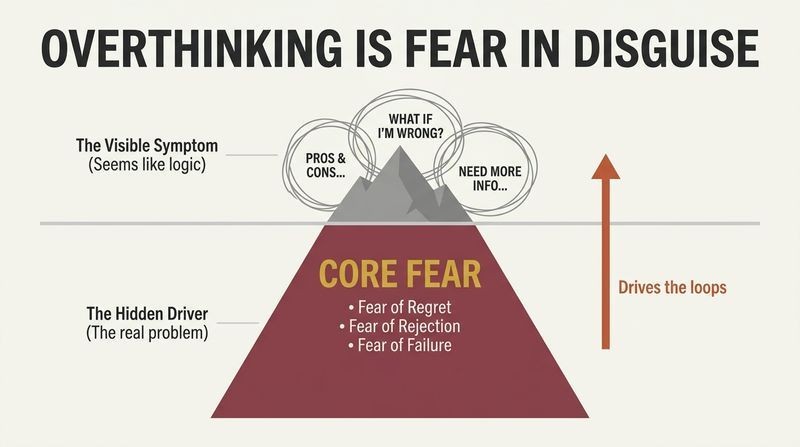
Overthinking is fear wearing a costume. Nguyen argues that endless mental looping is never really about logic. If decisions were purely rational, you would list pros and cons and move on. Instead, decisions act as mirrors: they reflect who you think you are and who you dread being. The real question underneath "Which path?" is "What will this say about me if I'm wrong? Will I still be loved, respected, safe?"
All overthinking traces to a handful of fears: failure, regret, disappointing others, or being exposed as not enough. The spiraling mind isn't malfunctioning. It's running mental simulations to grasp for control over pain, loss, and how others see you. Recognizing fear as the root lets you stop battling a thousand thoughts and address the single emotion driving them.
This reframe aligns with cognitive science on rumination, which research links less to problem-solving and more to threat appraisal in the amygdala. What's useful is Nguyen's move from content to source: instead of interrogating each anxious thought, name the emotion generating them. This resembles the therapeutic technique of "affect labeling," where UCLA studies by Matthew Lieberman show that simply naming a feeling reduces its neural intensity. One caution: not all overthinking is fear. Some is genuine complexity, incomplete information, or high-stakes tradeoffs. Collapsing every deliberation into "fear in disguise" risks pathologizing careful thinking, which sometimes deserves the time it takes.
Whatever you focus on when deciding, you feed and grow
Attention is oxygen for fear. Nguyen retells the Cherokee parable of two wolves, fear and hope, fighting inside every person. The grandson asks which wins. The grandfather answers: the one you feed. Resistance counts as feeding, because struggling against fear is still attention, and attention is fuel. Fear dies not through combat but through withdrawal of focus.
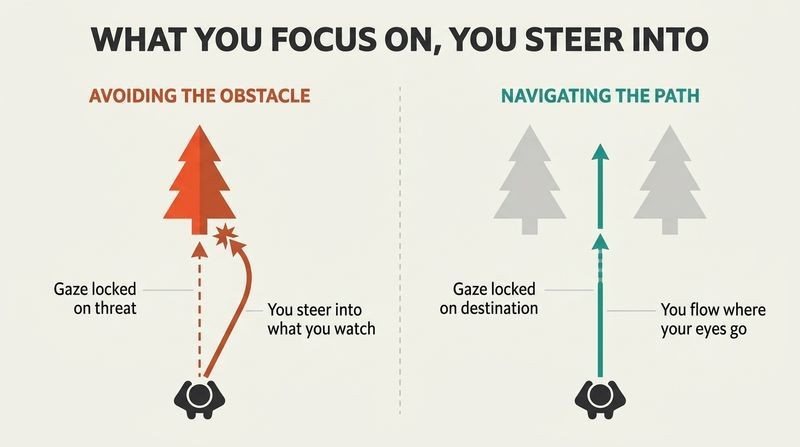
Look where you want to go. Ski instructors teach beginners to stare at the open path, not the trees, because fixating on an obstacle steers you into it. Decisions work identically. Deciding to avoid the worst case pulls you toward it. Confirmation bias compounds this: expect failure and your mind hunts for evidence of it. The fix isn't stripping out emotion (you would lose hope and desire too) but shifting focus toward what you want to create.
The skiing metaphor mirrors "target fixation," a documented phenomenon among motorcyclists and pilots who crash into the very hazard they stare at. Nguyen's claim that attention shapes reality echoes both Buddhist psychology and modern findings on selective attention, such as the famous invisible-gorilla experiment showing we literally fail to see what we aren't primed for. The weaker link is the leap from "focus shapes perception" to "focus attracts outcomes," which drifts toward law-of-attraction territory. A tighter framing: focus doesn't magnetize events, but it governs which options you notice and pursue, which is powerful enough without metaphysics.
Your best life decisions came from intuition, not spreadsheets
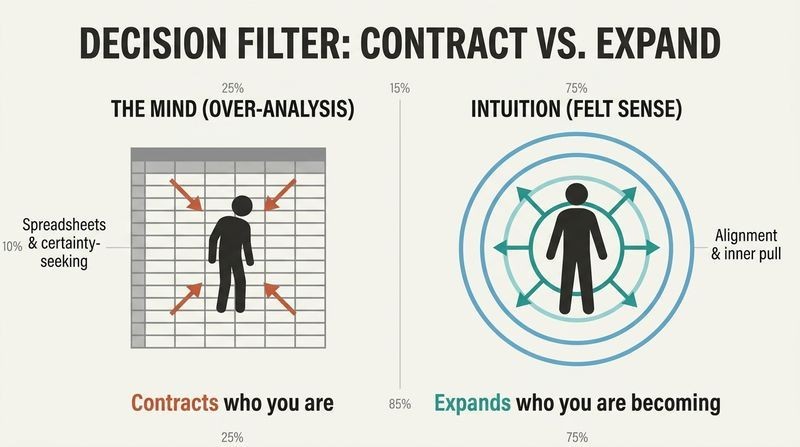
Recall your most transformative choice. Moving cities, leaving a relationship, starting a business, writing a book. Nguyen bets it wasn't the safest or most socially approved option, and it didn't come from the part of you obsessed with certainty and risk minimization. It came from a felt sense of alignment, a pull toward something larger.
The mind thinks, but intuition knows. Nguyen's single decision filter: will this contract who you are, or expand who you're becoming? Gathering information matters, but only up to the point where it adds clarity. Past that threshold, more research breeds confusion and doubt rather than confidence. The tell is simple: when additional analysis stops increasing certainty and starts deepening the fog, stop consulting your mind and trust what you already sense.
Nguyen's intuition-over-analysis stance finds real support in Antonio Damasio's somatic marker hypothesis, where patients with damage to emotional brain regions could reason flawlessly yet became paralyzed by trivial decisions. Gerd Gigerenzer's research on "fast and frugal" heuristics likewise shows gut judgments often outperform elaborate models in uncertain domains. Yet intuition is unreliable in low-validity environments lacking quick feedback, as Daniel Kahneman warns. Intuition earns trust where you have deep experience (relationships, values, taste) but misleads in unfamiliar statistical terrain. The honest synthesis: use analysis to inform, intuition to decide, and know which domain you're standing in.
No decision is purely good or bad until the story finishes
The wise farmer sees what neighbors miss. In the ancient Chinese parable Nguyen retells, a farmer's horse runs away ("bad luck!"), then returns with wild stallions ("good luck!"), then his son breaks his leg taming one ("tragedy!"), then war spares the injured son from a deadly draft. To every verdict the farmer answers only: "Maybe. We'll see."
Events are neutral until we label them. A volcanic eruption destroys, then enriches soil into the most fertile land on earth. Tragedy or necessity? The event doesn't decide; we do. Every "good" decision carried hidden costs, and every "bad" one likely forced growth. Since you never control outcomes fully, your real power lies in your response. How you feel about a choice depends far less on what happened than on the meaning you assign it.
The farmer story is a staple of Taoist thought and reappears in Stoicism, where Epictetus distinguishes what is "up to us" (judgments) from what isn't (events). Nguyen's neutrality claim connects to Viktor Frankl's insight from the concentration camps: the last human freedom is choosing one's attitude. The honest tension is that radical outcome-agnosticism can slide into denial. Some decisions genuinely are worse (drunk driving, betraying trust), and "maybe, we'll see" shouldn't dissolve accountability. Nguyen guards this with a boundary: when you're not acting from harm, there are no wrong decisions. That caveat keeps the philosophy from becoming an excuse.
Chasing everyone's approval quietly erases the self you're deciding for
More voices, quieter inner signal. Nguyen observes that we seek advice less for clarity than for reassurance, secretly hoping someone else decides so a bad result becomes their fault. But each borrowed opinion pulls you further from your own knowing. Most advice reflects the giver's fears and regrets, not your future. They tell you what they would do, which they cannot know is right for you.
Guilt is not proof of wrongdoing. When your choice disappoints someone who benefited from your self-sacrifice, guilt is often just old conditioning echoing. People who love you conditionally want you to choose them over yourself; people who love you unconditionally want you to come alive. The real question isn't "What if they're upset?" but "What matters more, my peace or their approval?" Their reaction is theirs; your integrity is yours.
This maps onto family-systems theory, where Murray Bowen's concept of "differentiation of self" describes the capacity to stay connected to others without dissolving into their expectations. Research on people-pleasing links chronic self-abandonment to anxiety, resentment, and burnout. Nguyen's distinction between support and validation is genuinely useful. One nuance worth adding: sometimes disapproval signals real information (a trusted mentor spotting a blind spot), not just conditioning. The skill is discerning between guilt that guards your growth and guilt that guards someone's convenience. Nguyen's test (does this person want my happiness or my compliance?) is a sharp filter, but it works best applied slowly, not defensively.
Judge choices by alignment and growth, not right versus wrong
Replace the wrong question. Instead of "What's the right choice?" Nguyen offers "What kind of life do I want to create with this choice?" He calls the answer an actualized decision: one made from self-trust, alignment, presence, and love rather than fear, pressure, or the hunger for approval. It borrows from Maslow's self-actualization, the peak of the needs hierarchy where actions reflect your truest self.
Use SAGE as a compass, not a checklist. Four dimensions:
1. Serenity: which choice gives the deepest long-term peace?
2. Alignment: which fits who you want to become?
3. Growth: which expands you most?
4. Emotion: which is driven by love and abundance rather than fear?
Your body registers the answer. Fear-based choices bring tightening; aligned ones bring a softening, a sense of coming home, even amid uncertainty.
SAGE is a values-based decision heuristic, and it resonates with Acceptance and Commitment Therapy, which coaches people to act on chosen values rather than on transient emotional relief. The bodily-signal component (tightening versus softening) has empirical grounding in interoception research, where awareness of internal states correlates with better intuitive decision-making. The framework's limitation is measurement: "which expands me most" is hard to assess before the fact and easy to rationalize after. Growth and comfort can also point the same direction. Still, as a reflective prompt that shifts attention from outcome-anxiety to identity and values, SAGE offers a genuinely different lens than the usual pro-con ledger.
Run overthinking through TRUST: breathe, name, uncover, shift, act
A five-step exit from the spiral. Nguyen's TRUST framework operationalizes his philosophy:
1. Take five deep breaths (try inhaling four seconds, exhaling eight) to activate the parasympathetic nervous system.
2. Reveal the root decision, stated in one plain sentence stripped of outcomes ("Stay in this job or leave?").
3. Uncover the fear and its cost: what you dread it means about you, and what listening to that fear has already stolen.
4. Shift from fear to intuition: if all doubt vanished, which SAGE-aligned option would you choose?
5. Take the smallest possible action, so small it feels silly not to (update the resume, write one sentence).
The goal isn't the right answer. It's to remember what you already know beneath the noise, then start moving. Motion dissolves paralysis: once you act, you're no longer stuck.
TRUST cleverly bookends emotional regulation (breathing) with behavioral activation (tiny action), the two most evidence-backed elements. The exhale-longer-than-inhale technique genuinely triggers vagal tone and lowers arousal, confirmed in respiratory physiology studies. The "smallest possible action" mirrors BJ Fogg's Tiny Habits and behavioral activation therapy for depression, where movement precedes motivation rather than following it. The framework's most contestable step is number four, treating fear-free preference as the truest answer. Sometimes fear encodes legitimate risk that shouldn't be edited out. But as a circuit-breaker for the specific problem of paralysis-by-analysis, TRUST is well-sequenced: calm the body, shrink the problem, then take one step.
Rebuild self-trust through tiny, low-stakes decision experiments
Wisdom comes from experience, not understanding. Nguyen closes with playful micro-challenges that train the nervous system to meet choice with clarity instead of dread. Examples:
1. Flip a coin, and before looking, notice which result you're hoping for. Your reaction reveals what you already wanted.
2. Order the first dish that speaks to you, no scanning or optimizing.
3. Make one 80% decision without chasing the final 20% of certainty.
4. Choose without research: no reviews, no ratings, no asking around.
5. Take a fifteen-minute walk with no destination, following whatever path calls.
Self-trust is built, not found. Each small act of honoring a preference, voicing a need, or saying a guilt-free no reinforces that your well-being matters. You become someone you can count on through repetition in tiny, safe moments, not through one heroic leap.
This experiential emphasis is the book's most practically sound move. Self-trust, like any belief about oneself, is updated by behavioral evidence, not affirmations, which is why the exercises resemble exposure therapy: repeated small doses of a feared action (choosing, disappointing someone, being uncertain) that recalibrate the threat response. The coin-flip trick is a well-known projective technique that surfaces preferences the analytical mind suppresses. The 80% rule echoes Jeff Bezos's principle that most decisions should be made with about 70% of the information you wish you had. What elevates this section is its recognition that insight without embodiment fades; behavior is the mechanism by which philosophy becomes character.
Analysis
Joseph Nguyen writes in the lineage of his earlier work on thought and suffering, and this book applies that lens to a narrow, universal pain point: decision paralysis. It is a hybrid of philosophy and workbook, roughly 19,000 words split between a short conceptual argument and an extensive set of journaling prompts and micro-experiments. The core thesis is elegant and defensible: overthinking is fear misidentified as logic, and the cure is not better analysis but a shift from outcome-control to self-trust. The intellectual architecture rests on three moves. First, relocating the problem from cognition to emotion (you can't out-think a fear). Second, reframing outcomes as inherently neutral, which transfers power from uncontrollable results to controllable responses, a distinctly Stoic and Taoist inheritance. Third, offering two mnemonics (SAGE for evaluating choices, TRUST for executing them) that make the philosophy portable.
The book's strengths are its emotional precision and its behavioral finale. The micro-experiments are its most original contribution, treating self-trust as a trainable muscle rather than a mindset to adopt. This grounds otherwise abstract advice in exposure-style practice.
Its vulnerabilities are twofold. The recurring claim that fear signals you're "on the verge of something right" is inspiring but epistemically loose; fear also signals genuine danger, and the book offers thin guidance on telling the two apart beyond "not acting from harm." Similarly, elevating intuition over analysis works in high-experience, values-laden domains but misleads in unfamiliar, feedback-poor ones, a distinction Kahneman and Gigerenzer have mapped carefully. Nguyen's language occasionally drifts toward manifestation metaphysics ("attention is the architect of your reality") that overstates a sound psychological point.
As a targeted intervention for chronic overthinkers and people-pleasers, the book delivers real value. It is less a decision-theory text than a permission slip backed by practice, and for its intended reader, that is precisely the medicine.
People Also Read


Download PDF
Download EPUB
.epub digital book format is ideal for reading ebooks on phones, tablets, and e-readers.








































