

Key Takeaways
Attraction runs on projected strength, and kindness alone repels
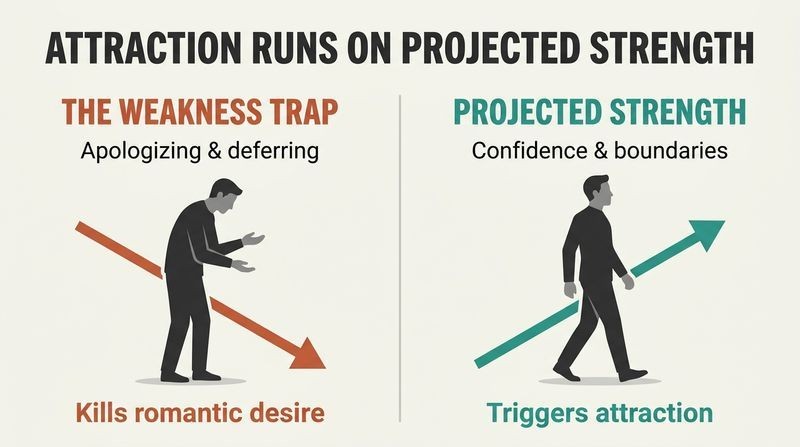
The book's central claim: women are not won by being sweet, chivalrous, or endlessly accommodating. Canwell argues that what he calls Nice Guy syndrome, the belief that supportiveness earns romantic access, actually kills desire. His illustrative pattern: a man lingers, hesitates, apologizes, and defers, and the woman quietly loses interest.
Strength versus weakness is the master lens. In his coffee-shop case study, a naturally better-looking but nervous, poorly dressed man is dismissed, while a balder man with stubble, style, and unflinching eye contact succeeds within seconds. The difference is confidence and self-possession, not bone structure. The prescription: in any romantic decision, ask which option is the strongest course of action (walking away rather than begging, ignoring rather than pleading) and take it.
The kernel here has real support: confidence and social ease are genuinely attractive, and anxious, approval-seeking behavior does undercut desire. But the framing overreaches. Large mate-preference studies (Buss and others) consistently rank kindness and warmth among the top traits both sexes want in long-term partners. What repels is not kindness itself but neediness and low self-regard, which the book conflates with kindness. The dichotomy of strong versus weak flattens a spectrum. Self-differentiation, a concept from family-systems therapist Murray Bowen, captures the real variable better: the ability to stay grounded without collapsing into another's approval, which reads as strength without requiring coldness.
Male attractiveness signals testosterone and status, not delicate good looks
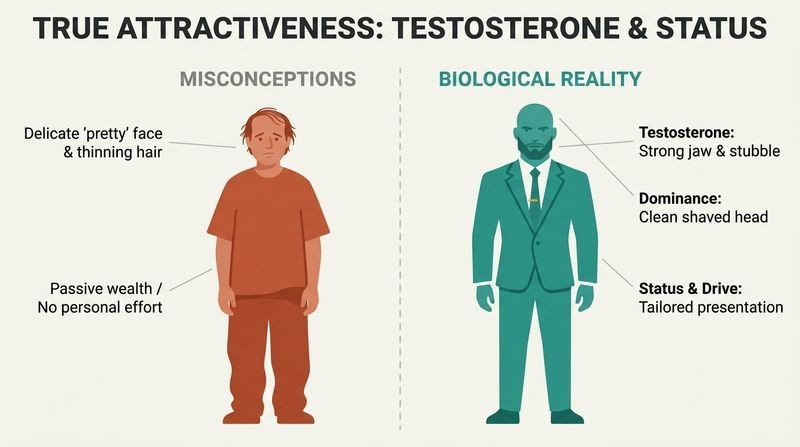
Men and women are attractive differently. Canwell contends women scan for markers of testosterone and health rather than a pretty face: a strong jaw, heavy stubble (he cites roughly ten days of growth rated most attractive), a muscular symmetrical build, and a deep breathy voice. He notes a study where balding men who shave their heads are rated more dominant and masculine than those clinging to thinning hair, and warns against Propecia because blocking DHT suppresses testosterone.
Status is prestige, not cash. Wealth attracts less than the drive that produces it, so an ambitious poor man beats a lazy rich heir. Clothing studies show well-dressed men are judged sexier across every relationship category, and one survey found most women rated a sharp dresser sexier than a rich man.
The evolutionary logic (testosterone as an honest fitness signal) is a real research tradition, but effect sizes are modest and context-dependent. Facial-hair preferences fluctuate with cultural cycles and with what is locally common, a phenomenon called negative frequency-dependent selection: beards get more attractive when rare. The muscularity findings hold mainly for short-term attraction, less for long-term. The Propecia warning oversimplifies; side-effect rates in trials are low single digits, though the concern is not fantasy. Most useful and least contested is the wardrobe point: grooming and dress are cheap, controllable levers that shift first impressions more than immutable features like height.
Raise your sexual market value by embodying strength, not faking it
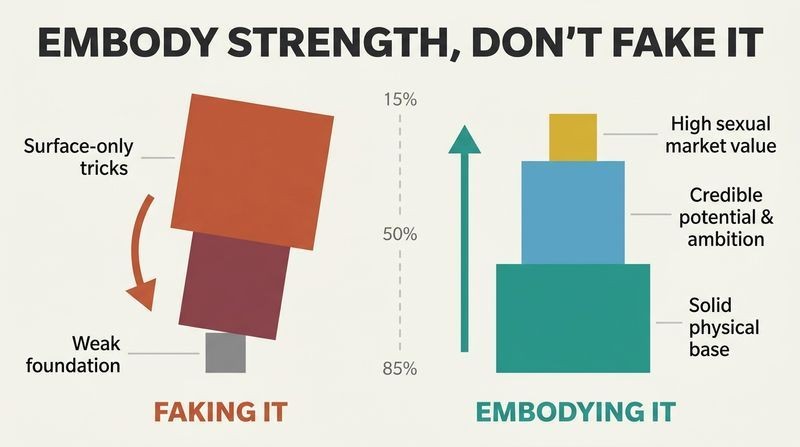
Sexual market value (SMV) is your desirability rank. Canwell defines it as the sum of appearance, confidence, status, skill, and ambition that determines how many romantic options you command. The same line, hi, how are you, gets a warm response from a high-SMV man and a cold shoulder from a low-SMV one. Superficial cues are shortcuts to deeper qualities: a fit body signals discipline and good genes, stylish clothes signal social intelligence.
Potential counts as much as achievement. He stresses that women respond to unrealized potential, the visible ambition, drive, and direction that predict future success, so you need not be successful now, only credibly on the way. The path from beta to alpha, he claims, begins with the body: strengthen it and the mind follows.
Reframing surface traits as proxies for underlying character is a genuinely useful cognitive move, and it aligns with signaling theory in economics: costly, hard-to-fake displays credibly convey quality. Treating attractiveness as trainable rather than fixed is also empowering and correct in many domains. The weakness is the market metaphor itself, which encodes people as ranked commodities and can breed exactly the outcome-obsessed anxiety the book elsewhere warns against. The claim that potential rivals achievement is shrewd; research on ambition confirms it reads as attractive. But SMV language risks reducing a relationship to a transaction, obscuring compatibility, shared values, and emotional attunement, which predict relationship satisfaction far better than rank.
Uncertainty and space, not security, ignite romantic desire
The engine of attraction is anxiety plus fascination. Canwell leans on Esther Perel's insight that eroticism lives in the ambiguous zone between the two. A cited study found women rated men most attractive when they were unsure whether the man liked them, more than when they knew he did. Certainty breeds boredom; mystery keeps a woman thinking about you, and thinking fuels desire.
Attraction grows in space, not proximity. He argues that couples who merge completely, sharing everything and leaving no distance, suffocate desire. His suffocation case study: a wife asks repeatedly for space, the husband panics each time, and she divorces him. The remedy is to tolerate distance, resist closing every gap, and let a partner pull away and return. He even endorses occasional separate beds to revive a fading sex life.
The space principle is the book's most defensible and most widely echoed idea. Perel, attachment researchers, and desire studies converge: too much fusion dampens eroticism because desire needs an other to reach toward. The scarcity-of-certainty finding is real but fragile; the same uncertainty that intrigues securely attached people triggers destabilizing panic in anxiously attached ones, a distinction the book underweights. There is also an ethical line between naturally having a full independent life (healthy) and manufacturing artificial ambiguity to keep someone anxious (manipulative). The former builds sustainable attraction; the latter, as decades of relationship research show, corrodes the trust that long-term intimacy actually requires.
Never invest heavily too soon; let her chase you
Over-investment signals you want it more. Canwell warns against declaring love early, planning lavish dates, or lavishing gifts. His examples: a man spends 5,000 dollars on a Caribbean trip and never sees the woman again; another buys a 200-dollar dinner and gets ghosted. He invokes the sunk cost fallacy (the more you pour in, the harder it is to walk from a bad bet) and loss aversion (people fear losing more than they enjoy gaining) to explain why the man who holds back stays valuable.
Flip the pursuit with the 80/20 rule. Once a woman warms up, back off so she reaches out roughly 80 percent of the time. Scarcity raises value, as in the study where a jar holding two cookies was rated more valuable than an identical jar of ten.
The behavioral-economics scaffolding is legitimately applied: scarcity, loss aversion, and sunk cost are robust findings, and effort invested does increase perceived value (the IKEA effect, the Aronson effort-justification work). Getting someone to invest in you does deepen their commitment. Where the advice curdles is in treating withholding as a permanent strategy rather than a corrective for genuine desperation. Healthy relationships eventually require mutual, reciprocal investment; a partnership permanently engineered around one person chasing is not a partnership. The sharpest practical takeaway, matching your investment to the other person's rather than front-loading it onto a near-stranger, is emotionally intelligent regardless of one's stance on the gamesmanship.
Text sparingly, mirror her pace, and stop over-explaining
Less is more on the phone. Canwell advises a first text that is a low-key feeler (nice to meet you), not an immediate date request. Long, frequent messages read as desperation; the natural rhythm should mirror face-to-face conversation, where a rambler who never lets the other speak is exhausting.
Mirror, do not chase. If she replies in an hour, reply in an hour; if she goes short, go short or silent. His cautionary tales show men who fire off seven unanswered texts, or blow up a phone with where are you messages, exposing insecurity that kills attraction. He also urges men to stop apologizing, citing research that refusing to over-apologize preserves a sense of control and status, and to go no contact when a woman pulls away, forcing her to reach out first.
The communication advice is the book's most practically transferable, and much of it is simply good conversational calibration: matching energy, not flooding, tolerating silence. It maps onto anxiety management more than seduction; the anxiously attached texter who over-pursues is soothing his own distress, not building connection, and learning to sit with the discomfort is genuinely useful. The apology research is real but narrow, and generalizing never apologize into relationships is corrosive; accountability builds trust. The strongest reframe is behavioral: response patterns are data about mutual interest, so reading them dispassionately beats interpreting every delay as catastrophe. The manipulation risk lies in weaponizing silence rather than simply not panicking.
Women test your strength; pass with calm indifference or humor
Testing is a screening mechanism. Canwell claims women probe men, often unconsciously, to gauge whether they are secure or fragile. He names two: the bitch test, where she acts rude or insults a sensitive spot to see if you crumble, and the jealousy test, where she mentions another man's interest to watch your reaction. Flaking on dates is another probe.
Respond by refusing to be rattled. The winning move is indifference, light humor, or simply walking away, never defensiveness, anger, or pleading. When a partner accuses you, he recommends agree and amplify: if she threatens to leave, say great, fewer headaches, which deflates the charge. The underlying rule he repeats: don't try to defeat emotion with logic, because a woman upset is not persuaded by reason, only met with unbothered composure.
The don't-fight-emotion-with-logic point has clinical backing: in flooded emotional states the prefrontal cortex is less accessible, so reasoning genuinely fails, and validation or space works better, a staple of Gottman's conflict research. Not taking bait and not spiraling into defensiveness is sound. But the testing framework is where the book veers into a self-sealing worldview: any behavior can be relabeled a test, making the theory unfalsifiable and encouraging men to dismiss legitimate grievances as manipulation. Agree and amplify can defuse absurd provocations, yet applied to real complaints it stonewalls, which Gottman identifies as among the strongest predictors of divorce. Discernment between a genuine concern and a provocation is the missing skill.
Master silent signals: read her body, project openness, skip the eager grin
Body language carries most of the message. Canwell cites estimates that 60 to 80 percent of communication is nonverbal and that women read it far more accurately than men. He maps interest cues (eye contact, smiling, preening such as hair-touching, exposing the wrist, feet pointed toward you) against disinterest cues (crossed arms, turned-away feet, objects moved as barriers). His bar case study shows a man charmed by a woman's polite words while her closed body screamed leave me alone.
Project expansive confidence, ration your smile. Open, space-taking posture and steady eye contact read as attractive; hunched, closed posture does not. Counterintuitively, he cites research that women rate brooding or proud male expressions above happy smiling ones, recommending a rare impish half-smile over a constant eager grin, echoing how Sean Connery's panther-like walk won him James Bond.
The observational skill here is broadly useful: learning to read disinterest saves everyone time, and open posture genuinely correlates with attractiveness in the zero-acquaintance studies cited. The 60 to 80 percent nonverbal figure, however, is a persistent myth traceable to Mehrabian's narrow experiments on emotional congruence, not general communication, and it does not mean words carry only 20 percent of meaning. The smiling finding is real but modest and specific to sexual attraction ratings; warmth still drives liking and long-term appeal. The genuine insight is that authenticity beats performance, as the book itself notes citing research that faked demeanor gets red-flagged, so the impish smile works only when it reflects real self-assurance.
Lead decisively, escalate touch, and refuse to play it safe
Leading is doing what you want and inviting her along. Canwell distinguishes leading from controlling: decide the plan, escalate physically, and pursue intimacy without asking permission at every step. His weak-leader case: a man defers on every choice, skips the goodnight kiss to be safe, and gets friend-zoned. Touch is central; he cites studies where a brief arm touch raised compliance with requests to dance or share a number.
Playing safe produces indifference. He argues attraction grows amid anxiety, jealousy, and tension, not comfort, and that a man too afraid to provoke any feeling provokes none. Sexual confidence matters too: passivity in bed breeds resentment, while masculine, present, dominant energy (cited as linked to partner orgasm frequency) sustains desire. The theme throughout: seek intimacy without apology.
Decisiveness and initiative are legitimately attractive, and the touch-compliance research (Gueguen and others) is real, though effect sizes are small and highly context-sensitive. The deeper truth is that comfort and predictability do dampen erotic charge, consistent with Perel's work on domesticity killing desire. The danger zone is escalation-without-consent framed as strength; the book flirts with treating resistance as a test to push through, which is ethically and legally reckless. Enthusiastic consent is not weakness, and confident leadership includes reading and respecting a clear no. The most defensible version: be the person who proposes, initiates, and takes responsibility for the direction of a date, while staying attuned to genuine reciprocation.
The X factor is attitude, and a dose of dark-triad edge magnetizes
Attitude is the missing multiplier. Canwell argues smart, handsome, technically informed men still fail when they lack edge: they smile too much, hedge with maybe and perhaps, and tolerate mistreatment. The fix is to eradicate the compulsion to please, not to become cruel.
Dark triad traits, in moderation, attract. He cites research linking narcissism, Machiavellianism, and psychopathy to more partners and higher attractiveness, attributing it to confidence, style, humor, risk-taking, and self-focus. Crucially, he draws a line: studies show men judged genuinely evil or mean are rated highly unattractive. So the appeal is not villainy but self-prioritization, ambition, and a mission beyond the relationship. His final counsel: build a purposeful life first, because seeking a relationship to supply meaning is itself the disqualifying weakness.
The dark-triad research is real but routinely overstated; effect sizes are small, the appeal concentrates in short-term mating, and longitudinal work shows these traits predict relationship instability, infidelity, and partner distress. What actually charms at first sight, per Back's narcissism-popularity studies, is the surface package (confidence, flashy self-presentation) that fades and often reverses on acquaintance. The book's own caveat, that outright meanness repels, quietly concedes the point: the attractive ingredient is self-assurance and purpose, which decouple cleanly from narcissism. The closing wisdom is the strongest note in the entire book and predates it by millennia: a person anchored in their own direction, not outsourcing their worth to a partner, is magnetic precisely because they are whole.
Analysis
Atomic Attraction is a thesis-driven self-help manual dressed in evolutionary-psychology citations, aimed at heterosexual men who feel invisible to women. Its structure is clean: become attractive, create attraction, build it, maintain it, moving from grooming to seduction tactics to long-term dynamics, each chapter anchored by a fictionalized case study contrasting a losing beta with a winning alpha. Its rhetorical engine is the strong-versus-weak binary applied relentlessly to every situation.
The book's genuine value lies in a handful of robust, transferable ideas that happen to be dressed in provocative language. Desire needs distance (Perel is correctly invoked). Neediness and approval-seeking do undercut attraction. Confidence, grooming, initiative, and an independent sense of purpose are legitimately appealing and, unlike height, are trainable. Matching someone's investment rather than front-loading emotion onto a stranger is emotionally intelligent. Not fighting flooded emotion with logic is clinically sound. Stripped of ideology, much of the advice is really anxiety management for men who over-pursue.
The liabilities are serious. The gender essentialism (women as auditory, emotional, hypergamous, testing creatures; men as visual, logical, mission-driven) is presented as settled biology when it is contested and often culturally contingent. Studies are cherry-picked and over-read: the misattribution-of-arousal bridge study, dark-triad attraction, and the nonverbal 60 to 80 percent figure all carry replication or interpretation problems the book ignores. Most troubling is the slide from be self-assured into engineer her anxiety, manufacture jealousy, deploy dread game, and push through resistance, which crosses from confidence-building into manipulation and, in the sexual-escalation passages, into ethically dangerous territory.
The honest reading: mine it for the confidence, independence, and calibration lessons, which align with mainstream relationship science, and discard the commodifying market logic and the manufactured-scarcity manipulations, which the best long-term research (Gottman, attachment theory) identifies as trust-destroying. The book accidentally proves its own best point: purpose and self-possession attract, while treating a partner as a target to be gamed does not.
Review Summary
Atomic Attraction receives mixed reviews, with an average rating of 4.14 out of 5. Positive reviews praise its practical insights on male-female dynamics and attraction, backed by scientific research. Critics argue it's sexist, oversimplified, and promotes manipulative behavior. Some readers find it eye-opening and essential for men, while others view it as common sense or outdated. The book's controversial approach to attraction and relationships sparks debate, with some appreciating its directness and others finding it offensive or misogynistic.
People Also Read









Glossary
Sexual Market Value (SMV)
Your overall romantic desirability rankCanwell's term for a man's total desirability, combining appearance, confidence, status, ambition, skill, and social intelligence. High SMV means abundant romantic options and warm responses to the same behavior that a low-SMV man would be punished for. The book frames self-improvement as the deliberate raising of one's SMV, treating attraction as a competitive marketplace of supply and demand.
Nice Guy Syndrome
Seeking sex through fake kindnessThe book's label for men who suppress their true desires and act supportive, chivalrous, and agreeable in the belief that kindness earns romantic and sexual access. Canwell argues this behavior is dishonest and self-defeating, signaling weakness and neediness that extinguish attraction rather than building it.
Alpha versus Beta
Strength versus weakness in menCanwell's central dichotomy. The alpha consistently chooses the strongest course of action, seeks no validation, and lives in abundance; the beta chooses the weakest, seeks approval, and acts from scarcity. He argues alpha status is mostly developed through conscious effort, beginning with strengthening the body, not fixed at birth.
Dread Game
Inducing anxiety to restore attractionA set of tactics for reviving a relationship in which a woman has lost interest: signaling you have options, going unresponsive, being seen with other women, or hinting at lost desire for commitment. The stated aim is to trigger fear of loss and anxiety, which the book claims recalibrates her emotions and rebuilds attraction by making you a scarce resource.
Agree and Amplify
Deflect accusations by exaggerating themA conflict-defusing verbal technique: instead of defending yourself against a complaint or insult, you agree with it and exaggerate it (if she threatens to leave, respond that it means fewer headaches). Canwell claims this neutralizes emotionally charged attacks by refusing to supply the defensive reaction the accusation seeks.
The 80/20 Rule (in dating)
She initiates most of the contactCanwell's application of the Pareto principle to relationships: a man should initiate contact roughly 20 percent of the time and let the woman reach out about 80 percent of the time. This is meant to ensure she does the chasing and that enough space exists for attraction to grow.
Preening
Nonverbal female interest signalsThe stage in Canwell's five-step courtship-signal sequence (eye contact, smile, communication, preening, touch) where a woman advertises attraction through grooming-like cues: playing with her hair, exposing her wrist, touching her neck, pointing her feet toward the man, or dangling a shoe. Reading these tells a man she is receptive to escalation.
Dark Triad
Narcissism, Machiavellianism, psychopathyA cluster of three personality traits the book cites as, in moderation, attractive to women because they correlate with confidence, style, humor, risk-taking, and self-focus. Canwell distinguishes this appeal from genuine cruelty, noting that men judged truly evil or mean are rated highly unattractive; the draw is self-prioritization and ambition, not villainy.
Hypergamy
Women mate upward in statusThe claim that women are hard-wired to pair with men they perceive as superior to themselves, and will seek a stronger man if they sense weakness in a current partner. Canwell uses it to argue for constant vigilance and to explain infidelity, citing a statistic that roughly one in twenty-five fathers is unknowingly unrelated to their child.
Misattribution of arousal
Mistaking fear for attractionThe idea, drawn from the Capilano suspension-bridge study, that physiological arousal from fear, exercise, or a roller coaster can be misread as romantic attraction toward a nearby person. Canwell uses it to argue that meeting women in high-arousal contexts, or inducing anxiety, can increase their attraction to a man.
FAQ
What's "Atomic Attraction: The Psychology of Attraction" about?
- Focus on Attraction: The book delves into the psychology of attraction, offering insights into how men can become more attractive to women by understanding and applying certain principles.
- Practical Advice: It provides practical advice on building, creating, and maintaining attraction in both short-term and long-term relationships.
- Case Studies: The author uses real-life case studies to illustrate how attraction works in various scenarios, making the concepts more relatable and understandable.
- Author's Expertise: Written by Christopher Canwell, a psychologist specializing in attraction and relationships, the book draws on his professional experience and research.
Why should I read "Atomic Attraction: The Psychology of Attraction"?
- Comprehensive Guide: It serves as a comprehensive guide for men looking to improve their dating and relationship skills by understanding the dynamics of attraction.
- Real-Life Applications: The book offers actionable strategies that can be applied in real-life situations, making it practical for those seeking immediate results.
- Debunking Myths: It challenges common misconceptions about attraction, such as the belief that women are non-sexual beings or that being a "nice guy" is the best approach.
- Empowerment: By understanding the psychology of attraction, readers can gain confidence and take control of their dating lives.
What are the key takeaways of "Atomic Attraction: The Psychology of Attraction"?
- Attraction is Psychological: Attraction is not just about physical appearance; it involves psychological elements like confidence, strength, and mystery.
- Role of Masculinity: Embracing masculinity and projecting strength are crucial for building attraction.
- Importance of Space: Attraction grows in space, not in close proximity, making it essential to maintain a balance between closeness and distance.
- Handling Tests: Women often test men to gauge their strength and confidence, and knowing how to pass these tests is vital for maintaining attraction.
What are the best quotes from "Atomic Attraction: The Psychology of Attraction" and what do they mean?
- "Attractive people have easier lives." This quote highlights the societal advantages that come with being perceived as attractive, such as better job opportunities and social interactions.
- "Women are attracted to strength and masculinity." It underscores the book's emphasis on the importance of projecting strength and masculine traits to attract women.
- "Attraction grows in space." This quote emphasizes the need for maintaining a balance between closeness and distance in relationships to keep attraction alive.
- "Women always test." It points to the idea that women test men to assess their strength and confidence, a recurring theme in the book.
How does Christopher Canwell suggest building attraction in "Atomic Attraction: The Psychology of Attraction"?
- Physical Appearance: Focus on building a strong, muscular body and choosing the right hairstyle to project masculinity.
- Confidence and Boldness: Approach women directly and confidently, making your intentions clear from the start.
- Mystery and Challenge: Maintain an aura of mystery and be a challenge to keep women intrigued and interested.
- Effective Communication: Use words skillfully to engage women emotionally and exploit their weakness for words.
What does "Atomic Attraction: The Psychology of Attraction" say about maintaining attraction?
- Balance of Space: Maintain a balance between closeness and distance to keep the relationship exciting and prevent it from becoming stale.
- Avoid Over-Investment: Don't invest too much too soon; let the woman invest in you to increase her commitment and attraction.
- Handling Conflict: Use strategies like "agree and amplify" to neutralize conflict and maintain your composure.
- Embrace Uncertainty: Introduce elements of uncertainty and anxiety to keep the woman focused on you and the relationship dynamic.
What role does masculinity play in "Atomic Attraction: The Psychology of Attraction"?
- Core Element: Masculinity is a core element of attraction, with women being naturally drawn to masculine traits like strength and confidence.
- Projection of Strength: Projecting strength and assertiveness is crucial for building and maintaining attraction.
- Avoiding Feminine Traits: The book advises against adopting feminine traits or behaviors, as they can diminish attraction.
- Embracing Dominance: Embrace dominant traits in both social and intimate settings to enhance your attractiveness.
How does "Atomic Attraction: The Psychology of Attraction" address the concept of "Nice Guy Syndrome"?
- Misconception of Niceness: The book challenges the belief that being overly nice and accommodating is the best way to attract women.
- Weakness Perception: It argues that "nice guys" often come across as weak and lacking confidence, which can be unattractive to women.
- Assertiveness Over Niceness: Emphasizes the importance of being assertive and confident rather than overly nice and agreeable.
- Balance of Traits: Suggests finding a balance between being kind and maintaining masculine traits to build genuine attraction.
What does "Atomic Attraction: The Psychology of Attraction" say about the role of communication?
- Emotional Engagement: Effective communication involves engaging a woman's emotions and using words to create a connection.
- Storytelling Skills: Good storytelling skills are seen as attractive because they demonstrate social intelligence and high status.
- Avoiding Serious Topics: Keep conversations light and playful, avoiding serious or negative topics that can kill attraction.
- Flattery and Compliments: Use flattery and well-placed compliments to exploit the "likability effect" and increase attraction.
How does "Atomic Attraction: The Psychology of Attraction" suggest handling rejection or flakiness?
- Stay Calm and Indifferent: Remain calm and indifferent when faced with rejection or flakiness, as overreacting can kill attraction.
- No Contact Rule: Implement the "no contact" rule to give the woman space and time to miss you and reconsider her feelings.
- Avoid Over-Pursuing: Don't chase or bombard her with messages; let her come to you when she's ready.
- Focus on Self-Improvement: Use the time to focus on self-improvement and increasing your own value and attractiveness.
What strategies does "Atomic Attraction: The Psychology of Attraction" offer for dealing with tests from women?
- Recognize the Test: Understand that women test men to gauge their strength and confidence, and recognize when you're being tested.
- Respond with Confidence: Respond to tests with confidence and humor, showing that you're unaffected by her attempts to rattle you.
- Avoid Defensive Behavior: Don't become defensive or try to justify yourself, as this can be seen as a sign of weakness.
- Maintain Composure: Keep your composure and remain indifferent to her tests, demonstrating your high value and self-assurance.
How does "Atomic Attraction: The Psychology of Attraction" define the "X Factor" in attraction?
- Attitude is Key: The "X Factor" in attraction is largely about attitude, which encompasses confidence, assertiveness, and self-assuredness.
- Dark Triad Traits: Men who possess dark triad traits like narcissism and Machiavellianism often have the "X Factor" due to their confidence and charm.
- Nonconformity and Risk-Taking: Nonconformist traits and a willingness to take risks are attractive because they signal strength and independence.
- Focus on Self: The "X Factor" involves focusing on oneself and one's goals, rather than seeking validation or approval from women.
Download PDF
Download EPUB
.epub digital book format is ideal for reading ebooks on phones, tablets, and e-readers.








































