
Key Takeaways
Money is a shadow; wealth consciousness is what casts it
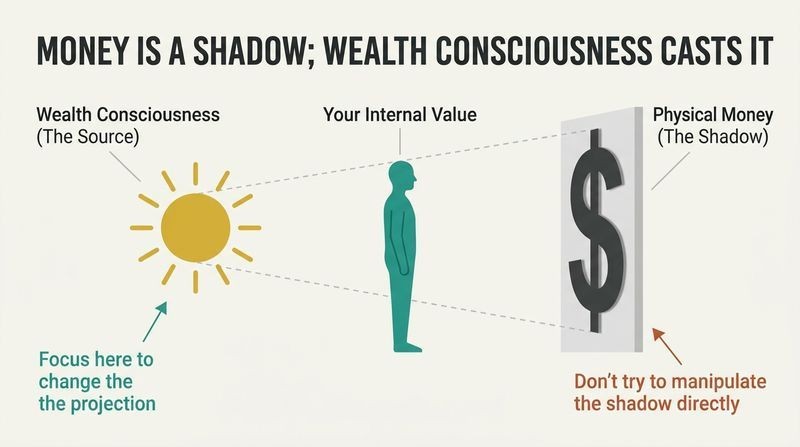
Cash is a symbol, not substance. Gikandi opens by stripping money of its mystique: only about 4% of the money in banks exists as physical notes and coins, the rest is numbers on servers, sustained purely by collective belief. A million one-dollar bills would weigh a ton and stand 361 feet high. Money, he argues, is merely the external readout of internal value, what he calls wealth consciousness.
Develop the cause, not the symbol. Wealth consciousness is your awareness of and access to the abundant parts of yourself. It is free, available to everyone equally, and requires nothing external. Stop staring at your bank balance (the shadow) and cultivate the inner value instead, and the money supposedly follows automatically. The first move toward wealth is refusing to mistake the symbol for the source.
The reframe has real teeth: behavioral economists confirm money's value is socially constructed, and bank runs (the 1929 example Gikandi cites) show how belief alone keeps the system standing. Reframing wealth as an internal capacity also echoes Stanford's Carol Dweck on mindset and the psychology of self-efficacy. The weak spot is the implied causality: cultivating inner states does not, by itself, deposit funds. What it plausibly does is shift attention, risk tolerance, and persistence, the behavioral preconditions of earning. Read as psychology rather than metaphysics, 'wealth consciousness' is a useful lens. Read literally, it risks letting readers mistake feeling rich for the work of becoming so.
Treat reality as fluid: what you attend to is what you get
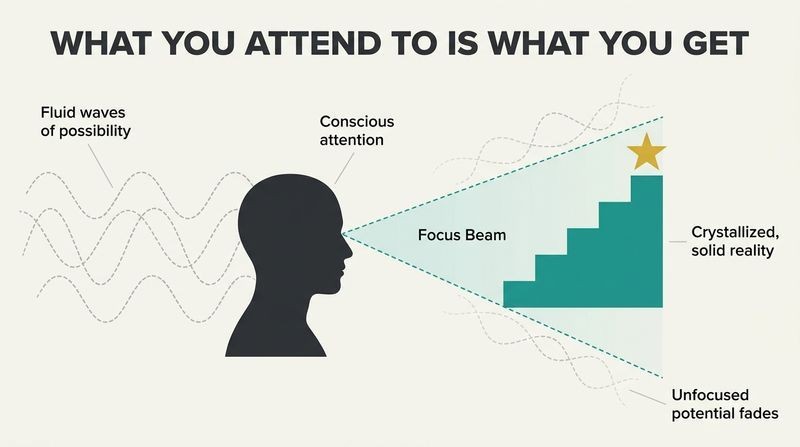
The observer shapes the observed. Gikandi's central engine is a popularized quantum physics: subatomic particles exist as probability waves until observation collapses them into a definite spot. He extends this to claim your attention and intention literally materialize your world from a field of infinite possibility, citing the double-slit phenomenon, Schrodinger's cat, Bell's theorem on nonlocal connection, and the many-worlds interpretation.
Practical upshot, regardless of the physics. Whatever you put attention and energy toward grows; remove attention and it fades. The actionable core survives even if the science is loose: be deliberate about what you focus on, because focus directs effort, perception, and the opportunities you notice. He frames humans as co-creators choosing which slice of an already-existing reality to experience, rather than victims of fixed circumstance.
This is the book's most contested claim. In physics, 'observation' means any measurement interaction, a detector suffices, no consciousness required. The von Neumann-Wigner 'consciousness causes collapse' interpretation exists but is fringe; most physicists favor decoherence or many-worlds without mystical agency. So the literal reading overreaches. Yet the psychological version is well-supported: the reticular activating system filters perception toward what we prioritize, confirmation bias amplifies expected patterns, and attention is a finite resource that shapes outcomes. Buy a red car and suddenly red cars appear everywhere. Gikandi smuggles a sound attentional principle inside shaky quantum metaphors. Keep the principle, hold the metaphysics lightly.
Drop the deadline: declare 'I Am' rich, never 'I will be'
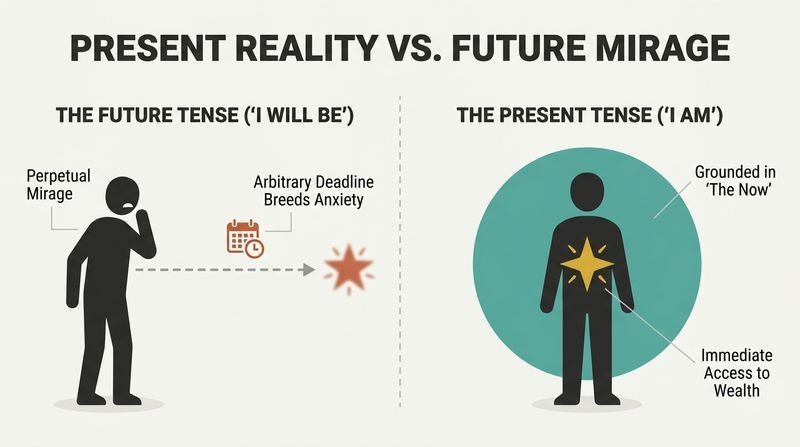
There is only Now. Gikandi argues time is an illusion produced by consciousness moving through a fixed field of all events. Since only the present exists, goals phrased in the future tense keep their fulfillment perpetually out of reach. The fix is grammatical and psychological: state every intention in the present tense, 'I am wealthy now,' not 'I want to be' or 'I will be.'
Arbitrary deadlines breed doubt. Setting a date like 'millionaire in one year' is a random grab that injects fear (will I make it?) and blocks faster, unforeseen paths. When asked when, answer 'soon.' He also warns against living in memory or daydream: experience each moment fresh, because the universe can only deliver opportunities into the present, not into an imagined tomorrow.
The 'I Am' technique is essentially an affirmation framed in the present, and the underlying instinct aligns with research on identity-based habit change: people who say 'I am a runner' adhere better than those who say 'I want to run.' Present-tense framing reduces the psychological distance Hal Hershfield studies, where the future self feels like a stranger. The deadline critique is double-edged, though. Goal-setting research from Locke and Latham shows specific, time-bound targets usually outperform vague ones. Gikandi's 'soon' may relieve anxiety but can also dissolve urgency. The reconciliation: anchor identity in the present, but keep concrete milestones for accountability.
Your imagination is the blueprint; render it in cinematic detail
Life is images of the mind expressed. The subconscious cannot tell a vividly imagined experience from a real one, so Gikandi treats mental imagery as literal construction specs. Vague goals like 'a nice car' fail because no such object exists; you must specify make, model, color, options. He recommends spending an hour a day visualizing in full color, backed by a Goals and Visualizations Journal stuffed with magazine cuttings and photos.
Stack reasons and emotion. Attach many vivid reasons to each goal (travel, gifts, art, generosity), because reasons convince the subconscious and energize the image. The subconscious also ignores negatives: 'I am not poor' registers only 'poor,' so phrase everything affirmatively. He cites Walt Disney, who clung to his imagination through repeated failures and launched an empire on a cartoon mouse.
Mental rehearsal is genuinely evidence-backed: athletes who visualize movements activate similar motor pathways to physical practice, and surgeons and musicians use it to consolidate skill. The 'subconscious ignores negation' claim mirrors a real linguistic finding, that the brain must represent a concept to negate it ('don't think of an elephant'). But sports psychology adds a crucial caveat Gikandi underweights: visualizing outcomes (owning the car) without visualizing the process can reduce motivation, as Gabriele Oettingen's research on positive fantasies shows. Her WOOP method pairs the wish with obstacles. The richest practice imagines not just the trophy but the grind that earns it.
Become wealthy on the inside first; action is the final step, not the first
Being is First Cause. Gikandi's creation sequence runs: being causes thinking, thinking causes speaking, speaking causes acting. Most people invert this, thrashing in constant activity (his Olympic swimmer analogy: effort alone never wins gold) while neglecting the inner state that gives action direction. You cannot 'do' a state like happiness or wealth; you decide to be it, the way you can simply choose to stop being upset.
Action receives, it does not create. Acting only builds the system to receive and experience what being and thinking already generated. This explains why hard work without wealth consciousness stalls. The instruction: choose the state of wealth now, without negating it through doubt, then let thoughts, words, and deeds align with that identity rather than with your current bank statement.
The sequencing resembles identity-first models across disciplines: James Clear argues habits flow from identity, and Viktor Frankl located meaning in chosen inner stance regardless of circumstance. There is wisdom in noting that frantic activity without clarity is wasted motion. The danger is the inversion becoming an excuse for inaction, the 'spiritual bypass' critics describe, where feeling abundant substitutes for building anything. Gikandi guards against this by insisting action still completes the cycle, but the emphasis tilts heavily inward. The defensible core: state and self-concept regulate which actions you take and how persistently, so cultivating them is leverage, not a replacement for execution.
Desire freely, but never let yourself want
Wanting is a state of lack. Gikandi draws a razor-thin but, he insists, decisive line between two words. To want something is to declare you do not have it, and because the universe executes your states precisely, wanting locks you in perpetual not-having. The dictionary even defines 'want' as to lack, to be destitute, to fall short. Desire carries no such deficit; it is an eager reaching that does not presuppose absence.
Why small wants get fulfilled. You unconsciously shift from wanting a snack to getting it because you have done it thousands of times. But for big, unfamiliar goals (a first million when you have never held more than twenty thousand) you cannot make that shift, so the wanting state persists. The remedy: replace 'want' with 'desire' or 'intend,' and pair intention with detachment.
Linguistically this is shaky, want and desire are near-synonyms, but psychologically it points at something real. Buddhist philosophy locates suffering in tanha, craving rooted in a felt void, and distinguishes it from healthy aspiration. Modern research on scarcity mindset (Mullainathan and Shafir) shows that fixating on what one lacks measurably narrows cognitive bandwidth and worsens decisions. So a state of grasping deficiency genuinely impairs the behaviors that build wealth. Gikandi's pairing of intention with detachment also echoes flow research: optimal performance comes when you commit fully to a goal yet release anxious attachment to the result. The word swap is a mnemonic for a real emotional reorientation.
Give first what you wish to receive; the return arrives multiplied
Cause and effect is multiplicative. Gikandi frames karma not as moral bookkeeping but as a law that returns your output amplified. To get wealth, cause others to have wealth; to be happy, make others happy. He recommends building giving directly into your goal list and giving cheerfully without demanding repayment from the same person, since the return comes from any source, in any form, at the best time.
Giving reveals hidden capacity. A striking secondary effect: by teaching others wealth or sharing freely, you discover abilities and resources you did not know you had. He extends this socially, arguing peace and fair trade are more profitable than exploitation, and that ignoring others' suffering (his Hitler example of collective indifference) eventually circles back to harm you. Businesses designed to enrich others, he predicts, become the most self-sustaining.
The reciprocity instinct is one of the most robust findings in social science: Cialdini documents it as a near-universal influence principle, and Adam Grant's 'Give and Take' shows that 'givers' often occupy the top of success distributions (though also the bottom, when they give without boundaries). Gikandi's insistence on giving without demanding direct repayment maps onto Grant's distinction between generous givers and transactional matchers. The 'sevenfold' and 'multiplicative' framing is faith, not data, and risks magical expectation. But the behavioral mechanism is sound: generosity builds social capital, networks, and reputation, the compounding assets that disproportionately generate opportunity over a career.
The conditions blocking you are illusions you manufactured
Conditionality does not exist. This is the book's most liberating and most radical claim. Gikandi argues that 'if-then' conditions (I would be rich if I had a degree, the right family, more time) are not real requirements but merely one possible path among infinite paths, which you adopt only because you believe in them. Since all outcomes already exist, nothing external can be a precondition for an outcome that is already present.
Stop energizing the cause. Fighting circumstances fights effects while preserving their cause. If you act broke (hoarding, fearful, stingy) to avoid getting broker, you reinforce the broke state. He cites Bill Gates leaving college as proof a 'condition' was just a belief. The Taoist farmer parable (good luck, bad luck, who knows) illustrates suspending judgment, since you cannot see the full chain of events being arranged.
As metaphysics this is dubious; structural barriers (poverty traps, discrimination, lack of capital) are not dissolved by disbelief, and the framing can slide into victim-blaming, implying the poor simply chose poverty consciousness. That is the serious ethical limit. Yet psychology rescues a real insight: learned helplessness (Seligman) shows that believing barriers are fixed and personal produces the very passivity that entrenches them, while an internal locus of control predicts resilience and achievement. The Gates example also illustrates survivorship bias, for every dropout billionaire, thousands struggled. The usable kernel: interrogate which of your 'requirements' are genuine constraints and which are inherited assumptions you have never tested.
Certainty is the cure for failure; fear is false evidence appearing real
Faith is the activating ingredient. Gikandi treats certainty as the force that gives the universe permission to act, the level of conviction with which you reach for a glass of water, never doubting you will drink it. Doubt and fear are the only true enemies of a vision. He reframes fear with an acronym: False Evidence Appearing Real, insisting that on the level of the indestructible Self there is genuinely nothing to lose.
Build belief deliberately. Two methods: decide once and refuse contradictory thoughts, or act your way into belief by behaving confidently until confidence becomes real. Persistence and faith reinforce each other in a loop. He also reframes failure entirely, since you only ever have events in the Now, never problems, and you have survived every present moment you have faced. Worry, by contrast, is a self-fulfilling prophecy that attracts what it dreads.
'Act your way into belief' anticipates a deep behavioral truth: attitudes follow actions as often as they precede them (cognitive dissonance, Festinger), and Amy Cuddy's work on embodied confidence, contested as it is, captures the felt experience. The reframe of worry as wasted simulation aligns with research showing most anticipated catastrophes never occur. The vulnerability is that unshakeable certainty can curdle into overconfidence, the planning fallacy, and ignored disconfirming evidence, which markets punish brutally. Genuine expertise pairs conviction with calibrated doubt. Gikandi's certainty works best as emotional steadiness against paralysis, not as a license to dismiss real risk signals.
Split every dollar 10:10:10:70 and own assets, not liabilities
The allocation formula. After chapters of metaphysics, Gikandi turns concrete. His magic ratio: of all income, route 10% to taxes, 10% to charity, 10% to long-term investments, and live on the remaining 70%. Pay yourself the investment slice first, before bills. Spend the 70% cheerfully, since your spending becomes others' income and circulates wealth.
Redefine asset and liability. Echoing Robert Kiyosaki, he insists an asset is anything that puts more money in your pocket than it takes out, and a liability does the reverse. By that test, a mortgaged home and a car are liabilities, not assets. The rule: always keep true assets exceeding true liabilities, and finance your liabilities (the boat, the beautiful house) from the income your assets generate, never from your own labor.
This section grounds the book in orthodox personal finance. The pay-yourself-first principle traces to 'The Richest Man in Babylon,' and the cash-flow definition of assets is Kiyosaki's signature. The 10% tithe to charity overlaps with research showing prosocial spending raises well-being (Dunn and Norton). One quibble: classifying a primary residence purely as a liability is contested, since it builds equity and hedges rent inflation, even while consuming cash monthly. And the fixed 10% investment rate may be too low for late starters or too high for those drowning in high-interest debt, which should be cleared first. As a default heuristic for a beginner, though, the framework is sound and memorable.
Make a dollar work for you, then build businesses instead of jobs
Compounding is the quiet engine. Gikandi's most motivating math: a single dollar invested at 20% annual growth becomes a million in 75 years; a dollar invested every day at that rate reaches a million in 32 years and a billion in 66. The point is not the optimistic return assumption but the principle, that you can never start too small, and that money working autonomously beats labor.
Jobs need you; businesses do not. A job requires your presence to produce income; a business, once built, runs without you. Many self-employed people merely own a demanding job. The wealthy build multiple independent income streams and delegate everything except the one thing they are genuinely fabulous at, the way Einstein focused on physics, not sweeping floors, and Gates did not try to do every task at Microsoft. Concentrate on your singular strength; hand off the rest.
The compounding illustration is directionally right but uses a 20% return that nearly no diversified investor sustains for decades (long-run equities average closer to 7 to 10% real). The lesson about time-in-market and early starts survives the inflated number. The job-versus-business distinction is Kiyosaki and Gerber's 'E-Myth' territory: working in your business versus on it. The delegation principle aligns with comparative advantage in economics and with strengths research from Gallup showing engagement rises when people spend time in their zone of excellence. The honest caveat: building passive income streams typically demands intense, non-passive labor upfront, a reality the breezy framing can obscure for impatient readers.
Analysis
A Happy Pocket Full of Money is best understood as a New Thought manifesto dressed in the borrowed authority of quantum physics. Written by the man who served as creative consultant on the 2006 film The Secret, it sits in a lineage running from Wallace Wattles and James Allen through Napoleon Hill to contemporary Law of Attraction media. Its thesis is monistic idealism: consciousness is primary, matter is its shadow, and wealth is therefore an inner state (wealth consciousness) that the external world obediently mirrors.
The book's structure is deliberately holistic rather than linear, the author warns readers that chapter one only fully resolves after chapter twenty-two, and the relentless 'I am wealth, abundance, joy' refrain functions as embedded affirmation. This makes it hard to summarize: it is less an argument than an incantation meant to reprogram the reader through repetition.
Intellectually, the work is strongest as practical psychology and weakest as physics. Its quantum claims conflate measurement with conscious observation, a move mainstream physics rejects, and its metaphysics of conditionality risks ethical hazard by implying circumstance is purely self-chosen. Yet beneath the cosmology sit durable behavioral truths: attention shapes perception, identity drives action, scarcity mindset impairs judgment, reciprocity builds opportunity, and present-tense self-concept aids change. The final chapter abruptly pivots to conventional, sensible personal finance (allocation ratios, cash-flow assets, compounding, delegation, multiple income streams), revealing the author's pragmatic spine.
The honest read separates two layers. The metaphysical layer is faith, unfalsifiable and best held loosely. The psychological and financial layers are actionable and broadly consistent with evidence from cognitive science, behavioral economics, and standard wealth-building literature. Readers who treat the quantum talk as motivating metaphor rather than literal mechanism, and who pair the inner work with the book's own concrete financial discipline, can extract genuine value. Those who expect belief alone to deposit funds will be disappointed, and possibly poorer.
Review Summary
A Happy Pocket Full of Money receives mixed reviews, with an overall rating of 4.40 out of 5. Many readers praise the book for its unique perspective on manifestation, quantum physics, and the law of attraction. They appreciate its inspirational content and its ability to shift mindsets around wealth and abundance. However, some criticize it for repetitiveness, spiritual bypassing, and promoting toxic positivity. Critics argue that it lacks practical application and relies too heavily on magical thinking. Despite these criticisms, many readers report positive changes in their lives after applying the book's principles.
People Also Read





Glossary
Wealth consciousness
Inner awareness of one's abundanceGikandi's central concept: the expansion of consciousness into the abundant parts of the self that, when developed and exercised, manifests externally as money and wealth. He frames it as free, equally available to everyone, requiring nothing outside oneself, and as the true cause of which money is merely the visible shadow or symbol.
Being (First Cause)
Chosen inner state that createsIn Gikandi's creation sequence, Being is the originating step: being causes thinking, which causes speaking, which causes acting. A state like wealth or happiness cannot be 'done,' only chosen and inhabited now. Because Being precedes and generates everything downstream, deciding to be wealthy internally is presented as the fastest, most powerful act of creation.
Sponsoring thought
Belief behind a thoughtThe deeper, subconscious thought that causes a surface thought. Gikandi argues every conscious thought has a sponsor rooted in what you truly believe, and when the two conflict, the sponsoring thought wins. This explains why people who pray or affirm for wealth fail if their underlying belief is one of lack.
Conditionality
Illusion of required preconditionsGikandi's claim that 'if-then' conditions for success do not actually exist. Since all outcomes already exist simultaneously, a so-called condition (needing a degree, capital, or time) is merely one optional path among infinite paths, real only because you believe in it. He insists you can reach any outcome without passing through the conditions you assume are mandatory.
'I Am' statement
Present-tense identity declarationGikandi's prescribed grammar for goals and self-talk: always state intentions in the present tense ('I am wealthy now') rather than future ('I will be') or lacking ('I want'). Because he holds that only the present moment exists, present-tense declarations are treated as direct commands the universe begins manifesting immediately.
10:10:10:70 formula
Income allocation ratioGikandi's recommended division of all income: 10% to taxes, 10% to charity, 10% to long-term wealth-building investments, and 70% for living and enjoyment. The investment portion is paid first, before bills. He presents these ratios as time-tested for producing optimal growth for both the individual and society.
FAQ
What's A Happy Pocket Full of Money about?
- Wealth Consciousness Focus: The book emphasizes that wealth is more than just money; it's about cultivating a mindset of abundance. It teaches that true wealth is a reflection of one's internal value.
- Quantum Physics Connection: It links quantum physics concepts to personal finance, suggesting that our thoughts and beliefs shape our reality. Understanding this can empower individuals to create desired outcomes.
- Practical Steps for Wealth: The book offers practical steps like goal setting, visualization, and maintaining a state of wealth to achieve financial success. It encourages action aligned with one's goals.
Why should I read A Happy Pocket Full of Money?
- Transformative Insights: The book challenges conventional beliefs about money and wealth, offering insights that encourage a rethinking of one's relationship with money.
- Empowerment through Knowledge: By understanding universal laws and their application to wealth, readers can empower themselves to create desired financial outcomes.
- Practical Application: It provides actionable advice and exercises to cultivate a wealth mindset, making it accessible for anyone looking to improve their financial situation.
What are the key takeaways of A Happy Pocket Full of Money?
- Wealth is Internal: Wealth is a reflection of one's internal state and consciousness, making wealth consciousness essential for attracting abundance.
- Power of Thought: Thoughts and beliefs shape reality, emphasizing the need for positive thinking and visualization. "You become what you think about."
- Action and Certainty: Taking action with certainty is crucial for manifesting desires, as certainty propels individuals toward their goals.
What are the best quotes from A Happy Pocket Full of Money and what do they mean?
- "You become what you think about.": This quote highlights the book's core message that thoughts shape reality, encouraging positive and abundant thinking.
- "Money is not real.": Challenges the conventional view of money, suggesting it represents value and emphasizes understanding internal value over external wealth.
- "The universe never makes mistakes.": Reassures readers that everything happens for a reason, encouraging trust in life's process and the unfolding of one's journey.
How does A Happy Pocket Full of Money relate quantum physics to wealth?
- Quantum Reality: The book explains that reality is not fixed and can be influenced by thoughts and beliefs, aligning with the idea of creating one's reality through intention.
- Observer Effect: It applies the observer effect from quantum physics to personal finance, suggesting beliefs about money shape financial reality.
- Creating Possibilities: Understanding quantum principles allows individuals to tap into infinite possibilities for wealth creation by shifting their mindset.
What is the concept of wealth consciousness in A Happy Pocket Full of Money?
- Definition of Wealth Consciousness: It's the awareness and belief in one's inherent ability to attract and create wealth, recognizing abundance as a natural state.
- Internal vs. External Value: Wealth consciousness involves developing internal value rather than relying on external circumstances, allowing wealth experience regardless of financial situation.
- Cultivating Wealth Consciousness: Techniques like visualization, affirmations, and gratitude practices help reinforce a mindset of abundance and attract financial opportunities.
What role do goals play in A Happy Pocket Full of Money?
- Goals as Roadmaps: Goals serve as roadmaps for achieving wealth and success, focusing thoughts and actions toward desired outcomes.
- Setting Effective Goals: The book stresses clarity and specificity in goal setting, framing them in the present tense to reinforce a mindset of abundance.
- Continuous Growth: Encourages setting new goals beyond current achievements to foster growth and prevent stagnation, keeping individuals motivated and aligned with their vision.
How can I apply the principles from A Happy Pocket Full of Money in my life?
- Practice Visualization: Dedicate time daily to visualize goals and desired outcomes, reinforcing a wealth mindset and attracting opportunities.
- Affirmations and Gratitude: Incorporate affirmations and gratitude into daily routines to shift mindset toward abundance, expressing gratitude for current and desired possessions.
- Take Action with Certainty: Emphasizes taking action aligned with goals while maintaining certainty about success, crucial for manifesting desires.
How does meditation contribute to wealth consciousness according to Gikandi?
- Connection to Higher Self: Daily meditation connects individuals with their higher self and universal consciousness, fostering clarity and insight into true desires.
- Calmness and Focus: Cultivates calmness essential for maintaining focus on wealth-building goals, making the mind more receptive to inspiration and opportunities.
- Enhancing Awareness: Increases awareness of thoughts and beliefs, allowing identification and change of limiting patterns, crucial for developing a wealth-conscious mindset.
What role does gratitude play in attracting wealth in A Happy Pocket Full of Money?
- Attracting Positive Energy: Gratitude acts as a magnet for positive experiences and abundance, opening individuals to receiving more.
- Shifting Focus: Shifts focus from lack to presence, fostering a mindset of abundance essential for cultivating wealth consciousness.
- Creating a Cycle of Abundance: Gratitude creates a cycle where giving thanks leads to more reasons to be grateful, reinforcing a positive relationship with wealth.
What practical steps does Gikandi suggest for achieving wealth?
- Visualization Techniques: Encourages detailed visualization of desired life, using all senses to align the subconscious mind with goals.
- Affirmations and Mantras: Suggests using affirmations like “I am wealth. I am abundance. I am joy.” to reinforce a positive mindset and attract wealth.
- Taking Action: Stresses consistent action toward goals, advising identification of small, actionable steps aligned with the vision of wealth.
How does the concept of “conditionality” play a role in A Happy Pocket Full of Money?
- Illusion of Limitations: Conditionality is an illusion created by beliefs and perceptions, which can be transcended by changing one's mindset.
- Empowerment Through Choice: Individuals have the power to choose responses to circumstances, altering reality by rejecting conditionality.
- Creating New Conditions: Encourages creating new, empowering conditions through thoughts and actions, allowing greater freedom and potential in achieving wealth.
Download PDF
Download EPUB
.epub digital book format is ideal for reading ebooks on phones, tablets, and e-readers.








































