

Key Takeaways
Equality made relationships fair but drained them of erotic charge
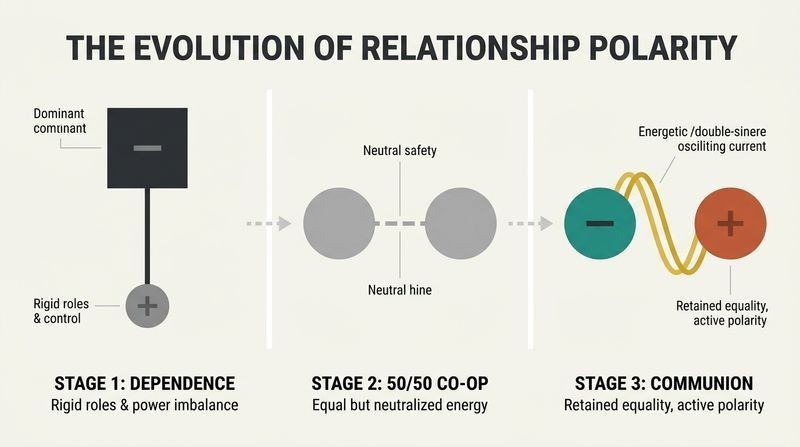
Deida's central provocation: the modern push toward the 50/50 Relationship (two independent partners splitting duties evenly, like business colleagues) solved real injustices but neutered sexual passion. He describes a three-stage evolution:
1. Dependence Relationship: rigid old sex roles, mutual need, imbalance of power.
2. 50/50 Relationship: equal, safe, communicative, but often lukewarm.
3. Intimate Communion: partners freely gift their deepest sexual essence without losing hard-won equality.
Men complain their partners have hardened; women complain their partners have gone limp. The diagnosis: chasing sameness, couples suppressed the magnetic differences that drew them together. Deida insists equality is a necessary phase, not a destination. The next step reclaims polarity without regressing to domination.
Deida wrote this in 1995, and the thesis remains genuinely contrarian in progressive circles. What's compelling is that he refuses to attack equality itself, framing it as a prerequisite rather than a problem. The weakness is empirical: he offers no controlled data, only workshop anecdotes, so the claim that fairness causes passion loss stays correlational. Sociologists studying the division of household labor have found mixed results, with some studies suggesting egalitarian couples report equal or higher satisfaction. His insight lands best as a phenomenological description of a felt tension many couples recognize, less as a proven causal law.
Sexual polarity needs opposite poles, exactly like magnets
Deida separates three things people blur under love:
1. Love: an open heart, available toward anyone or anything.
2. Romance: infatuation rooted in childhood imprints, doomed to disappoint.
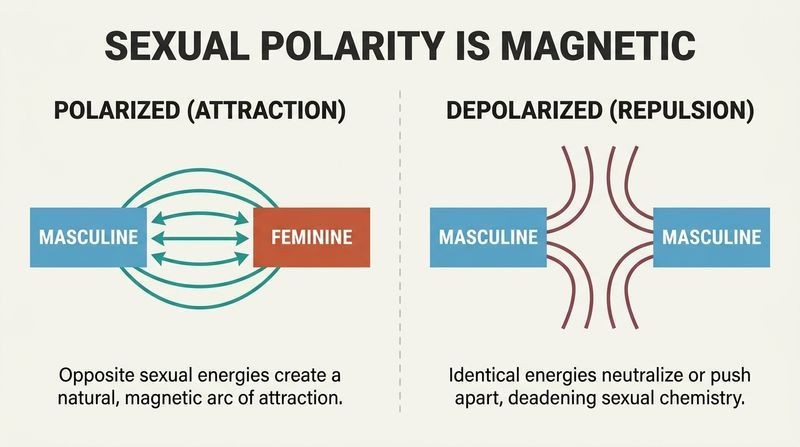
3. Polarity: an energetic arc that flows only between a masculine and feminine pole.
Polarity behaves like magnetism. Opposite poles attract, like poles repel. When a woman feeds her man from her fingers and opens to him, she radiates feminine energy and magnifies attraction. When both partners assert directive, competitive energy at once, they neutralize or repel each other, like two north poles. He calls the deadening of attraction depolarization. The supermarket jolt from a stranger's eyes is polarity operating unconsciously, proof it runs independent of love or romance.
The magnet metaphor is elegant and memorable, giving couples a diagnostic vocabulary for a vague feeling. Its risk is determinism: real desire is shaped by novelty, narrative, status, scent, and context, not a tidy two-pole circuit. Esther Perel's work on eroticism converges with Deida on one point, that desire needs distance and difference, that too much fusion kills wanting. But Perel locates polarity in psychological space and mystery rather than fixed masculine and feminine forces, which makes her framing more flexible for same-sex and egalitarian couples. Deida does allow either partner to play either pole, which softens the essentialism somewhat.
Masculine and feminine are energies, not genders, like New York versus Hawaii
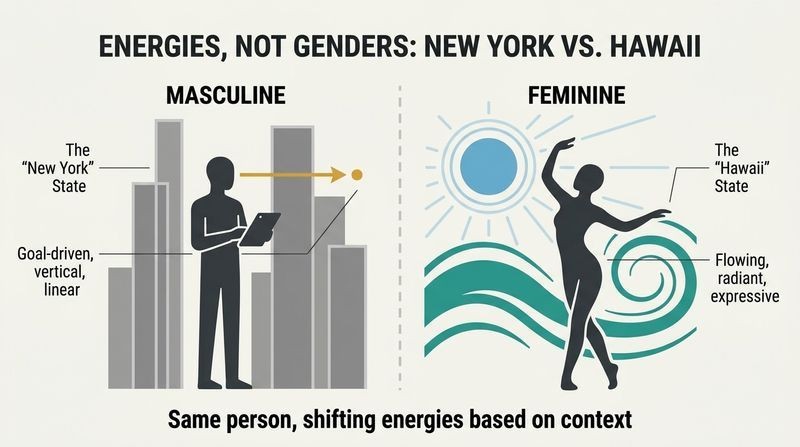
Deida decouples masculine and feminine from male and female. They are universal forces present in everyone. His signature images: New York is masculine energy, vertical, focused, goal-driven, allergic to interruption. Hawaii is feminine energy, flowing, radiant, sensual, alive with life force. A CEO closing a deal runs masculine energy whether man or woman. A person dancing, savoring a meal, or moving with nature runs feminine energy.
Everyone carries both. You can be all New York at the office and melt into Hawaii at home. The point is not to be one, but to know which you are radiating in a given moment, because that energy determines the polarity, or its absence, with whoever is near.
Separating the archetypes from biological sex is Deida's most defensible move, echoing Jungian anima and animus and Taoist yin and yang, both of which treat these as complementary principles within each psyche. The geographic metaphor is unusually sticky because it is concrete and value-neutral, neither pole is better. The lingering critique is the naming itself: labeling focus as masculine and flow as feminine imports cultural baggage that the energies-not-genders disclaimer cannot fully wash out. A reader could keep the functional insight, that attraction needs a directive pole and a radiant pole, while questioning whether those poles deserve gendered names at all.
Your sexual essence is what secretly turns you on, not your resume
Deida's term sexual essence means your core erotic disposition, whether you long to ravish or to be ravished, to lead or to be swept away. It sits on a spectrum from extreme masculine through neutral to extreme feminine, and it does not match gender. Roughly, he estimates from workshop surveys that about 80% of women have a feminine essence, 80% of men a masculine essence, and about 10% sit neutral or crossed.
Crucially, you attract your reciprocal. Project more masculine directive energy than is true to you, and you draw indecisive partners who fill the space you left. A corporate warrior woman may still, at her core, want to be cherished as a goddess. The essence hides under acquired armor built for career or self-protection.
The attract-your-reciprocal principle is the book's most actionable diagnostic: if you keep drawing partners who disappoint in the same way, examine the energy you habitually broadcast. That reframe shifts blame from the dating pool to one's own signal, which is empowering. The shakier element is the 80/20 statistic, drawn from self-selected workshop attendees, not representative sampling, so it should be read as impression, not measurement. Still, the deeper idea, that people armor over their native desires and then wonder why they feel unmet, resonates with attachment theory and with therapeutic work on the false self. The catalog thought experiment vividly separates anatomy, character, and essence.
Love is a verb you practice, not a feeling you await
Deida reframes love as an action: opening your heart in this moment, especially when hurt. Waiting to feel love before giving it, he argues, guarantees a long wait. This is the foundation of Intimate Communion, a discipline more than a diagnosis.
He contrasts this with therapy culture's endless excavation of childhood. Digging a little is useful to understand the roots, but he compares dwelling on old wounds to repeatedly falling on the same scraped knee. Clean it, bandage it, then stop re-injuring it by practicing intimacy now. Old patterns, closing down or punishing a partner when hurt, dissolve through the repeated counter-practice of staying open. The past loses power not by analysis but by present loving.
The love-as-practice framing aligns strikingly with cognitive behavioral and third-wave therapies that emphasize present action over insight alone, and with Erich Fromm's classic argument in The Art of Loving that love is a skill, not a windfall. It also anticipates behavioral activation research showing that action often precedes feeling rather than following it. The tension is that Deida somewhat underrates trauma. For survivors of serious abuse, the scraped-knee analogy can minimize how deeply nervous-system responses are wired, and simply practicing openness can retraumatize without professional support. As a corrective to rumination it is bracing; as a blanket substitute for therapy it overreaches, which he partly concedes elsewhere.
The masculine chases freedom; the feminine chases love, in three stages
Deida maps parallel growth arcs. The masculine seeks freedom; the feminine seeks love. Both mature through three stages:
1. First stage: seeks the prize outside, money and conquest for him, being loved by another for her.
2. Second stage: turns inward, self-improvement and self-mastery for him, self-love and independence for her.
3. Third stage: stops seeking entirely, resting as free consciousness for him, radiating as love itself for her.
The engine of growth is crisis. His midlife emptiness (the vision quest) and her black hole of unfilled need force the collapse of the second-stage self. Only by surrendering the search, rather than winning it, does either arrive at what they wanted all along.
The stage model reads as a spiritual bildungsroman fusing Ken Wilber's developmental thinking with Advaita and Tantric notions of ego-death and surrender. Its strength is narrative: it gives people a map for why arriving at healthy independence can still feel hollow, a phenomenon self-determination research does not fully capture. The obvious critique is the rigid gendering of two universal human longings, autonomy and connection, which developmental psychology treats as needs present in everyone regardless of sex. Reading his masculine and feminine as two motivational systems within every person, rather than his-and-hers scripts, makes the framework far more portable and harder to dismiss.
You are cheating on your partner with surf, career, and cabernet
Deida's sexual substitutes are the non-human sources we unconsciously use to get masculine or feminine energy we are not receiving intimately. A surfer married to the ocean, a businesswoman wedded to her city, a man soothed nightly by beer and TV, all are having low-grade affairs that drain the essence available for a real partner.
He classifies them: alcohol, marijuana, and heroin soften and open, so they deliver feminine energy. Caffeine, cocaine, and amphetamines thrust forward, so they deliver masculine energy. Even long talks with opposite-sex friends leak subtle polarity. The remedy is not abstinence but consciousness. When your partner is unavailable, deliberately visiting a rejuvenating place can heal your essence rather than deplete your relationship.
The substitute concept is one of the book's most original and testable contributions. It reframes seemingly harmless hobbies as energetic infidelities that quietly lower relational investment, an idea that dovetails with research on how porn, gaming, and parasocial media can displace real intimacy by satisfying a need just enough to kill motivation. The drug taxonomy (uppers as masculine, downers as feminine) is a clever heuristic but pharmacologically loose. What holds up is the underlying economics of desire: attraction requires a partner who has not fully outsourced their core needs elsewhere. A person completely self-soothed has little hunger left to bring to the dance.
Criticizing his direction wounds like calling her ugly
Because directionality is the masculine core and radiance the feminine core, attacks on each land with equal devastation. Tell a masculine-essence partner he is lost, driving wrong, or failing at his mission, and you trigger collapse. Tell a feminine-essence partner she looks drab or worn, and you trigger the same contraction.
Deida's practical fix inside intimacy: describe your feeling rather than criticize the core. Say I get nervous seeing where our money is going instead of that is a bad investment. Say I love when your skin glows instead of you look old today. At work, criticize freely, professional goals outrank polarity there. But in the bedroom, decide whether the criticism is worth the depolarizing price it extracts.
This maps almost perfectly onto Gottman's research on I-statements versus criticism and on the corrosive power of contempt, giving Deida's mystical framing an empirical anchor he never cites. The symmetry claim, that direction is to men what radiance is to women, is neat but overstated; plenty of men are wounded by looking weak or unattractive, and plenty of women by having their competence dismissed. The durable takeaway is domain-switching: the same bluntness that serves a boardroom sabotages a bedroom, and skilled partners consciously toggle registers. Framing feedback as your own felt experience rather than a verdict on their essence is broadly sound relational technique.
When he wants out, he wants out of pressure, not out of you
Deida decodes a chronic mismatch. When a masculine-essence partner feels burdened, his instinct is release, I want out. A feminine-essence partner hears this as rejection and concludes he no longer loves her, which is usually false. He wants freedom from constraint, not from the relationship. Meanwhile her bad mood is the ache of feeling unloved, and his instinct, to analyze and fix the problem, only makes her feel dissected rather than embraced.
The repair is counterintuitive for each. She can dissolve his mood in five minutes of radiant, playful energy rather than withdrawing in hurt. He can dissolve hers by giving direct love, touch, presence, humor, before any problem-solving. Each must give what the other's core actually receives.
This is practical translation work between two communication dialects, and it echoes Deborah Tannen's linguistics of report-talk versus rapport-talk and the popular fix-it versus feel-it dynamic. The insight that a partner's mood is often self-generated rather than a referendum on you is genuinely stabilizing, it prevents the contagion where one person's funk detonates the whole evening. The caution is that it can be weaponized: dismissing a partner's legitimate grievance as just his need for release or her need to feel loved risks gaslighting real problems. Deida hedges by urging discernment between genuine issues and mood static, which keeps the tool honest.
The deepest pleasure is surrendering the self, and we call it taboo
Deida's culminating claim: the ecstasy lovers crave is the dissolution of the separate self into love, a kind of little death. Culture forbids naming this because it demands surrender, which we equate with weakness and loss of control. So couples settle for safe, guarded, mediocre intimacy.
He distinguishes surrender as slave from surrender as free lover. The dependent partner surrenders to get love; the free partner surrenders as a gift, recognizing oneness. He tells of finally making love to his partner Ophelia with unrestrained passion after years of holding back, and both discovering a wilder register they had feared. The task is to embrace the taboo: admit the desire to ravish and be ravished, then infuse that force with love rather than need.
The self-transcendence-through-eros theme places Deida in a lineage running from Tantric traditions through Georges Bataille's linking of eroticism and death to contemporary neuroscience of ego-dissolution, where studies of flow, orgasm, and psychedelics all show quieting of the brain's self-referential default mode network. That convergence lends unexpected credibility to his little death language. The vital ethical guardrail he insists on, that the only difference between ravishment and violation is whether love, not need or control, is the motive, is doing enormous work and deserves emphasis in an era of consent. Surrender presupposes deep trust and safety, without which the whole practice curdles into its opposite.
Analysis
Intimate Communion is a work of erotic-spiritual philosophy disguised as a relationship manual, and its ambition is larger than its genre. Deida's real target is a cultural contradiction: the same egalitarian project that liberated women and softened men also, he argues, sanded down the erotic friction between partners. His solution is not regression but transcendence, a third stage that preserves equality while restoring charge. That is a sophisticated dialectical move, thesis (dependence), antithesis (50/50), synthesis (communion), and it is why the book has outlasted its 1990s New Age packaging.
The framework's power is phenomenological. It names felt experiences, the dead feeling when passion goes, the collapse when a mission is mocked, the hollowness after achieving independence, that people recognize instantly but rarely articulate. Its liability is empirical and political. The evidence base is workshop observation, not research; the statistics are impressionistic; and the relentless gendering of universal human capacities invites, fairly, the charge of essentialism. Deida partly inoculates himself by insisting the energies are not gender-bound and either partner can play either pole, but the vocabulary keeps dragging the reader back toward stereotype.
The most transferable insight, stripped of metaphysics, is this: attraction requires difference, and sameness, however fair, dissolves it. That is defensible, and it converges with Esther Perel's clinical work and with basic principles of desire. The second durable contribution is the reframe of love as a practiced action and the mapping of communication dialects, both of which align with Gottman and Tannen. Read literally, the book risks prescribing rigid roles. Read as a psychology of two motivational polarities present in everyone, autonomy and communion, directive focus and receptive flow, it becomes a genuinely useful map for why intimacy goes flat and how deliberate polarity, honest feedback, and courageous surrender can revive it.
Review Summary
Intimate Communion receives mostly positive reviews, praised for its insights on masculine/feminine dynamics in relationships. Readers appreciate Deida's perspective on sexual polarity and intimate connections. Some find the book repetitive and overly simplistic in its gender approach. Critics argue it can be sexist and detached. Many readers consider it eye-opening and valuable for understanding relationship patterns, though some struggle with its spiritual tone. The book is seen as thought-provoking but potentially controversial, especially regarding traditional gender roles.
People Also Read







FAQ
What's Intimate Communion: Awakening Your Sexual Essence about?
- Exploration of Intimacy: The book explores "Intimate Communion," a deeper form of intimacy that surpasses traditional relationship models, focusing on the interplay of Masculine and Feminine energies.
- Stages of Relationships: It outlines three stages of intimacy: Dependence Relationships, 50/50 Relationships, and Intimate Communion, each representing different levels of connection.
- Sexual Polarity: Emphasizes the importance of sexual polarity, the attraction between Masculine and Feminine energies, and how it can be cultivated for deeper intimacy.
Why should I read Intimate Communion by David Deida?
- Enhance Relationships: Offers insights into improving intimate relationships by understanding Masculine and Feminine dynamics, providing practical advice for deeper connections.
- Personal Growth: Encourages self-awareness of one's sexual essence, leading to personal growth and more fulfilling partnerships.
- Spiritual and Emotional Depth: Combines spiritual teachings with practical advice, making it valuable for exploring the spiritual aspects of intimacy.
What are the key takeaways of Intimate Communion?
- Understanding Sexual Essence: Recognizing one's sexual essence—Masculine, Feminine, or Neutral—affects relationship dynamics and enhances intimacy.
- Three Stages of Intimacy: Progression through Dependence, 50/50, and Intimate Communion stages encourages moving beyond equality to a passionate connection.
- Cultivating Sexual Polarity: Essential for maintaining attraction and passion, with methods provided to enhance sexual energy and connection.
What is the definition of "Intimate Communion" in Intimate Communion?
- Deeper Connection: Defined as a relationship style that transcends traditional roles and the 50/50 ideal, involving profound emotional and sexual connection.
- Surrendering to Love: Involves surrendering oneself to love, allowing energy flow that transcends individual needs, seen as a source of true pleasure.
- Beyond Gender Roles: Not about adhering to old gender roles or striving for equality, but embracing each partner's unique sexual essence.
How does Intimate Communion describe the three stages of intimacy?
- Dependence Relationships: Partners rely on each other for support, often leading to power struggles and lack of true intimacy.
- 50/50 Relationships: Modern approach with equality and independence, but often lacks passion and emotional connection.
- Intimate Communion: Partners embrace their sexual essences, cultivating deep emotional and sexual intimacy, marked by willingness to surrender and share love.
What is the concept of sexual essence in Intimate Communion?
- Definition of Sexual Essence: Refers to inherent qualities of Masculine and Feminine energies individuals embody, key to navigating relationships.
- Masculine and Feminine Dynamics: Masculine represents direction and purpose, while Feminine embodies love and receptivity, creating natural polarity.
- Impact on Relationships: Embracing these essences leads to fulfilling and passionate relationships, enhancing emotional and sexual connection.
What are the differences between love, romance, and sexual polarity in Intimate Communion?
- Love: Defined as the opening of the heart, allowing connection with anyone or anything, independent of sexual desire.
- Romance: Characterized by infatuation and destiny with a partner, often fading over time as flaws become apparent.
- Sexual Polarity: Magnetic attraction between Masculine and Feminine energies, essential for maintaining passion and can be cultivated.
How can couples practice love in Intimate Communion?
- Open-Heartedness: Encourages practicing open-heartedness, even in conflict, choosing love and connection over retreating.
- Embracing Vulnerability: Requires embracing vulnerability and trust, allowing deeper emotional and sexual connection.
- Moment-to-Moment Practice: Love is an ongoing action, focusing on giving and receiving love continuously for a dynamic relationship.
What are some common sexual substitutes mentioned in Intimate Communion?
- Geographic Substitutes: Places like Hawaii and New York serve as substitutes for Feminine and Masculine energies, respectively.
- Substance Use: Alcohol and drugs provide temporary relief but weaken sexual essence, distracting from genuine intimacy.
- Emotional Attachments: Attachments to pets or children can substitute for lacking Masculine or Feminine energy in relationships.
What are the best quotes from Intimate Communion and what do they mean?
- "Love is what is when your heart is open.": Emphasizes love as a state of being from openness and vulnerability, not contingent on external factors.
- "Intimate Communion is about opening our hearts and giving the unique gifts that lie deep in our sexual, emotional and spiritual core.": Highlights the essence of Intimate Communion as sharing one's true self, underscoring authenticity and connection.
- "Surrender of self into love is the basis for Intimate Communion.": Suggests true intimacy requires letting go of ego and control, leading to deeper connection and fulfillment.
How does Intimate Communion address the concept of mid-life crisis?
- Rediscovery of Purpose: Suggests mid-life crisis stems from losing connection to one's purpose, encouraging self-reflection to rediscover desires.
- Need for Solitude: Emphasizes solitude for the Masculine essence to reconnect with its core, leading to clarity and renewed commitment.
- Transformation through Intimacy: After self-discovery, individuals can return to relationships with a fresh perspective, leading to deeper intimacy.
How can I apply the teachings of Intimate Communion in my daily life?
- Embrace Your Sexual Essence: Understanding and embracing your sexual essence enhances interactions and leads to authentic relationships.
- Practice Intimate Communion: Consciously practice love and connection, being present and open to sharing your true self with your partner.
- Reflect on Your Desires: Regular reflection on desires and alignment with relationships helps maintain core needs and emotional fulfillment.
About the Author
Other books by David Deida








Download PDF
Download EPUB
.epub digital book format is ideal for reading ebooks on phones, tablets, and e-readers.








































