Key Takeaways
1. Executive Skills, Not Just Intelligence, Drive Success
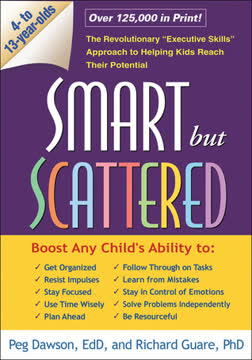
Scientists who study child development and the brain have discovered that most children who are smart but scattered simply lack certain habits of mind called executive skills.
Beyond raw intelligence. Many children possess high intelligence but struggle with everyday tasks, leading to frustration for both them and their parents. This isn't a lack of "smarts" but rather a deficit in executive skills, which are the brain-based abilities needed to manage oneself and one's resources to achieve goals. These skills are crucial for organizing output—deciding what to do, when, and how to control one's behavior to get it done.
Fundamental brain functions. Executive skills are the cognitive processes required to plan and direct activities, initiate work, stay on task, control impulses, regulate emotions, and adapt to change. They help us take in sensory data and choose how to respond effectively. Without these skills, a child might understand complex math but fail to remember their homework or manage their emotions when plans change.
Lifelong impact. The development of strong executive skills is essential for navigating the demands of childhood, school, and social interactions. Ultimately, they are critical for successful independent living in adulthood. Acting early to boost these skills can prevent significant difficulties later in life, fostering greater self-control, decision-making, and problem-solving abilities.
2. Eleven Core Executive Skills Guide Behavior and Learning
The scheme we arrived at consists of 11 skills: Response inhibition, Working memory, Emotional control, Sustained attention, Task initiation, Planning/prioritization, Organization, Time management, Goal-directed persistence, Flexibility, Metacognition.
A comprehensive framework. The authors' model identifies eleven distinct executive skills, categorized by whether they primarily involve thinking (cognition) or doing (behavior). This detailed breakdown allows parents and educators to pinpoint specific areas of weakness, moving beyond vague labels like "scattered" to actionable problem definitions. Understanding these skills helps in designing targeted interventions.
Thinking vs. doing. The cognitive skills, such as working memory, planning, organization, time management, and metacognition, help children formulate goals and strategize paths to achieve them. Behavioral skills, including response inhibition, emotional control, sustained attention, task initiation, flexibility, and goal-directed persistence, enable children to act on those plans and regulate their actions. Both sets are interdependent and crucial for effective functioning.
Developmental progression. These skills emerge gradually throughout childhood and adolescence, with some, like response inhibition and working memory, appearing in infancy, while others, like complex planning and metacognition, mature much later. Recognizing this progression helps set realistic expectations for a child's capabilities at different ages. For instance, expecting a 7-year-old to master a skill typically not developed until age 11 is counterproductive.
3. Assess Your Child's and Your Own Executive Skill Profiles
Knowing where your own executive skill weaknesses and strengths lie can enhance your efforts to build your child’s executive skills and also reduce conflict that may have arisen due to certain mixes or matches between you.
Understanding "goodness of fit." A crucial step in helping your child is to understand your own executive skill profile and how it interacts with your child's. When parents and children have vastly different strengths and weaknesses, it can lead to increased conflict and frustration. For example, a highly organized parent may struggle to empathize with a disorganized child.
Leveraging similarities and differences. Identifying shared weaknesses can foster camaraderie and a collaborative approach to improvement, as both parent and child work on the same skill together. Conversely, a parent's strength can be used to model and teach a skill where the child is weak, provided the parent adapts their approach to the child's learning style. Awareness of these dynamics is key to effective parenting.
Self-assessment tools. The book provides questionnaires for parents to assess their own and their child's executive skills across different age groups. This objective assessment helps parents move beyond irritation to understanding, allowing them to tailor their support. Recognizing your own "weak organ theory" – how stress impacts your weakest executive skills – can also inform when and how to best support your child.
4. The ABCs of Intervention: Antecedents, Behavior, Consequences
Behavior management experts often call this the ABC model. A in this model stands for antecedent, B for behavior, and C for consequences.
A foundational framework. The ABC model provides a systematic approach to understanding and changing behavior, including the development of executive skills. It posits that behavior is influenced by what happens before it (antecedents) and what happens after it (consequences). This model offers three distinct points of intervention to help children improve their executive functioning.
Three angles of attack.
- Antecedents: Modifying the environment or task before the behavior occurs to make desired actions more likely.
- Behavior: Directly teaching the child the specific skills or steps needed to perform the desired action.
- Consequences: Providing incentives or penalties after the behavior to increase or decrease its likelihood in the future.
Integrated approach. While each component can be addressed individually, the most effective interventions often combine elements from all three. For instance, a child struggling with morning routines might benefit from a visual schedule (antecedent), direct instruction on each step (behavior), and a reward for completing the routine on time (consequence). This holistic strategy maximizes the chances of success.
5. Modify the Environment First to Support Skill Development
The principle of starting with external modifications is so important—and so effective—because it removes the burden for decision making from the child.
External scaffolding. For children with weak or underdeveloped executive skills, the easiest and most effective starting point is to modify external factors. This means altering the physical or social environment, or the nature of the task itself, to reduce the demands on the child's executive functions. This approach is akin to how parents child-proof a home or establish routines for infants.
Practical environmental changes:
- Physical barriers: Using gates, locks, or placing tempting objects out of reach for impulsive children.
- Reduced distractions: Creating quiet homework spaces, limiting screen time, or using noise-canceling headphones.
- Organizational structures: Providing labeled bins, cubbies, or visual schedules to make tidiness easier.
- Simplified social settings: Restricting playdates to one child or structuring social activities for children with emotional control issues.
Task modifications. Altering the task itself can also significantly help. This includes making tasks shorter, building in frequent breaks, providing explicit step-by-step instructions, or creating schedules. By reducing the cognitive load, children are more likely to initiate and complete tasks, building confidence and gradually internalizing the underlying executive skills.
6. Directly Teach Missing Executive Skills Through Structured Learning
Children require ongoing support and supervision as they perform the new skill, and this support needs to be provided as a matter of course and without resentment on the part of the parent.
Beyond incidental learning. While some children naturally pick up executive skills, many require direct, explicit instruction. This involves defining problem behaviors, setting clear goals, and outlining the specific steps a child needs to follow. This structured approach ensures that children understand how to perform tasks they currently struggle with.
Informal teaching methods:
- Verbal scaffolding: Providing explanations, guidance, and asking questions at an appropriate developmental level. This helps children make connections, understand cause-and-effect, and build metacognitive awareness.
- Games: Engaging in classic board games (checkers, chess) or strategy video games can naturally develop planning, attention, inhibition, and working memory.
- Family activities: Involving children in meal planning, cooking, shopping, or vacation planning provides real-world contexts for practicing executive skills with built-in incentives.
Targeted instructional sequence. For persistent challenges, a more direct intervention involves:
- Identifying the specific problem behavior.
- Setting a clear, measurable goal (often with child's input).
- Outlining step-by-step procedures.
- Turning steps into visual aids (lists, checklists, picture schedules).
- Supervising the child through practice sessions.
- Gradually fading supervision as mastery is achieved.
7. Leverage Motivation and Incentives to Reinforce Desired Behaviors
What is immediately rewarded is repeated. What is immediately punished is avoided.
The power of positive reinforcement. Motivation is a critical component in helping children learn and use executive skills, especially for tasks they find unpleasant or difficult. Praise is a powerful, underused tool; specific, immediate praise that highlights effort and value is far more effective than generic compliments. This positive feedback encourages children to repeat desired behaviors.
"Something fun at the finish line." A simple yet effective motivator is to link a less preferred task with a highly preferred activity that immediately follows its completion. This "Grandma's law" approach ("First do X, then you get Y") creates a positive drive state, making the effort seem worthwhile. Wording these as positives ("As soon as you finish, you can...") rather than negatives ("You can't until...") is also more effective.
Formal incentive systems. For more challenging behaviors, a structured point system can be implemented. Children earn points for demonstrating target behaviors, which can then be traded for a "menu" of rewards (small daily treats, larger weekly activities, or long-term goals like a desired toy). This system teaches delayed gratification and provides concrete, visible progress, which is especially motivating for children with executive skill deficits.
8. Tailor Interventions to Your Child's Developmental Level and Needs
You will need to match the task demands to the child’s actual developmental level if that’s different from his peers or from what you would like it to be.
Realistic expectations. It's crucial to align intervention strategies with your child's actual developmental stage, not just their chronological age or your desired level of independence. Expecting too much too soon can lead to frustration and failure. The book provides age-specific questionnaires and developmental benchmarks to help parents gauge their child's current executive skill capacity.
Customization is key. No single intervention works for every child or every problem. Strategies must be customized to fit the child's unique profile of strengths and weaknesses, their interests, and the specific context of the problem. For younger children, interventions should be shorter, simpler, and rely more on pictures and direct supervision. For older children, involving them in the design of the plan and using negotiation becomes more effective.
Start small and build. Begin with minor, easily achievable goals to build confidence and demonstrate success for both parent and child. If a task feels like a "10" (very hard) to the child, modify it to feel like a "3" (manageable effort) by breaking it into smaller steps or offering immediate rewards. This incremental approach ensures that the child experiences success, which is a powerful motivator for continued effort and skill development.
9. Fade Support Gradually to Foster Lasting Independence
You don’t hold on to the back constantly and then suddenly just let ’er fly and expect the child and bike to keep going without a crash.
The path to self-reliance. The ultimate goal of any executive skill intervention is for the child to internalize the skill and perform tasks independently. This requires a gradual reduction of external supports, not an abrupt withdrawal. Just as teaching a child to ride a bike involves slowly letting go, parental supervision, cues, and incentives must be systematically faded over time.
Phased withdrawal. Initially, parents provide maximum support, actively guiding each step and offering frequent praise. As the child gains proficiency, support is gradually reduced:
- From constant supervision to intermittent check-ins.
- From explicit verbal cues to subtle reminders or visual prompts.
- From tangible rewards to social praise and the intrinsic satisfaction of accomplishment.
Monitor progress and adjust. Parents should continuously monitor the child's performance, looking for small signs of progress and adjusting the level of support accordingly. If a child "relapses" when support is reduced, it's a signal to temporarily increase support and fade more slowly. Consistency in this process, even when it feels tedious, is vital for long-term habit formation and skill internalization.
10. Collaborate with Schools for Comprehensive Executive Skill Support
For genuine improvement to occur, everybody has to work harder. Teachers have to do more for children with executive skill weaknesses than for other students, you need to provide more supervision and monitoring than a typical child would need, and children with executive skill weaknesses will have to work harder than they would have to if all their executive skills were developing normally.
A shared responsibility. Executive skill challenges often manifest significantly in the school environment. Effective intervention requires a collaborative effort between parents, teachers, and the child. Parents should initiate conversations with teachers, framing the discussion as a partnership to find solutions, rather than assigning blame.
Practical school-based strategies:
- Teacher accommodations: Teachers can implement whole-class routines for organization, planning, and time management. They can also provide individual support like checking assignment books, breaking down long-term projects, or offering modified assignments.
- Parental support: Parents can offer to make it easier for teachers by sending weekly email reminders for progress reports or even helping organize classroom materials.
- Formal services: For significant challenges impacting academic success, children may qualify for a Section 504 Plan (accommodations) or special education (specialized instruction) under federal laws like IDEIA. These plans can formalize supports like extended test time, modified homework, or direct executive skill instruction.
Advocacy and communication. Parents should be prepared to advocate for their child's needs, ensuring that IEP (Individualized Education Plan) goals are precise, measurable, and regularly monitored. Open, non-adversarial communication, coupled with a willingness to share resources like this book, can foster a more supportive school environment.
11. Prepare Adolescents for Adulthood by Fostering Self-Reliance
The goal is for the parent to provide a framework that the child, through repeated experiences, can use as his or her own.
Navigating the teenage years. Adolescence presents unique challenges for executive skills, as teens seek independence, are heavily influenced by peers, and face increased academic and social demands. Parents must shift from direct control to a more collaborative, coaching role, allowing teens to make choices and experience natural consequences.
Strategies for adolescent development:
- Natural and logical consequences: Allowing teens to experience the direct outcomes of their choices (e.g., missing out on social events due to uncompleted homework) is a powerful teacher.
- Contingent privileges: Linking access to desired privileges (e.g., car use, electronics) to the demonstration of responsible executive skills.
- Negotiation and collaboration: Involving teens in problem-solving and decision-making processes, even if it's less efficient, fosters ownership and internalizes planning skills.
- Positive communication: Using effective communication strategies, avoiding lectures or sarcasm, and actively listening can maintain open dialogue during a period of increasing independence.
Embracing "failure as opportunity." While it's natural to want to shield children from failure, allowing them to make mistakes and learn from them is crucial for developing resilience and metacognition. Parents should provide the "least support necessary" for teens to pick themselves up, reflect on their experiences, and adjust their strategies, guiding them toward independent adult functioning.
Review Summary
Smart but Scattered receives mostly positive reviews, averaging 4.01/5. Readers appreciate its breakdown of executive functioning skills and practical strategies for helping children improve. Many find it valuable for both ADHD and typically developing children. Common criticisms include repetitiveness, lack of citations, heavy reliance on behavior modification and reward systems, and occasional unrealistic advice. Some feel the strategies are overly time-intensive or outdated. Several reviewers note the book prompted useful self-reflection on their own executive skill weaknesses.
People Also Read