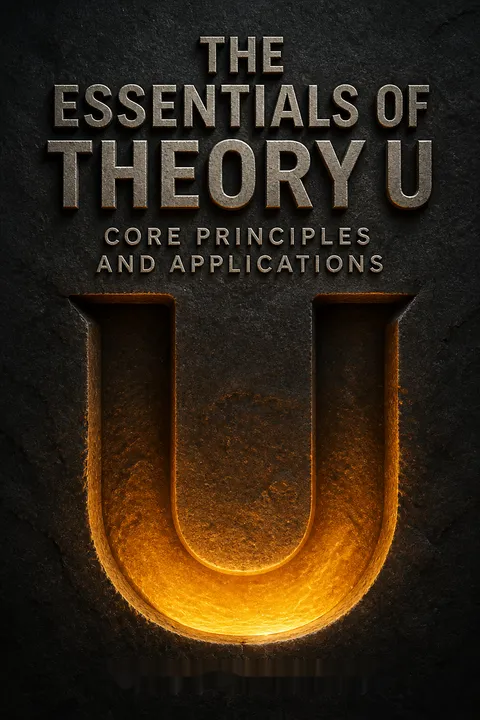

Key Takeaways
1. The Blind Spot: The Hidden Source of Our Actions
The blind spot concerns the inner place—the source—from which we operate when we act, communicate, perceive, or think.
Unseen influence. In leadership, management, and daily life, we often focus on what we do and how we do it, but rarely on who we are when we do it. This "blind spot" – our interior condition or inner source – profoundly shapes the outcomes we create, individually and collectively. Bill O'Brien, a CEO, famously stated, "The success of an intervention depends on the interior condition of the intervener," highlighting this crucial, often overlooked dimension.
Three divides. This blind spot is the root cause of the three major divides facing humanity today:
- Ecological divide: Loss of nature (e.g., consuming 1.5 planets' resources annually).
- Social divide: Loss of society due to extreme inequity (e.g., 8 billionaires owning as much as half of mankind).
- Spiritual divide: Loss of meaning and Self (e.g., 800,000 suicides annually).
These are not separate problems but different faces of the same underlying issue: our collective inability to perceive and shift our inner source of action.
Artist's analogy. To understand this, consider an artist: we can analyze the finished painting (the what), the process of creation (the how), or the artist's state of mind before creation begins (the source). Theory U focuses on this "blank canvas" perspective, asking: What quality of attention do I bring to a situation, and how does that quality change the course of action moment to moment?
2. Form Follows Consciousness: The Core Principle of Theory U
The quality of results in any social system is a function of the consciousness from which the people in that system operate.
Consciousness shapes reality. Theory U posits that our actions and attention don't just happen; they emerge from a specific quality of awareness. This means that how we pay attention directly influences what emerges. This core idea, "form follows consciousness," suggests that to change external results, we must first shift our internal state of being and awareness.
System seeing itself. When this shift happens individually, it's mindfulness – paying attention to your attention. When it happens in a group, it's dialogue – the capacity of a system to see its own patterns and assumptions. This is the essence of systems thinking: enabling a system to sense and see itself, moving from an "ego-system" (siloed) view to an "eco-system" (holistic) awareness.
Origins of the U. The U-shape framework emerged from insights into different levels of organizational change:
- Structure
- Process
- Mental Models
- Source (Presencing)
This framework visually represents a journey from the surface of observable phenomena down to the deeper source of creation, and then back up to manifest new realities.
3. The U-Process: A Journey from Surface to Source and Back
The U integrates two different views of time: The shape of the U is a bow to the Eastern cyclical view, and the arrow is a nod to the Western linear view of development, which, as the ecological crisis demonstrates, is equally relevant.
Deep learning cycle. The U-process describes a deep learning cycle that moves individuals and groups from reacting to the past to sensing and actualizing emerging future possibilities. This journey involves three core movements:
- Observe, observe, observe: Connecting to places of most potential.
- Retreat and reflect: Allowing inner knowing to emerge.
- Prototype: Acting from what emerges in the now.
This cycle is crucial for navigating disruptive challenges that cannot be solved by merely reflecting on past experiences.
Seven stages of awareness. The U-process further breaks down into seven stages, each representing a shift in how we attend and co-shape the world:
- Downloading: Reconfirming past patterns.
- Seeing: Suspending judgment, noticing the new.
- Sensing: Redirecting attention to source, opening observer-observed boundary.
- Presencing: Stillness, letting go, connecting to future potential.
- Crystallizing: Envisioning from the field of the future.
- Prototyping: Exploring the future by doing.
- Performing: Embodying the new within the larger eco-system.
This journey allows for a profound inversion of the system-self relationship, moving from being shaped by the past to co-shaping the future.
Connecting to the future. What sets humans apart is our capacity to connect to an "emerging future" – a quality of the present moment that functions as a gateway to future possibilities. This connection allows us to break past patterns and create new ones at scale, moving from being victims of disruption to co-shapers of our destiny.
4. Mastering Inner Knowing: Open Mind, Heart, and Will
The heart of Theory U concerns the interior dimension of the intervener that Bill O’Brien talked about.
Three instruments. To access and shift our inner source, Theory U identifies three essential "instruments of inner knowing":
- Open Mind: The capacity to suspend old habits of judgment and see with fresh eyes.
- Open Heart: The capacity to empathize and see a situation through another's eyes.
- Open Will: The capacity to "let go" of the old and "let come" the new.
These instruments are crucial for developing the deeper awareness needed for transformative change.
Listening as a skill. Listening is a fundamental, yet often underrated, leadership skill that directly reflects these inner instruments. Theory U outlines four archetypes of listening:
- Downloading (Level 1): Reconfirming what we already know; inner commentary.
- Factual Listening (Level 2): Noticing disconfirming data; opening the mind.
- Empathic Listening (Level 3): Seeing through another's eyes; opening the heart.
- Generative Listening (Level 4): Listening for emerging future possibilities; opening the will.
Shifting our mode of listening is life-changing, as it alters how we experience relationships and the world.
Cultivating attention. The success of leadership and change work depends on a leader's ability to observe and adjust their quality of listening. This requires daily practice and intentional effort. For example, moving from factual to empathic listening requires activating the "intelligence of the heart" by finding genuine interest or appreciation for the other person. Generative listening, the most challenging, involves "doing nothing" – simply holding space for what wants to emerge.
5. Navigating Resistance: Overcoming the Voices of Judgment, Cynicism, and Fear
What makes this journey so difficult is that these gates tend to be guarded by three “enemies” (as I would say as an American) or three “inner voices of resistance” (as I would say as an European), each of which blocks the entrance to these deeper domains.
Inner guardians. The journey down the left side of the U, towards deeper awareness, is often obstructed by three internal "voices of resistance" that guard the gates to our inner knowing:
- Voice of Judgment (VoJ): Blocks the open mind, preventing us from suspending habitual patterns and seeing with fresh eyes.
- Voice of Cynicism (VoC): Blocks the open heart, creating emotional distance and hindering empathy and vulnerability.
- Voice of Fear (VoF): Blocks the open will, preventing us from letting go of the old and embracing the new, often manifesting as fear of loss or ostracization.
Cultivating curiosity, compassion, and courage is essential to overcome these internal barriers.
Barriers to action. Once past the bottom of the U, two main barriers hinder movement up the right side:
- Mindless action: Blindly implementing abstract ideas without learning or adaptation.
- Action-less mind: "Analysis paralysis," where discussion replaces exploration through doing.
The key to overcoming these is "staying with it" – holding space for something new to be born without over-intervening or disengaging.
Absencing vs. Presencing. These voices of resistance contribute to a cycle of "absencing," characterized by:
- Ignorance: Closing of the mind (stuck in one truth).
- Hate: Closing of the heart (stuck in us vs. them).
- Fear: Closing of the will (stuck in one will).
This cycle creates an "architecture of separation," leading to blaming, destruction, and a disconnect from emerging realities. Conversely, "presencing" fosters curiosity, compassion, and courage, building an "architecture of connection."
6. The Matrix of Social Evolution: Understanding Systemic States
Social fields describe the social system that we collectively enact—for example, the team, the group, the organization, or social system—from the perspective of source.
Social field dynamics. Just as water changes states (ice, liquid, steam) while its molecules remain the same, social systems shift their collective behavior based on the quality of their "social field." This field is the quality of relationships that gives rise to patterns of thinking, conversing, and organizing, ultimately producing practical results. Leadership involves shifting the state of this social field by changing our inner operating place.
Four archetypes of social fields. The "Matrix of Social Evolution" maps four archetypes of social fields across different system levels (micro to mundo) and states of awareness:
- Field 1 (Habitual): Action from inside my boundaries (I-in-me), triggered by past habits.
- Field 2 (Ego-system): Action from the periphery (I-in-it), analyzing exterior data.
- Field 3 (Empathic-Relational): Action from beyond my boundaries (I-in-you), sensing from others' viewpoints.
- Field 4 (Generative Eco-system): Action from the surrounding sphere (I-in-us/I-in-now), presencing future potential.
Most systems operate from Fields 1 and 2, but great leaders and innovators access the entire spectrum.
Inversion process. Moving from Field 1 to Field 4 involves a process of "inversion" – turning inside out and outside in. This means:
- Opening: Taking our microcosm and making it part of the larger macrocosm, connecting with the collective mind, heart, and will.
- Deepening: Internalizing what is outside, deepening our own interiority.
This combined process allows for a profound shift in awareness and a reintegration of matter and mind, moving from rule-repeating to rule-generating behavior.
7. Inverting the System-Self Relationship: A Personal Transformation
The key leverage point for transformational change starts with attending to how you as a change maker relate to the system that you want to change and to the system that you want to give birth to.
Evolving relationship. A change maker's relationship with the system they wish to transform is not static; it evolves. This journey often begins with seeing the system as an external "enemy" (e.g., protesting a nuclear plant), then shifts to working within the system (e.g., studying economics to change its core DNA), and eventually to learning how to be helpful to change makers within it.
Collapsing boundaries. Deeper transformation occurs when the boundary between "self" and "system" collapses. This can manifest as:
- Moments of clarity: A sudden, undeniable calling that reorients one's life path.
- Co-imagining: Forming circles to jointly envision new possibilities, where the primary reality is a shared imagination, not an existing external system.
- Co-inspiring: Activating the collective heart by holding space for generative social fields to emerge across individuals and institutions.
These shifts move beyond reacting to an existing system to actively co-creating a new one.
Regenerating from within. The ultimate inversion is moving from reacting to the system to regenerating it from a place of deep connection. This involves listening to "what is emerging from oneself, to the course of being in the world; not in order to be supported by it, but in order to bring it to reality as it desires." This attention focuses on holding space for the future that wants to be born, manifesting through a blend of inner and outer work.
8. Co-initiating: Uncovering Shared Intention
The starting point of the process is to build a container for a core group that is going through the process together.
Building the container. The first movement of the U-process, co-initiating, focuses on uncovering a shared intention and building a strong "container" or holding space for the journey. This involves deep listening: to one's own calling, to core partners, and to what life is asking to emerge in the present moment. It's about creating a foundation for collective action.
Key principles:
- Listen to what life calls you: Grounding the initiative in a deeper purpose.
- Dialogue with interesting players: Engaging diverse voices, especially from the edges of the system.
- Clarify intention and core questions: Defining the "what" and "why" of the inquiry.
- Convene a diverse core group: Bringing together stakeholders who need each other to move forward, fostering shared ownership.
- Build the container: Cultivating a web of relationships through collective listening and evoking a generative field.
Practical steps. This stage involves:
- Identifying disruptive forces and their impact.
- Creating a blueprint for learning journeys.
- Generating an initial intention statement and guiding questions.
- Establishing an effective support structure with resources.
- Practicing intentional silence and daily self-reflection to attune to deeper knowing.
The goal is to establish a shared purpose and a committed team ready to embark on the transformative journey.
9. Co-sensing: Seeing Reality from the Edges of the System
You must go there yourself because it is in these connections that the seeds of the future come into the world.
Beyond the bubble. Co-sensing is about breaking free from our "echo chambers" – virtual, institutional, and affinity bubbles – to immerse ourselves in new, relevant, and often unfamiliar contexts. It's not about outsourcing the legwork to experts, but about direct, embodied perception, much like a kitten learning to see by actively moving and experiencing its environment.
Deep-dive journeys. This involves taking "learning journeys" to places of most potential, where the seeds of the future are emerging. These are not benchmarking trips but total immersion experiences combining shadowing, participation, and dialogue. The aim is to:
- Observe, observe, observe: Suspend judgment and connect with a sense of wonder, noticing what is surprising or contradicts expectations.
- Practice deep listening: Engage all four channels of listening (habitual, factual, empathic, generative) with an open mind and heart.
- Engage in collective sense making: Use methods like "Voices from the Field" or Social Presencing Theater to make visible the deep structures of the social field.
Outcomes and impact. Co-sensing generates:
- Revised driving forces and core questions.
- Insights into profound opportunities and systemic barriers.
- Enhanced capacity for building generative stakeholder relationships.
- A team "switched on" to sensing profound opportunities.
For example, a car manufacturer team visiting a Chinese medicine expert to learn about self-healing led to prototyping a "dream state" for cars, enabling overnight self-analysis and repair functions.
10. Presencing: Connecting to the Highest Future Potential
Presencing, the blending of sensing and presence, means to operate from the source of one’s highest future possibility in the now.
Accessing deeper sources. After deep immersion in co-sensing, the presencing movement focuses on connecting to one's deeper source of knowing, creativity, and Self. It's about operating from the highest future possibility in the present moment, using one's higher Self as a vehicle for embodying what wants to emerge. This involves addressing the two root questions of creativity: "Who is my Self?" and "What is my Work?"
The presencing retreat. This stage often involves a multi-day retreat designed to create a special holding space for profound personal and relational shifts. Key elements include:
- Sharing and synthesizing sensing findings.
- A solo experience in nature, followed by debriefing in a sacred circle.
- Crystallizing emerging insights and developing prototyping initiatives.
These practices reliably produce profound personal shifts, activating a co-creative social field that inspires ongoing conversations and actions.
Principles of presencing.
- Circles: Charging the container: Intentionally creating a holding space through unconditional love and non-judgmental listening, fostering a "Circle Being."
- Letting go: Cultivating courage and vulnerability to release personal boundaries and past attachments, allowing the collective to emerge.
- Intentional silence: Engaging in personal practices (meditation, prayer, journaling) to connect with one's source and future resonance.
- Follow your journey: Trusting one's "heart's intelligence" and felt sense of an emerging future, doing what you love.
- Letting come: Relaxing the "small will" and allowing the "grand will" of the emerging future to manifest through us.
11. Co-creating and Co-shaping: Prototyping and Scaling the New
The aim of co-creating is to build landing strips for the future through prototypes that allow us to explore the future by doing.
Prototyping the future. Co-creating focuses on bringing new ideas into reality through rapid prototyping. This means presenting ideas before they are fully developed to generate immediate feedback from stakeholders, allowing for continuous iteration and learning. The goal is to "fail often to succeed sooner" by exploring the future through action rather than just analysis.
Key principles for co-creating:
- Power of intention: Crystallizing a compelling vision and shared intent within a core group.
- Form core groups: Small, committed teams (e.g., five people) can drive profound change.
- Create a platform or place: Providing a "cocoon" for innovation with milestone structures for rapid feedback.
- Build a 0.8 prototype: Developing quick, rough iterations to generate early feedback.
- Iterate, iterate, iterate: Continuously learning from the "universe's" feedback and refining ideas.
- Seek it with your hands: Integrating head, heart, and hand intelligence in practical application, trusting embodied wisdom.
Scaling for collective impact. Co-shaping focuses on scaling these prototypes and evolving innovation eco-systems for collective impact. This addresses the "broken feedback loop" between parts and the whole in societal systems. It involves:
- Creating enabling infrastructures that allow the system to sense and see itself (e.g., RSF Social Finance's interest rate setting, hospital check-in conversations).
- Developing massive capacity-building mechanisms (e.g., u.lab's online-to-offline learning).
- Cultivating social soil through labs and platforms that foster generative social fields.
The goal is to move beyond isolated successes to systemic transformation, fostering awareness-based collective action.
12. Upgrading Society's Operating System: A Call for Systemic Renewal
To address these challenges, we need to step back and look at the bigger system. We need to update the mental and structural operating code.
Beyond symptoms. Addressing today's global challenges – the ecological, social, and spiritual divides – requires more than just new initiatives; it demands an upgrade of society's fundamental "operating system." This involves shifting our collective consciousness from ego-system to eco-system awareness across all sectors.
Seven acupuncture points for economic transformation. Theory U identifies seven leverage points to transform the economic OS from ego-centric to eco-centric:
- Nature: From resource to eco-system (circular economy, regenerative agriculture).
- Labor: From doing a job to doing your own thing (universal basic income, Education 4.0).
- Money: From extractive to intentional (circular currencies, tax reform).
- Technology: From creativity-reducing to creativity-enhancing (tools for social-ecological footprint visualization, self-seeing systems).
- Leadership: From pandering to super-egos to co-sensing and co-shaping the whole (u.lab, co-sensing infrastructures).
- Consumption: From consumerism to well-being for all (sharing economy, GNH).
- Governance: From competition to awareness-based collective action (ABC) (system-sensing infrastructures, commons-based ownership).
Democracy and cross-sector 4.0. This systemic upgrade extends to democracy, moving from 2.0/3.0 (multi-party, participatory indirect) to a potential 4.0 (participatory direct, distributed, digital, dialogic) democracy. Similarly, critical systems like health, education, food, and finance are evolving from traditional 1.0/2.0 models to 4.0 approaches that:
- Health: Shift from pathogenesis to salutogenesis (strengthening well-being sources).
- Education: Move from student-centric to activating deeper sources of learning and creativity.
- Food: Evolve from organics to living eco-system presence (cultivating farms for holistic renewal).
- Finance: Transform from extractive to generative capital (intentional, long-term impact).
These transformations require cross-sectoral collaboration and new innovation labs to cultivate generative social fields at scale.
Review Summary
Reviews of The Essentials of Theory U are polarized. Many praise its accessible condensation of Scharmer's original 500-page work, highlighting its insights on leadership, systemic change, and mindfulness. Positive reviewers appreciate its practical framework and empowering perspective on societal transformation. Critics, however, find it overly esoteric, lacking scientific grounding, and filled with vague buzzwords and repetitive concepts. Some feel the theory resembles existing frameworks like Design Thinking. The book scores well with those in leadership, organizational development, and sustainability fields, while skeptics question its depth and academic rigor.
People Also Read



About the Author
Other books by C. Otto Scharmer

Download PDF
Download EPUB
.epub digital book format is ideal for reading ebooks on phones, tablets, and e-readers.








































