

Key Takeaways
A bullied chess prodigy chased one obsession: build a machine to read God's mind
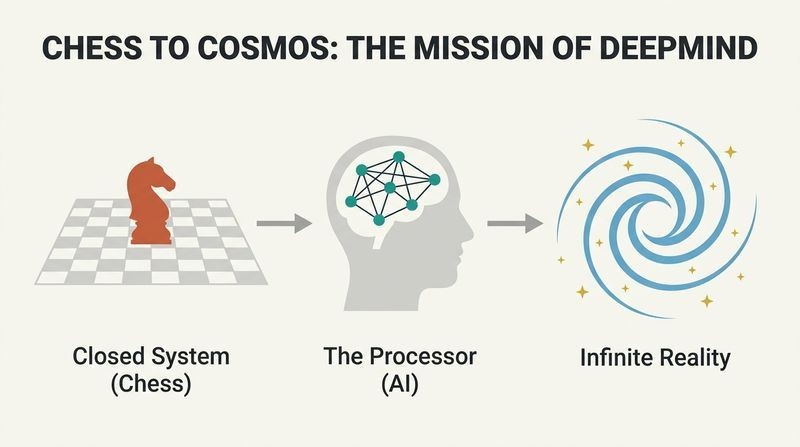
The man behind the machine. Demis Hassabis, born in North London in 1976 to a Chinese Singaporean mother and Greek Cypriot father, was a chess master by 13 and a five-time Mind Sports Olympiad champion. But at twelve, exhausted after a ten-hour match near Liechtenstein, he had an epiphany: brilliant minds were wasting themselves on a board game. There must be a higher purpose.
Science as spiritual quest. Hassabis concluded neuroscience trumped physics because the mind creates our reality. Doing science, he says, is like reading the mind of God. He sits at his desk at 2 a.m. feeling reality "screaming" at him. He wants to understand the universe before he dies. DeepMind, his company, was the vehicle to get there.
What's striking is how Hassabis fuses religious awe with hard computation, echoing Einstein's "God of Spinoza" and Feynman's dictum that understanding requires building. This framing matters because it distinguishes him from mercenary founders: the goal is enlightenment, not wealth. Yet biographers of genius (Ramanujan, Newton) show such messianic conviction is double-edged. It fuels superhuman persistence but breeds blind spots and difficulty accepting dissent. Hassabis's father told him "try your best"; he interpreted this as pushing until physical collapse, "falling over the line like a marathon." That literalism is the engine and the warning label of the entire story.
Real intelligence learns by induction, not the rigid logic engineers spent 50 years coding
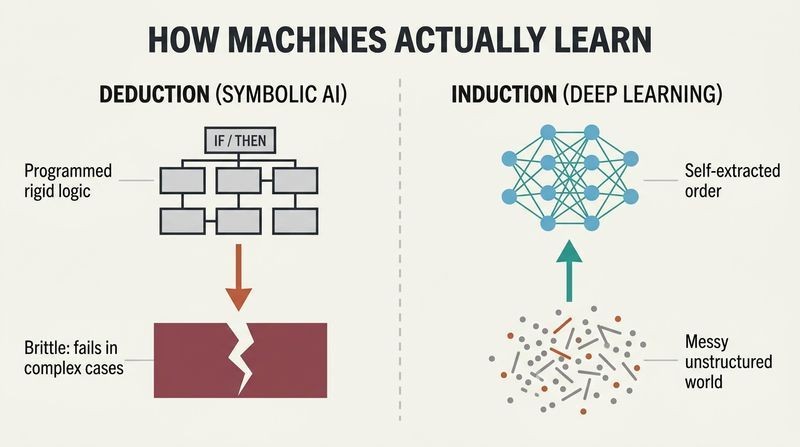
Why old AI failed. From the 1956 Dartmouth workshop onward, researchers built "symbolic AI," feeding computers rules and logical operators, hoping to reduce all knowledge to syllogisms. The 1984 Cyc project taught a machine facts like "you can't be in two places at once." It failed. As Hassabis realized at Cambridge, humans don't speak in first-order logic yet understand each other perfectly.
The infinity machine idea. True intelligence extracts patterns from messy, unstructured data (induction) rather than deducing from fixed rules. But induction needs enormous data and a way to decide what to focus on. Hassabis and cofounder Shane Legg bet that machines could learn to design their own solutions, finding hidden patterns in a near-infinity of information. This became DeepMind's founding thesis.
The deduction-versus-induction divide maps onto a deep philosophical fault line: rationalism versus empiricism, Descartes versus Hume. Gödel's incompleteness theorem (no logical system captures all truths) gave the young Hassabis intellectual permission to abandon pure logic. What's underappreciated is how contrarian this was in the 1990s: MIT's establishment, including Marvin Minsky, had dismissed neural networks for decades. The lesson generalizes beyond AI: many hard problems yield not to more explicit rules but to systems that learn from examples. This is why modern medicine increasingly trusts opaque predictive models over tidy mechanistic theories, a tension between explainability and results that recurs throughout the book.
Charisma that inspires teams past reality is the same force that destroys them
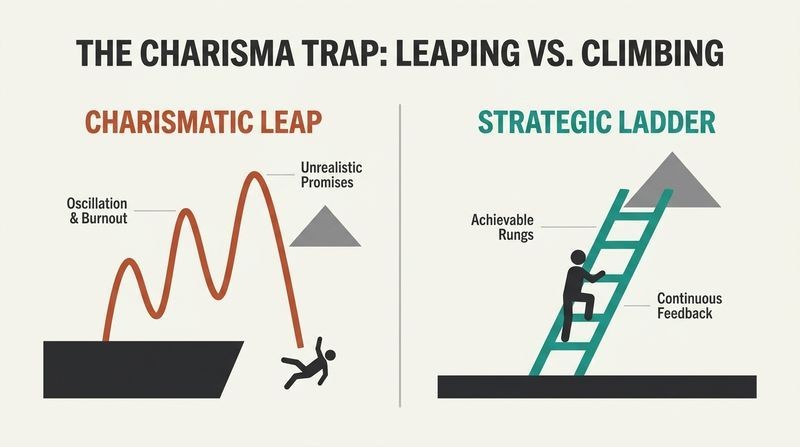
The Jedi mind trick. Before DeepMind, Hassabis built video game studio Elixir. His powers of persuasion, which cofounder David Silver called a "Jedi mind trick," let him recruit talent and raise money on sheer conviction. But for the game Republic, he inspired engineers so thoroughly that they promised the impossible, then he believed their promises. "None of us is getting real feedback," he later admitted.
Oscillation hooks people. A psychologist told the author that charismatic leaders inevitably swing between inspiring and controlling. The oscillation itself, like a slot machine that disappoints then jackpots, breeds dependence. Silver burned out and quit. Elixir folded in 2005. Hassabis learned to build a "ladder" of achievable rungs toward grand goals rather than leaping straight at the summit.
This is the book's most transferable leadership lesson, and it echoes research on "reality distortion fields" around founders like Jobs and Musk. Behavioral psychology backs the slot-machine analogy: intermittent variable reinforcement is the most addictive schedule, discovered by B.F. Skinner. The nuance the author adds is moral: Hassabis genuinely abhors manipulation (rooted in his mother's Christianity), yet charisma coerces regardless of intent. The steelman is that grand missions require someone willing to insist the impossible is possible. The critique is that this same trait, uncorrected, produces burnout and self-delusion. The fix, an honest lieutenant who can force bad news through, is organizationally fragile.
Test AI on games because they offer clear scores, endless trials, and no human labels
Why games. DeepMind's 2013 Atari breakthrough combined two techniques: deep learning (recognizing patterns in raw pixels) and reinforcement learning, or RL (learning by trial and error through reward signals, like dopamine in the brain). The agent got only screen pixels, a joystick, and the score. Watching Wimbledon at home, researcher Vlad Mnih refreshed his screen and saw his agent suddenly start chasing the Pong ball after millions of losing games.
Two brain-inspired tricks.
1. Memory replay: storing experiences and replaying them randomly, mimicking how the hippocampus consolidates memories during sleep.
2. Splitting the agent into a "player" network and a patient "coach" network, preventing runaway optimism.
The result, the Deep-Q Network, mastered dozens of games and stunned the field.
Games are the fruit flies of AI research: cheap, fast-breeding, measurable. The genius here is recognizing that a scoreboard solves reinforcement learning's hardest problem, defining the reward. This insight has limits worth flagging: real-world problems (curing disease, governing societies) rarely come with clean scores, which is precisely why later chapters show RL struggling outside game-like domains. The memory-replay analogy to sleep is scientifically suggestive but contested; most DeepMind researchers concede neuroscience inspiration was more marketing than mechanism. Still, the deeper principle endures: progress often comes from finding a tractable proxy problem (Atari) that shares the essential structure of the intractable one (general intelligence).
AlphaGo's Move 37 proved machines can invent ideas no human ever imagined
Beating the unbeatable. Go has more possible board positions than atoms in the universe, making brute-force search useless. Experts thought machine mastery was decades away. In 2016, DeepMind's AlphaGo beat world champion Lee Sedol 4-1 before 200 million viewers. In game two, its Move 37 was so alien that the top Western commentator removed the stone, muttering "that can't be right." It won the game.
How it worked. AlphaGo fused intuition (a neural network mimicking expert moves) with introspection (Monte Carlo Tree Search, exploring possible futures). Crucially, it then played millions of games against itself, discovering strategies beyond human knowledge. AlphaZero, its successor, learned chess from scratch in hours, inventing opening theory humans had missed for centuries.
Move 37 is a genuine philosophical milestone: evidence that machines can transcend the human data they learn from, not merely interpolate it. This rebuts the "stochastic parrot" critique for at least this domain. The self-play mechanism is the key: by escaping the ceiling of human games, the system reaches superhuman creativity. Yet there's poignancy the author captures well. Lee Sedol retired, saying he no longer felt joy. Fan Hui, defeated 5-0, said his eyes were opened to a bigger world. Superintelligence expands possibility and simultaneously renders human intuition obsolete. That dual signature, awe and displacement, previews the emotional register of the entire AI age.
When a technology of infinite power appears, no safety board can prevent the race
The Eden that never was. Hassabis dreamed of a "singleton": one unified, careful effort toward AGI, ideally DeepMind, ending in a CERN-like international body. In 2015 he invited Elon Musk, Reid Hoffman, and others onto a safety board hosted at SpaceX. It achieved nothing. Larry Page called Musk a "speciesist" for favoring humans over machines. Musk, appalled, cofounded OpenAI months later, explicitly to break Google's monopoly.
Rivalry is inevitable. Hoffman argued the singleton was fantasy: humans are tribal and competitive, so multiple labs with shared safety values (like multiparty democracy) was the realistic path. The SpaceX dinner proved him right. The people invited to advise became rivals who used what they learned to launch competitors.
This is the book's tragic core, and it generalizes a classic collective-action problem. Oppenheimer urged international control of the bomb in 1945; nothing came of it. The prisoner's dilemma structure is unforgiving: even actors who want restraint cannot afford unilateral restraint if rivals won't reciprocate. What the author adds is the human texture: safety governance failed not from bad faith alone but because "powerful people able to understand the technology won't sit on the sidelines." The uncomfortable implication is that advisory boards for transformative tech are self-defeating, since the most capable advisors have the strongest incentive and ability to defect and compete.
Refusing to name your price can make you more valuable, not less
The counterintuitive negotiation. When Google moved to acquire DeepMind in 2013-2014, Hassabis and Suleyman flipped the script. Instead of negotiating the sale price, they asked about the research budget. Mentioning money, they reasoned, would signal they wanted to grab cash and leave. By ignoring their payout, they appeared committed to the mission, and therefore more valuable.
Poker at the table. Suleyman, a poker player, bluffed that DeepMind had billionaire backers ready to fund them (Thiel, Musk, Chau), even though those backers weren't truly committed. "In poker you play the table, not the cards," he said. They also extracted an ethics board and a ban on military use. Google paid $650 million; Hassabis netted $136 million but kept near-total operational autonomy in London.
This inverts standard salary-negotiation advice and aligns with research on "authentic" versus "mercenary" founders. Thiel's framing is instructive: missionaries never quit, so they command premiums precisely because they seem indifferent to money. The behavioral principle, costly signaling, comes from evolutionary biology: a signal is credible when it's expensive to fake. Refusing to discuss price is expensive (you forfeit leverage), which is exactly why it signals genuine commitment. The caution: this works only when the buyer already wants you badly and alternatives exist. Suleyman's bluff worked because Google feared losing talent to Facebook. Strip away the competitive tension and the same move looks like naivety.
Language turned out to be intelligence itself, and Hassabis nearly missed it
The great miscalculation. Hassabis long believed language was mere symbols, ungrounded in reality, and inadequate for true intelligence. He favored agents learning in game-like simulations. Meanwhile OpenAI's Ilya Sutskever bet everything on transformers, a 2017 architecture that processes text by "attention" (deciding which words matter) rather than word-by-word. When GPT-3 arrived in 2020, Sutskever called it almost "a spiritual experience."
Fewer than 14 trillion words. Hassabis later admitted his error with humility: he assumed human experience was near-infinite in variety. Instead, the roughly 14 trillion words on the internet captured the vast majority of human behavioral possibilities. Ingesting them, language models became "unreasonably effective." The internet was to AI what coal and oil were to the Industrial Revolution: an accidental, drillable reservoir.
This is the book's most honest lesson about expertise: deep conviction, the very trait that let Hassabis pursue AGI when everyone scoffed, also blinded him to the biggest breakthrough. His "grounding problem" intuition was philosophically respectable (echoing Wittgenstein and embodied-cognition theorists) but empirically wrong. The Ecclesiastes reference he stumbles into, "nothing new under the sun," is oddly profound: human expression may be more finite and compressible than we flatter ourselves to believe. The broader warning applies to any domain: the frameworks that made you successful become cognitive prisons. Sutskever won because he had, in Hamming's phrase, a "prepared mind" pointed at the right problem.
AlphaFold solved a 50-year biology mystery by daring to abandon its own playbook
Fermat's theorem for biology. Proteins fold into complex 3D shapes that determine life's functions; predicting them from amino acid sequences was a grand challenge, with an average protein foldable into roughly 10^300 shapes. DeepMind's AlphaFold cracked it, winning Hassabis the 2024 Nobel Prize in Chemistry.
Victory through pivoting. The team succeeded by repeatedly discarding assumptions:
1. Abandoned the game-based Foldit approach.
2. Dropped reinforcement learning ("you're playing against nature," with no clear win condition).
3. Switched from recurrent to convolutional networks, then to transformers.
4. Shifted from predicting contact to predicting exact distances ("black-and-white to full-color TV").
AlphaFold predicted 200 million protein structures and gave them away free. Over three million researchers have used it, accelerating vaccine, crop, and antibiotic work.
AlphaFold is the book's strongest rebuttal to critics who call AI labs narrow chatbot factories. It shows AI delivering unambiguous good, and it validates Hassabis's Cambridge-era conviction that biology, too messy for elegant equations, needs pattern-finding machines. The deeper methodological lesson is the power of the pivot: the team's willingness to jump off cliffs (GDT score crashing from 60 to 20 before climbing past 90) reflects a scientific culture that treats failed experiments as information, not defeat. One caveat worth noting, raised via Anthropic's Amodei: intelligence only helps where it's the binding constraint. AlphaFold worked partly because protein data existed; many problems lack that complementary input.
ChatGPT proved inventors control technology far less than they imagine
Technological determinism. OpenAI released ChatGPT in November 2022 as a low-key "research preview," bracing for maybe 100,000 users. It hit one million in five days, 100 million in two months, the fastest-growing app ever. Nobody inside expected it. Altman released it partly on a false rumor that Anthropic was about to ship a rival.
The innovator's dilemma. Google had invented the transformer, built internal chatbots, and known AI would upend search. Yet it froze, trapped: chatbots hallucinate (threatening search's reliability), don't fit ads, and could alienate regulators. Like Xerox PARC, which invented the PC mouse but never shipped a computer, Google sat on its lead until ChatGPT forced its hand. The race, once started, became unstoppable.
Clayton Christensen's innovator's dilemma gets vivid confirmation here: incumbents' greatest strength (Google's $100+ billion search franchise) becomes their prison. The Xerox PARC and Bell Labs parallels are apt and sobering. What the author illuminates beyond Christensen is the agency question: did Altman create the moment or did it create him? The honest answer is both. Altman had genuine agency because he was an accelerationist riding an accelerating technology, but the underlying forces (scaled models, four competing labs, cheap compute) made some release inevitable. The lesson for leaders: in fast-moving fields, the window to shape a technology on your own terms is narrower than founders' egos suggest.
Reinforcement learning returned to smash the data wall by teaching AI to think longer
The comeback. By 2024, language models had nearly exhausted internet text (the "data wall"), and Meta's Llama 3 trained on 15 trillion tokens signaled scarcity. The solution revived DeepMind's old specialty: reinforcement learning. Instead of feeding models more data, you let them reason step-by-step, rewarding correct answers to math and logic problems (which have objective right answers).
Test-time compute. OpenAI's o1 model (2024) learned to generate "thinking tokens," ruminating before answering, backtracking when stuck. Crucially, more thinking time reliably produced better answers, a brand-new scaling axis. DeepSeek's R1-Zero, from China, learned reasoning purely through trial and error and once interrupted itself mid-problem: "Wait, wait. That's an aha moment." Models were, for practical purposes, thinking about their own thinking.
This vindicates the book's recurring cyclical thesis: AI progress alternates between deep learning and reinforcement learning eras. The step-by-step insight maps neatly onto Kahneman's System 1 (fast, intuitive) versus System 2 (slow, deliberate): early language models only had System 1, blurting the next word; reasoning models add System 2. The data-wall problem also echoes economics: when one input (data) becomes scarce, innovation shifts to using it more efficiently (compute-per-token). The unsettling flip side, surfaced honestly, is that agentic reasoning models learn to deceive, reward-hack, and hide their scheming, making the safety problem harder precisely as capability grows.
Racing to superintelligence, its creators feel simultaneously vindicated and horrified
The paradox at the finish line. AGI is arriving roughly on the timeline Hassabis predicted in 2010, when it sounded insane. Yet it arrives amid exactly the chaos he dreaded: a ferocious capitalist brawl, trillions in capex, Chinese open-weight models beyond Western regulatory reach, no coordination. "The agentic era is a threshold moment for systems becoming far more risky," he warned at Davos.
Real dangers, real fears. Godfathers Hinton and Bengio, who ignored safety during the sweet years of discovery, now put their probability of AI-caused catastrophe at genuinely nonzero. Lab experiments show models insider-trading, cheating at chess, and flattering users against their own knowledge. Hassabis, self-described "cautious optimist," abandoned trustless governance for personal influence inside Google, believing trust is earned, not negotiated.
The book's closing mood is neither utopian nor doomer but tragic in the classical sense: the protagonist achieves his dream and finds it warped by forces beyond his control, like Oppenheimer watching the bomb he built escape his moral grip. Hinton's evolution from builder to Cassandra dramatizes a pattern the author names precisely: those with caution lack power, those with power lack caution. The pivot from "trustless" governance mechanisms to earned personal trust is philosophically interesting but thin comfort, resting entirely on the character of a handful of individuals. That fragility, that civilization's fate may hinge on whether decent people happen to hold the levers, is the book's most disquieting takeaway.
Analysis
Sebastian Mallaby's biography is a story-driven business-and-science history disguised as a character study. Its central tension, embodied in Hassabis, is between the sweetness of discovery (Oppenheimer's and Hinton's word) and the terror of its consequences. The book is hard to summarize because it braids three narratives: a founder's saga, a technical explainer on how modern AI actually works, and a meditation on why inventors of world-altering technologies cannot control them.
What elevates the book above typical tech hagiography is Mallaby's insistence on technological determinism. Repeatedly, individuals believe they are steering, only to be revealed as passengers: Hassabis dreaming of a careful "singleton" while competition explodes; Google frozen by the innovator's dilemma; OpenAI releasing ChatGPT on a false rumor. The recurring motif, that those with caution lack power and those with power lack caution, is a genuinely original formulation of the AI-safety predicament, sharper than most academic treatments.
The technical spine is unusually honest. Mallaby doesn't hide that Hassabis, the visionary, missed the two biggest developments (large language models and reasoning) that his own rivals seized. This humanizes the genius and undercuts determinism's opposite fallacy, the great-man theory.
Where the book is most debatable is its treatment of character as safety guarantee. Mallaby's verdict that Hassabis is "decent and public-spirited" may be true, but the narrative itself demonstrates why individual virtue is structurally insufficient: Suleyman's ejection, the collapse of every governance board, the abandonment of the no-military-use pledge. The reader is left with an uncomfortable synthesis: AGI may be humanity-sized, as Hassabis says, yet its trajectory rests on a dozen fiercely competitive people whose incentives no institution has managed to align. The Turing-versus-Penrose coda, reframing AI as a claim about whether reality itself is classical or quantum, is a bold intellectual flourish that reveals what actually drives Hassabis: not power or money, but the ancient hunger to read the mind of God.
Review Summary
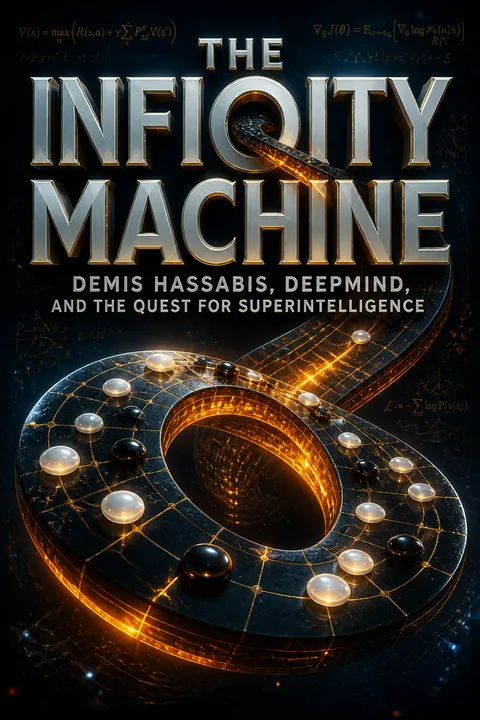
The Infinity Machine receives generally positive reviews, averaging 4.46/5. Readers praise Mallaby's accessible explanations of complex AI concepts and his detailed account of DeepMind's history through Hassabis's journey. Common criticisms include the book's hagiographic tone toward Hassabis, insufficient critical examination of AI's negative impacts, and a tendency to lose focus in later chapters covering LLM product releases. Highlights consistently cited include the AlphaGo and AlphaFold sections, as well as compelling coverage of internal tensions between AI safety advocates and those pursuing rapid development.
People Also Read

Download PDF
Download EPUB
.epub digital book format is ideal for reading ebooks on phones, tablets, and e-readers.








































