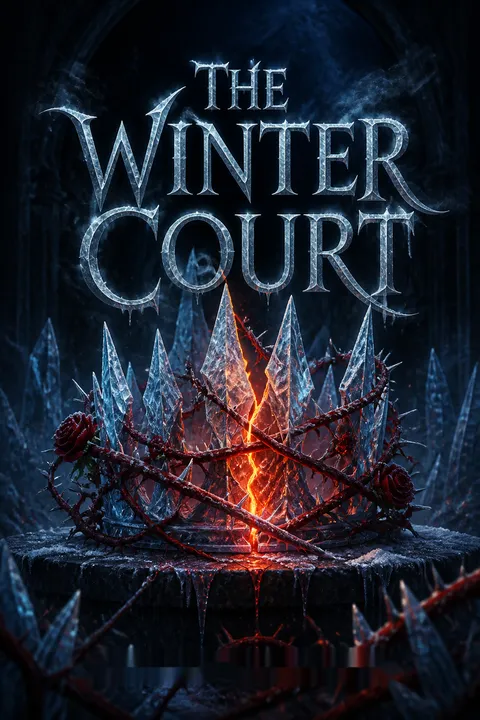

Plot Summary
Snowfall and Oaths
In the perpetual snowdrifts of the Winter Court, Sinjinn and his Horde brothers push through biting cold and suspicion. Bound by an ancient tithe and the promise of marriage to cement alliances, they hunt for the hidden castle. The land is unforgiving, its heart as icy as its laws. Jests between brothers crack in the cold, but fear lurks beneath: this is not just a mission, but a test of will against nature and treachery. Cailean is set to collect his bride—the court's reluctant princess—in a world where vows are chains forged in blood and loss. Every step into the blizzard foreshadows danger, and within this frozen wild, an unraveling destiny awaits both the seekers and the sought.
Arrow in the Night
Sinjinn is ambushed in the shimmering night, an iron-tipped arrow tearing through his flesh. The attack is swift—a message as much as a weapon—marking him as an invader, not a savior. Icelyn, the ice-haired princess, is revealed as the archer. Bitter over being bartered, she imprisons her prey, desperate to deny the Horde their prize. Her lashing words betray trauma and rage, yet the act sets both captor and captive on paths impossible to uncross. Blood stains the snow; a prince's vulnerability and defiance meet a princess's hurt and rebellion. Here, the ancient rites of power and war seem to freeze, suspended in the winter air.
Captive in Ice Caverns
Within the cave's blue shadows, Sinjinn and Icelyn's hate dances dangerously close to desire. Chained and wounded, Sinjinn's fire simmers beneath icy taunts. Icelyn tends her captive—out of duty, or mercy, or confusion. Their collision is more than physical: stories of ancient Horde atrocities haunt every touch, laying bare histories of violence and sorrow. Sinjinn starves for the Fae's kind of sustenance; Icelyn, still resisting fate, fears him as both a beast and a man. Forced proximity crackles with peril. The cave becomes not just a prison, but a crucible for vulnerability, revelation, and a reluctant, relentless draw between enemies.
Feeding the Beast
Trapped and desperate, Icelyn faces an unthinkable dilemma: feed the enemy, or let him die. The Fae's hunger is both magical and carnal, and Sinjinn's need is becoming lethal. Their mutual antagonism warps into a charged, uneasy ritual. Touch is both weapon and balm, ice fighting fire at every turn. Ancient wrongs are exhumed, defended, denied. When Icelyn relents and yields herself as sustenance, the act is compelled yet transformational—inscribed with violence, reluctant empathy, and a loss of innocence neither can erase. The feeding changes both, unleashing vulnerabilities and a connection as dangerous as it is intimate.
Seduction and Survival
Emotional and physical lines blur, as Sinjinn regains strength and Icelyn's carefully maintained distance collapses under relentless desire. Hatred dissolves—momentarily—into heat, leaving them both chained to new compulsions. The Horde prince asserts primal dominance, determined to punish and possess; Icelyn, though terrified and conflicted, finds her own agency twisted by the Fae's predatory magic and her court's impossible fate. Their sex is survival and struggle, enabling Sinjinn's escape at the price of Icelyn's own freedom. Outside the cave, the predator is now the prey—a prisoner of those she'd sought to outmaneuver.
Fire, Ice, and Chains
Sinjinn's brothers and Horde soldiers descend, "rescuing" their prince and binding Icelyn in new chains. The power has shifted: she, the queen's daughter, finds herself at the mercy of the Horde, forced into their midst as a living prize. The dynamic between her and Sinjinn is now public, fraught with shame and a reckless, dangerous chemistry. Within the Horde camp, the expectations of tithe, alliance, and subjugation become more than diplomatic—a brutal, personal reckoning for Icelyn. Her world narrows: every gesture, every word, is now about survival in a cage of her own making.
Unveiled Betrayals
With the storm rising and the Horde's grip tightening, secrets churn beneath every conversation. Icelyn faces not just the loss of her autonomy, but the betrayal of her own people—her father's willingness to murder, her friends' shifting loyalties, and the court's deep-rooted misogyny. The scars left by the Horde's old king, Alazander, are open wounds; trauma is layered over politics and personal pain. In this maelstrom, Sinjinn's and Icelyn's connection remains fraught, an unsteady truce in a landscape where even the earth and weather seem ready to turn on them all.
Across the Winter Wilds
As Horde and Winter Court tensions mount, survival becomes an urgent race across frozen wilderness. Sinjinn, both jailor and protector, and Icelyn, reluctantly reliant on him, battle not only enemies without but storms of magic, resistance, and longing within. Treacherous landscapes mirror treacherous hearts as they evade assassins, magical beasts, and their own destructive impulses. Allies are rare, and motives are never pure. Through forced alliances and harsh confessions, the escape from captivity becomes a test—of trust, endurance, and the possibility of choosing something other than hate.
Storms and Surrender
A devastating, unnatural storm—cast by the Winter King's fury—traps Sinjinn, Icelyn, and their companions. The storm is punishment and warning, a magical force that mirrors the personal tempests brewing between the lovers. Stranded, hungry, and battered by cold and fear, they are forced to confront truths about family, history, and themselves. The isolation shatters pretense and catalyzes a surrender to vulnerability. Sinjinn and Icelyn, bound by shared ordeal and threatened by a world that offers neither true safety nor absolution, inch toward a fragile, fragile trust and the beginnings of true intimacy.
Falling Kingdoms
Sinjinn's journey turns from quest to nightmare as the Horde's men are massacred and the Winter King escalates his treachery—framing his own daughter, aligning with dark magical forces. Icelyn's return to the palace is a horror: corpses of loved ones displayed, the family she'd tried to protect already destroyed. Those who survive are broken, and trust is a luxury no one can afford. As outside powers—including the Seelie and the Mages—begin to circle, the struggle for the throne sharpens into a struggle for survival and vengeance. The old order is falling, and no one is safe beneath its ruins.
Palace of Frozen Corpses
Icelyn's forced return to her father's palace is a descent into a waking nightmare: her mother and brother executed, the halls haunted by corpses of loyalists. The king's madness is absolute, his intentions for Icelyn both incestuous and lethal. Allies are rare, betrayals common. Desperate bargains and unlikely alliances proliferate: with the Seelie, the shifter Sebastian, even with her own worst self. Asher, a Seelie prince, becomes both threat and reluctant savior. Every room in the castle is a trap, every vow a double-bind—a court in decay, feeding on its own like the winter devours the land.
Dealings with Monsters
To save her unborn children and Sinjinn's life, Icelyn bargains with monsters: Seelie, Mages, even her own darkest instincts. The sexual and magical currency of this world is always grim, always transactional. Asher uses his powers to heal the children's magic at a high price; Sinjinn and Icelyn's bond is stretched to the breaking point. Her former friends reveal themselves as betrayers or cowards; violence and the threat of sexual domination pervade every space. One desperate act after another sharpens the narrative to a razor edge: there may be no heroes, only the least monstrous among monsters.
Birthright and Bondage
The ancient, brutal truths of lineage are revealed—Icelyn's birthright as both Light Heir and Winter's true queen, Sinjinn's near-fatal wounds, and the indelible mark of mating and pregnancy. Ritual, prophecy, and curse entwine: bonds of magic cannot be severed without a price, and even consent and love are caught in the machinery of old oaths. In a courthouse of ice and spilled blood, Icelyn faces her stepfather for the last time, her own power awakened by rage and loss. She kills him with her own hand, severing at last the thread of patriarchal violence that ruled her life.
The Hunger of Fae
Trauma's aftermath demands magical healing as well as vengeance. Icelyn and Sinjinn reunite in privacy, their passion now fully a wellspring for power, selfhood, and healing—purging the violation of others' hands, forging a new link despite all that has been taken. Their union is neither innocent nor simple: it is survival, restoration, and the detonator of change, both personal and political. No longer powerless, Icelyn claims her desires and scars alike. Together, they plan the rescue and resettlement of a people whose home may be lost, but whose will is unbroken.
Transition and Transformation
The price of survival has been thirst, sacrifice, and transformation. Icelyn, finally free from the shackles of her cruel lineage, must reshape her role as both the Winter Queen and the Light Heir. Sinjinn's love is now a pillar, not a prison, but their happiness is not assured: to save her people and mend Faery's wounds, she must accept responsibility, new alliances, and the dangers of prophecy. War threatens. The Mages' approach forces a final reckoning, not only for the court, but for all who would claim power through cruelty. Even in victory, they stand wary—changed, scarred, but together.
Wedding of Ice and Fire
No longer fugitives or pawns, Sinjinn and Icelyn marry by their own choosing before queen and court. The ceremony is brief but radiant, a communal celebration birthed from tragedy and endurance. This union—of ice and fire, queen and once-enemy—is a promise to the survivors that there is still hope, even in the ashes of lost kingdoms and fallen vows. Divorced from her contractual marriage and crowned not by birthright but by courage, Icelyn is now both sovereign and wife, partner and mother-to-be, guiding her people toward a new beginning.
Queen's Last Stand
As the Mages' army descends, Icelyn's court faces its crucible. Rallying survivors, forging new alliances with unlikely kin—including the Seelie—she risks everything to lead her people's escape. The palace is surrendered to what remains of magical power—collapsing beneath lake ice rather than be claimed by the enemy. With her world in ruins but her people alive, Icelyn's final act of leadership is one of destruction mingled with hope: to choose exile, endurance, and a new home over surrender or annihilation. Only together, with fire and ice, love and memory, can they survive.
All Hail the Survivors
The storm has passed. Ruins smoke beneath a starless sky. Queen Icelyn, Sinjinn, their children-to-be, and the ragged court march not homeward, but forward—toward a future rebuilt from ruin, kinship assembled from kin and foe alike. New alliances form: with Seelie, with shifters, and with the remnants of broken courts. The story closes not with peace, but with the courage to endure, to create family where once there was fragmentation, and to seek warmth, even amid the never-ending winter. Fire, ice, and grace survive. The Queen and her king walk into legend—forever marked, never defeated.
Analysis
A fantasy about trauma, autonomy, and choosing love in a hostile worldAmelia Hutchins' "The Winter Court" stands apart among fae-fantasy romances for its unflinching treatment of abuse, consent, and survival. This is not a story of easy redemption or "taming" the monster; rather, it is a harrowing, nuanced meditation on how harm is woven into family, culture, and magic—and how only through fire, ice, and the refusal to emulate one's abusers can a new world be born. Hutchins crafts fantasy as emotional allegory: sex is fraught and complex, reflecting the ways intimacy can heal or wound; power is contested in both heart and kingdom. The dissolving of oaths, the willingness to kill for survival, and the forging of unconventional family are urgent, timely themes—a recognition that our traumas may not be chosen, but our futures can be. Ultimately, "The Winter Court" offers no simple victories and few fairy-tale endings. Its lesson is hard-won: Healing is slow, sometimes ugly, but through solidarity, vulnerability, and the relentless search for hope, even the coldest world can produce warmth.
Review Summary
Reviews for The Winter Court are largely positive, averaging 4.36/5. Many readers praise the chemistry between Sinjinn and Icelyn, the action-packed plot, and the introduction of new characters like Asher. Fans of the broader Fae Chronicles universe particularly enjoyed the world-building and strong female lead. Common criticisms include an overabundance of sex scenes at the expense of plot development, repetitive character dynamics across the series, and formulaic storytelling. Readers consistently recommend starting the series from the beginning rather than using this as an entry point.
People Also Read


Characters
Icelyn
Icelyn begins the story as a pawn, bartered for alliance in a world that values her blood more than her personhood. Scarred by her family's traumas and the legacy of the Horde's cruelty, she first shoots Sinjinn out of rebellion, then must care for him in captivity—a loop of violence and intimacy that sets the tone for her tumultuous growth. Her initial self-doubt and tendency to self-sacrifice are products of deep abuse and survival instinct, but the crucible of court betrayal and repeated violation forges a steely resilience. Psychoanalytically, Icelyn embodies the struggle between victimhood and agency: wrestling with the internalized voices of misogyny and powerlessness, she ultimately claims her body, her throne, and her love. Her journey is about learning she is worthy, not because of others' needs, but in her own right. Her relationships—to Sinjinn, to her murdered family, to her abuser-stepfather, and to her unborn children—show a woman hammered by pain but unyielding: she is trauma and tenderness, vengeance and mercy, making her one of the most complex and dynamic fantasy heroines.
Sinjinn
Sinjinn is both monster and man—a Horde prince, half Fae and half fire-djinn, bred in violence and groomed for war. At first, he is arrogant and predatory, demanding submission through strength and magical hunger. Yet his harshness is offset by deep bonds of loyalty: to his brothers, to his king, and eventually to Icelyn herself. Psychologically, he is a study in conflicted masculinity—raised in a culture of brutality, haunted by generational trauma, and yet hungry for connection and for a chance at goodness. His path from captor to lover, from survivor to protector, is marked by uncertainty and guilt, especially as he sees his own father's monstrous legacy alive in himself. Ultimately, Sinjinn is redeemed not by blood or birth, but by his willingness to change, to admit vulnerability, and to fight for someone not through force but love. The mark he gives Icelyn becomes a symbol of choice overcoming curse, of intimacy fighting back against generational abuse.
Cailean
Cailean exists at first as a foil—a brother meant to marry Icelyn, more interested in avoiding responsibility than in love or power. His comic bravado hides deeper insecurities about worth and autonomy. He finds himself both victim and participant in systems that commodify women and bind men to oaths they never wanted. Unwilling to claim Icelyn fully, he nevertheless becomes the linchpin in the ritual that breaks the princess's bondage. Over the narrative, he shifts from selfish bystander to essential ally—willing to support his brother's happiness and Icelyn's liberation, regardless of his own pride. Psychologically, Cailean represents the possibility of men stepping back from toxic cycles, giving up privilege rather than enforcing old contracts.
Gerald (The Winter King)
Icelyn's stepfather and the antagonist at the castle's heart, Gerald is a study in patriarchal decay—at once pitiful and despicable. His actions are those of a man unmoored: sexually obsessed with his stepdaughter, murderous of his own children, aligning with monstrous allies out of a hunger for impossible power. Gerald's psychological portrait is of abuse metastasized into madness. His court is a tomb; his legacy, corpses. As Icelyn grows in power, his hold on reality and control slips, culminating in his violent death at her hands—a catharsis both personal and mythic.
Asher
Asher is a liberated Seelie, both enemy and savior, embodying the most disturbing powers of fantasy sexuality. He is blunt about his needs—hungers for sex, power, and survival—yet is capable of moments of loyalty, insight, and dark humor. Psychologically, he is a trickster, neither good nor wholly evil, loyal only to appetite. His partnership with Icelyn is transactional; his "help" always carries a price. Still, he aligns with Icelyn and Sinjinn at key junctures, and ultimately, he becomes a member—albeit a dangerous one—of their found family. Asher disrupts binary thinking: enemy/ally, pleasure/violence, self/other.
Synthia
Synthia, queen of the Horde, is both a model and a warning—survivor of the Horde's patriarchal legacy, goddess-figure, and caretaker for a fractured world. She's practical, empathetic, and wields her own traumas with intelligence—always calculating how best to save the maximum number of lives while not allowing sentiment to cloud strategic judgment. In Icelyn, she sees both a younger self and a cautionary tale. Her interventions ground the story's romantic and political chaos in fierce maternal logic and solidarity.
Ryder
Ryder rules the Horde with a charismatic blend of strength and deep scars—bearing both guilt over his father's monstrous reign and hope that he can be a better king. He is a presence that compels, intimidates, and, ultimately, unites. Ryder is repeatedly caught between absolute power and moral responsibility: consolidating alliances at the price of individual happiness, and extending compassion only as strategy allows. His relationship with Synthia and the other Horde members models power tempered by vulnerability, ambition constrained by love.
Bale
Bale, once an ally to Icelyn, is revealed as a dangerous betrayer, motivated by envy and thwarted entitlement. He abuses, attempts rape, and ultimately meets his end by Icelyn's hand. Psychologically, he is the embodiment of wounded male pride metastasized into violence: obsessed with Icelyn as an object to possess, resentful of any power she exerts, and perceptually "wronged" by the world. His meltdown and death are a bleak warning about where unchecked resentment ends.
Sebastian
Initially a jailer, Sebastian reveals unexpected depths: shaped by exile from his own people and the perils of acting morally in a world where virtue is punished. Though risking his life for Icelyn and her sister, his ultimate loyalty is to survival and the few he trusts. Sebastian thus personifies the hard choices pressed upon all the "lesser" Fae, and stands as a kind of moral thermostat in a landscape where everyone must navigate between damnation and redemption.
Frostine
Icelyn's younger sister, Frostine, is gentle, kind, and traumatized—a mirror of what Icelyn might have been without her own passage through violence. Early on a victim, she is hidden throughout much of the narrative, but emerges to play a crucial role in Icelyn's final stand against their father. She is the seed of hope: that with evil purged, one can begin anew, weaving shattered fragments into future strength.
Plot Devices
Trauma and Transformation
The novel's central device is the compression of trauma and survival into the mechanics of magical rites, court intrigue, and sex. The magical "feeding" of Fae—through sexual exchange—doubles as a metaphor for intimacy, violation, and the possibility of recovery. Violence is not glamorized; it is explicitly depicted as destructive, and the path to healing is long and marked by repeated, wrenching setbacks. Trauma triggers transformation—physical (as in Icelyn's transition) and social (as in the remaking of alliances, the collapse and rebirth of kingdoms).
Enforced Vows, Oaths, and Blood Magic
Blood oaths, ancient tithes, and magical contracts serve as both literal and figurative chains, binding characters to roles they might not otherwise choose. The story leverages these oaths to escalate personal stakes: forced marriages, sacrificial rescues, and the devastating consequences of breaking or bending a contract. Blood magic opens doors (and pits) that can only be closed by sacrifice or cunning, and oaths—once set—are difficult to manipulate without significant cost.
Duality and Foil Characters
Fire versus ice, Horde versus Winter Court, prisoner versus captor, victim versus avenger: everywhere, the story employs duality to explore the ways identities are constructed and destroyed. Sinjinn and Icelyn are literal foils—his heat tames her cold, and vice versa. Courtly dynamics are filled with duplicity and treachery—no side, no character, is purely good or evil. Relationships evolve precisely because alliances are unstable and choices are always fraught.
Subverted Rescue and Agency
Repeated foreshadowing and bait-and-switches are used to destabilize narrative expectations. Icelyn is at times rescued, at others saves herself and others—sometimes through love, sometimes through violence. Major turning points (Sinjinn's likely death, Icelyn's supposed powerlessness) are undercut by the sudden reversal of roles. There is no simple hero's journey; rather, cycles of disempowerment and reclamation, reflecting the messy reality of abuse and healing.
Political Fantasy as Emotional Mirror
The constant, almost living setting—the snow, the storms, the collapse and movement of courts—is a device to reflect characters' interior landscapes. Political machinations are rendered personal and vice versa; every shift in power is registered as both communal and deeply individual. The world rises and falls according to the mental and emotional state of those who lead and those who survive.
Fae Universe Series Series
About the Author
Download PDF
Download EPUB
.epub digital book format is ideal for reading ebooks on phones, tablets, and e-readers.








































